

 Freedom Index
Listen to the article
My father’s dissertation adviser emigrated from the USSR on the eve of his postdoctoral defence. In the Soviet Union, emigration was an act of betrayal, and by the time my father appeared before the committee tasked with approving his defence, his fate had already been sealed. Committee members peppered him with questions so far afield from the subject of his dissertation that he—a brilliant 29-year-old geophysicist—never stood a chance.
My father understood immediately what was happening. The year was 1974, and Soviet anti-Zionist hysteria was at a peak, blocking countless Jews from university admissions, academic advancement, professions, and entire career fields. He walked out, returned to his desk, and went on to do work so innovative that, when we landed in America in 1990, a major company grabbed him and never let him go. Shortly before emigrating, he successfully defended a brand new dissertation, but by then he had nothing left to prove to himself—or anybody else.
Twenty-five years after our emigration, as the ghosts of antisemitism we thought we’d left behind reappeared across the West, I asked my father: Were the people on that committee personally antisemitic? “No, no,” he told me. “They just knew what time and country they were living in.”
Antisemitism is often viewed as visceral hatred of Jews. But that’s a limited understanding of the phenomenon.
Antisemitism is also a politics and a zeitgeist; a conspiracy theory that feeds mass hysteria about Jewish power; an underlying culture that teaches people that Jews are different, they don’t belong, they aren’t on our side—and ultimately, that they are our misfortune. It draws an invisible line between Jews and the broader society, step by step normalising their marginalisation and disappearance.
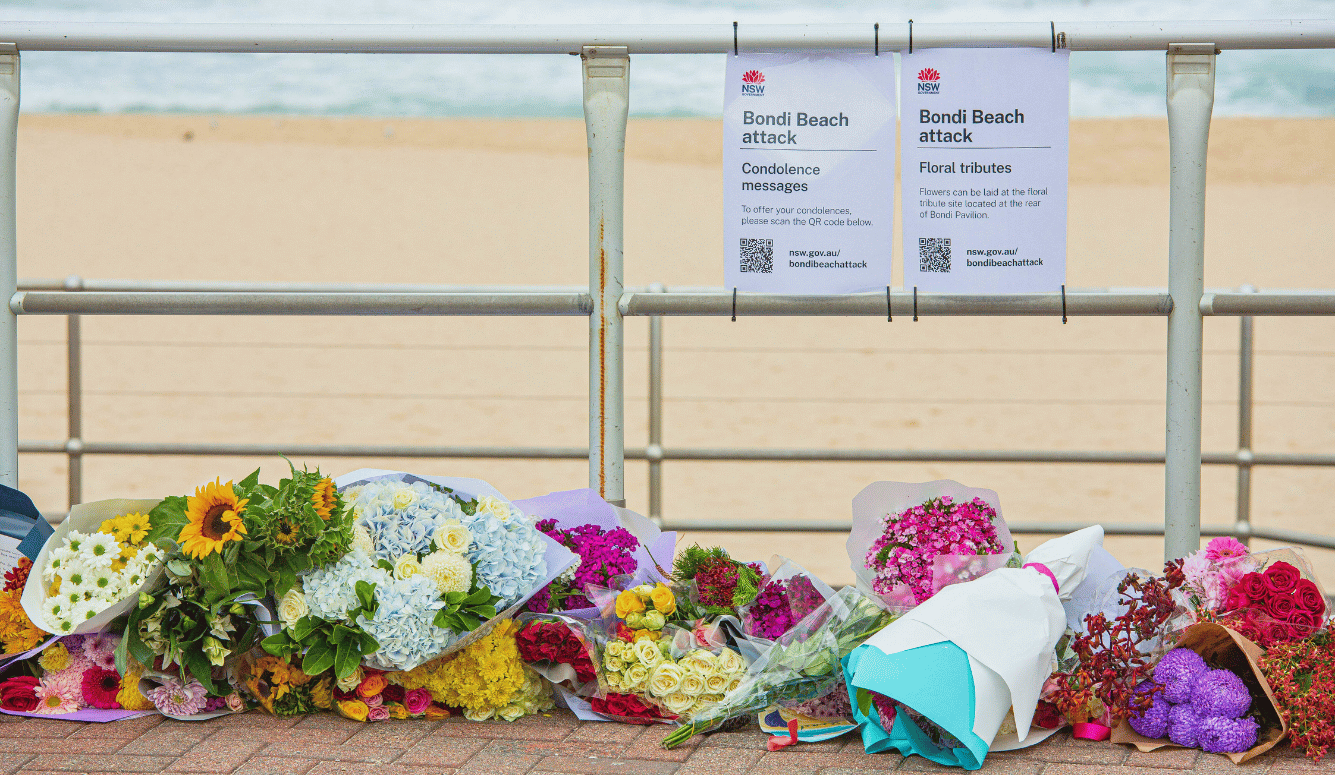
That process is already underway across the free world, and Jewish testimonies before Australia’s Royal Commission on Antisemitism and Social Cohesion, established in the wake of the Bondi Beach massacre, offer striking evidence to that effect. Eerily reminiscent of German Jews recalling how their lives began to change, they are utterly absorbing: snapshots of the present refracted through a deeply familiar historical memory.
Musician and writer Deborah Conway talks about a call from the director of a writers festival, telling her there’s been pushback against her participation in the programme. He assures her everything is fine, but at the festival, she finds herself surrounded by heavy security. At one panel, people rise to their feet, unfurl signs, and start screaming at her. In Brisbane, a dozen masked people pound on the glass of the bookshop where she is speaking, screaming to globalise the intifada, while policemen do nothing. Intimidation bears fruit: music critics sidestep her new album, and she can’t book venues to perform it in. Her public presence is quietly diminished. Has anybody noticed?
Anti-Zionism as Redemptive Racism: A History of Modern Antisemitism
Contemporary anti-Zionism encodes a totalising worldview that blends the tributaries of Nazi, communist, and Islamist anti-Zionism into a single stream.
But it doesn’t stop there. Large social media accounts target her daughter, an online food personality. Her hummus adds to Palestinian suffering, apparently, so they threaten to show up at markets where she sells the food. “She had to pack and leave,” says Conway. At those markets, did anybody notice she’s no longer there?
There is a history of Jews vanishing and others choosing not to notice. “I don’t know where the Jews who lived here went—they just moved out at some point,” was a common postwar refrain about the murdered Jews next door.
Some of the most striking testimonials in “Some Were Neighbours,” an exhibit originally shown at the Holocaust Museum in Washington, DC, come from German Jews recalling non-Jews disappearing from their lives as the antisemitic Nazi state asserted itself. One-time friends, neighbours, classmates, colleagues, dance partners, lovers just marched on into the promise of a great new German future, leaving Jews behind. So strong was the sting of this personal betrayal that neither the horror of the genocide that followed nor the passage of time diminished the force of its memory.
Another testimony from the present: Joshua Moshe, an award-winning saxophonist and composer. His career is destroyed after his bandmates of seven years publicly expel him from the band via a social media post declaring that they do not tolerate Zionism in any form. Other fellow creatives follow: one pulls out of a joint show, another withdraws performance rights to his song. Invitations vanish. It’s business, nothing personal; these are the times. Nobody wants to lose work “by association.”
Doxxed and targeted in a “coordinated online pile-on across every channel,” Joshua and his wife make a hard decision: move to another part of Melbourne for the sake of their son, who is also now being threatened. As they pack up their gift and homewares shop, passers-by scream, “Good, we don’t want Zionists in our area.”
If you want to understand what it feels like to watch one’s world narrow, with the walls closing in on you, ask Moshe: the “relentless” abuse left him “with anxiety, night sweats, an elevated heart rate, and an inability to sleep,” he told the Royal Commission. He felt “devastated,” sensing that his life “was starting to unravel—not knowing what would happen.”
Colleagues, friends, and neighbours aren’t the only ones: the authorities turn a blind eye too. The police stand idly by; the eSafety Commissioner declines to intervene because the abusers used the word “Zionist” rather than “Jew,” which means they were not formally antisemitic. Easier and cleaner to wash one’s hands of it than get involved. It is completely rational: the thugs are violent and committed; they may turn against you too.
And then there is the testimony of a young woman identified as ABN. Her employer asked her to use a different name at work because her “identifiably Jewish name could upset a stakeholder.” Her Jewishness could add “some complexity to the relationships and to that partnership,” she’s told. She is asked to overhaul her work identity, complete with a new email address. She must understand: it could potentially “have negative commercial outcomes.” Once again, it’s strictly business: everyone is simply trying to help her keep her job while also keeping the client happy.
ABN leaves the experience with a painful realisation. Prior to this, she “took comfort in the assumption that if you worked hard, you were capable, you acted professionally, that that was the basis on which you were judged.” She now knows that this is not the case for her as a Jew. She wonders whether she would have “equal employment opportunity in the future, whether she would have to hide part of herself to progress in her career, and whether she can be outwardly and openly Jewish in professional workplaces.”
ABN is not the only one wondering about this. Alongside the epidemic of Jews being erased by others, a parallel epidemic is unfolding across the West: one of Jews quietly erasing themselves.
University student Mia Klein describes feeling “increasingly isolated… alone and misunderstood” at her university in the wake of October 7. Her course of action? Disappear as a Jew: “I just thought it was easier to filter myself down to my most digestible”—”just another student on campus who doesn’t necessarily declare herself as Jewish.”
Food writer Dani Valent holds back for months from posting a review of an Israeli restaurant she loved for fear that they “might get harassed,” while berating herself “for a lack of courage.” She now understands her Jewish grandfather’s term for living as a Christian in wartime Budapest: “open hiding.” “I tell myself it’s fine to stay quiet,” she tells the Commission, and adds: “I am brave. I am scared.”
Jewish publications are now reporting a wave of requests from Jews asking for their names to be removed from published articles. “Modestly, apologetically, politely,” they ask if the publication could “possibly help them stop existing online as a Jew,” because their Jewishness might cost them future employment, writes Richard Ferrer, editor of UK Jewish News. Alana Newhouse, editor of the American Tablet magazine, confirms they receive the same requests. Under current circumstances, no story feels innocuous enough to appear in publicly as a Jew.
Reflecting on the same phenomenon, Zvika Klein, editor of the Jerusalem Post, explains that the people asking them to strike their names from the paper aren’t doing it because they no longer feel Jewish. On the contrary, they “often feel their Jewishness more fiercely than they have in years. They are not less attached,” he notes. “They are more exposed.”
“Something has shifted psychologically, socially, and professionally for Jewish people in this country,” concludes Ferrer. “Everybody knows it, even those who make a career out of pretending otherwise.”
Western democracies are not the same as 20th-century totalitarian dictatorships with built-in institutional antisemitism. Australia’s decision to establish a national commission of inquiry into antisemitism and to link it with issues of social cohesion shows that democracies are still capable of grasping the danger of antisemitism and acting on that understanding.
At the same time, we must ask why it took the Bondi Beach massacre for Australia to take notice. The experiences described in Jewish testimonies did not begin on that catastrophic day last December. They began more than two years earlier, and Jews have been warning about them ever since. Their warnings were ignored, dismissed, misclassified, and swept under the rug.
In this, too, there are tragic echoes of history. For the fifteen victims of the massacre and their families, the inquiry is coming much too late. For the Jews who testified, it is too late in other ways, with careers, aspirations, and often entire lives destroyed under the banner of “just anti-Zionist, not antisemitic.”
Perhaps the most troubling thing the Jewish testimonies reveal is how much the culture has already changed. To the Jews experiencing the brunt of it, it hardly matters what exactly is driving the shift: hate, ideology, or social incentives. As in other societies shaped by antisemitic cultures, they are now learning that their Jewishness carries costs. Left to fend for themselves, they are adjusting accordingly.
Which is another reason the Royal Commission inquiry is important. By inviting Australian Jews to speak openly about what this moment feels like from inside it, the commission has exposed realities much of the democratic world has preferred to ignore. It is a step other countries should consider following.
Quillette invites thoughtful responses to its essays.
Selected responses are published once per week as part of a curated Letters to the Editor feature. If selected, letters appear under the contributor’s real name and may be edited for clarity and length.
To submit a letter for consideration, please email [email protected].
Read the full article here
Fact Checker
Verify the accuracy of this article using AI-powered analysis and real-time sources.