Close Menu
FSNN NewsFSNN News
  • Home
  • News
    • Politics
    • Legal & Courts
    • Tech & Big Tech
    • Campus & Education
    • Media & Culture
    • Global Free Speech
  • AI & Crypto
    • AI & Censorship
    • Cryptocurrency & Free Speech Finance
    • Blockchain & Decentralized Media
  • Opinions
    • Debates
  • Video/Live
  • Community
  • Freedom Index
  • About
    • Mission
    • Contact
    • Support
Trending

Ether Surges 8%, Outpacing Bitcoin Gains Amid Staking ETF, Tokenization Optimism

20 minutes ago

Real Finance secures $29M to build institutional rails for tokenized assets

22 minutes ago

US Tech Giants Unite to Battle China’s Open-Source AI Dominance

27 minutes ago
Facebook X (Twitter) Instagram
Facebook X (Twitter) Discord Telegram
FSNN NewsFSNN News
Market Data Newsletter
Tuesday, December 9
  • Home
  • News
    • Politics
    • Legal & Courts
    • Tech & Big Tech
    • Campus & Education
    • Media & Culture
    • Global Free Speech
  • AI & Crypto
    • AI & Censorship
    • Cryptocurrency & Free Speech Finance
    • Blockchain & Decentralized Media
  • Opinions
    • Debates
  • Video/Live
  • Community
  • Freedom Index
  • About
    • Mission
    • Contact
    • Support
FSNN NewsFSNN News
Home » Jeffrey Epstein’s Secret Role in Washington’s Middle East Diplomacy
Media & Culture

Jeffrey Epstein’s Secret Role in Washington’s Middle East Diplomacy

News RoomBy News Room4 weeks agoNo Comments6 Mins Read1,068 Views
Share Facebook Twitter Pinterest Copy Link LinkedIn Tumblr Email VKontakte Telegram
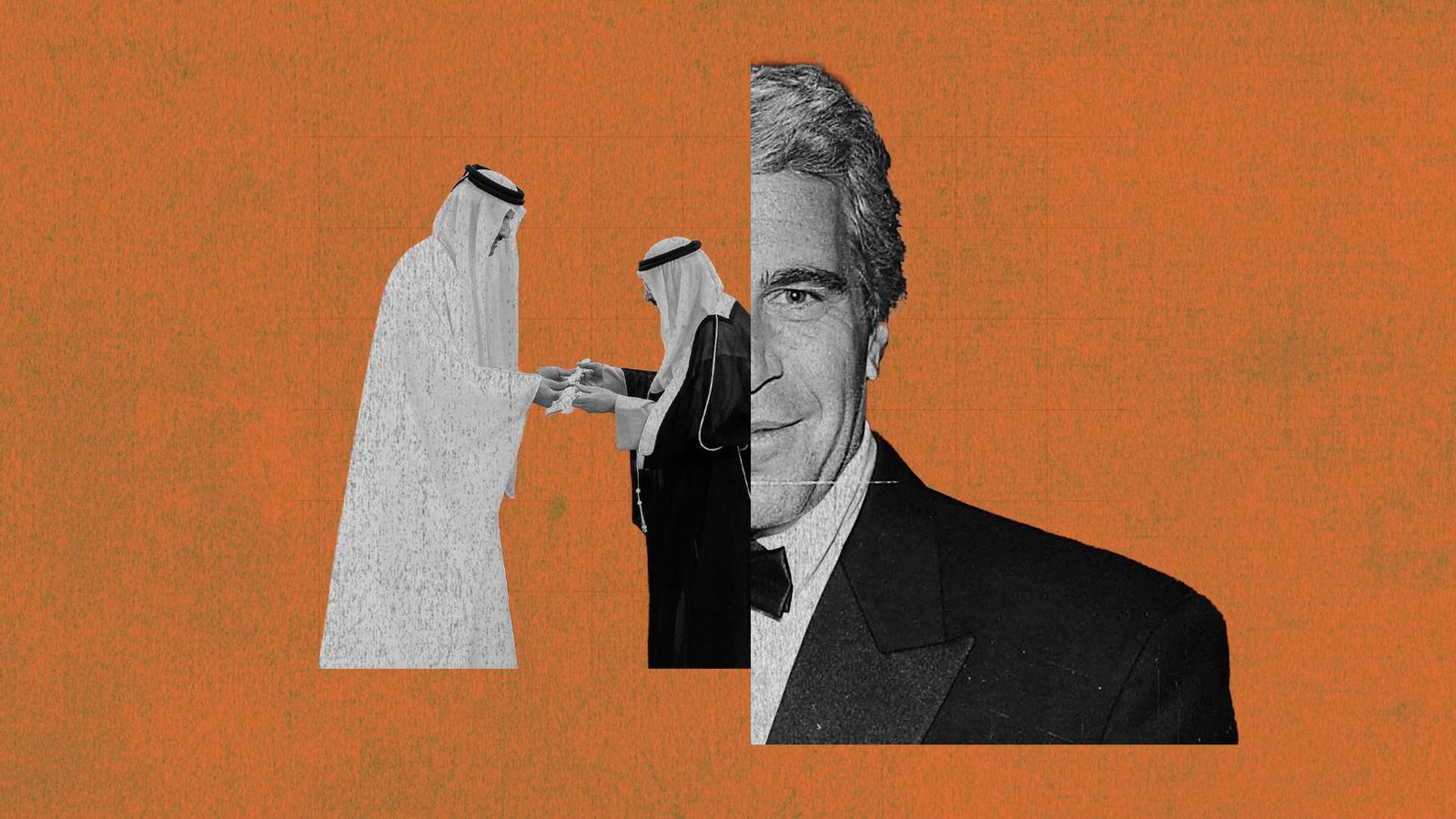
Jeffrey Epstein’s Secret Role in Washington’s Middle East Diplomacy
Share
Facebook Twitter Pinterest Email Copy Link

Listen to the article

0:00
0:00

Key Takeaways

Playback Speed

Select a Voice

President Donald Trump announced in 2017 that his first official overseas trip would be to the Middle East. An unnamed political figure, possibly from Kuwait, wanted to know how to deal with the new, unpredictable American leader. So the person turned to his acquaintance, Jeffrey Epstein.

“[A]ny tips on how we should communicate with him?” the figure wrote in an email. Epstein asked what “concrete” things the person’s emir (prince) would like the U.S. to offer. “[A] good word about the Amir’s effort to host the yemen peace talk will be great, i think..and if peace agreement was signed in kuwait that would be [thumbs up emoji],” the figure wrote back.

Kuwait had hosted unsuccessful peace talks in mid-2016 to resolve the Yemeni civil war, which was the worst humanitarian crisis in the Middle East at the time.

Epstein sent the person a link to a Jerusalem Post article about cosmetics heir Ronald Lauder’s attempts to act as a freelance diplomat. “[H]e just left my house when you arrived. [H]e is the key for you. I understand Dubai,” Epstein continued.

Lauder did not immediately respond to requests for comment sent through his company, Estée Lauder, or his nonprofit organization, the World Jewish Congress.

House Oversight Committee

Emails published as part of the House Oversight Committee’s investigation into Epstein’s estate this week shed new light on the late sex trafficker’s international political dealings. Long after his 2006 guilty plea, he was active and welcome in powerful circles. Epstein bragged to a former Norwegian president about passing on information about Trump to a Russian ambassador, and offered former Trump adviser Steve Bannon help meeting with politicians in Europe.

But the most intriguing revelations have been about Epstein’s dealings in the Middle East. Some of Epstein’s relationships to the region are already known. He kept a photo of himself with Saudi Crown Prince Mohammed bin Salman in his apartment, and did business with former Israeli Prime Minister Ehud Barak, while helping Barak set up backchannel contacts with Russia to negotiate over the future of Syria.

The House Oversight Committee’s disclosures add two other countries to the mix. Along with the mysterious figure asking about favors for Kuwait—the name is completely redacted—the emails show that Epstein was in contact with an influential man in Qatar referred to only as “Jabor Y.” 

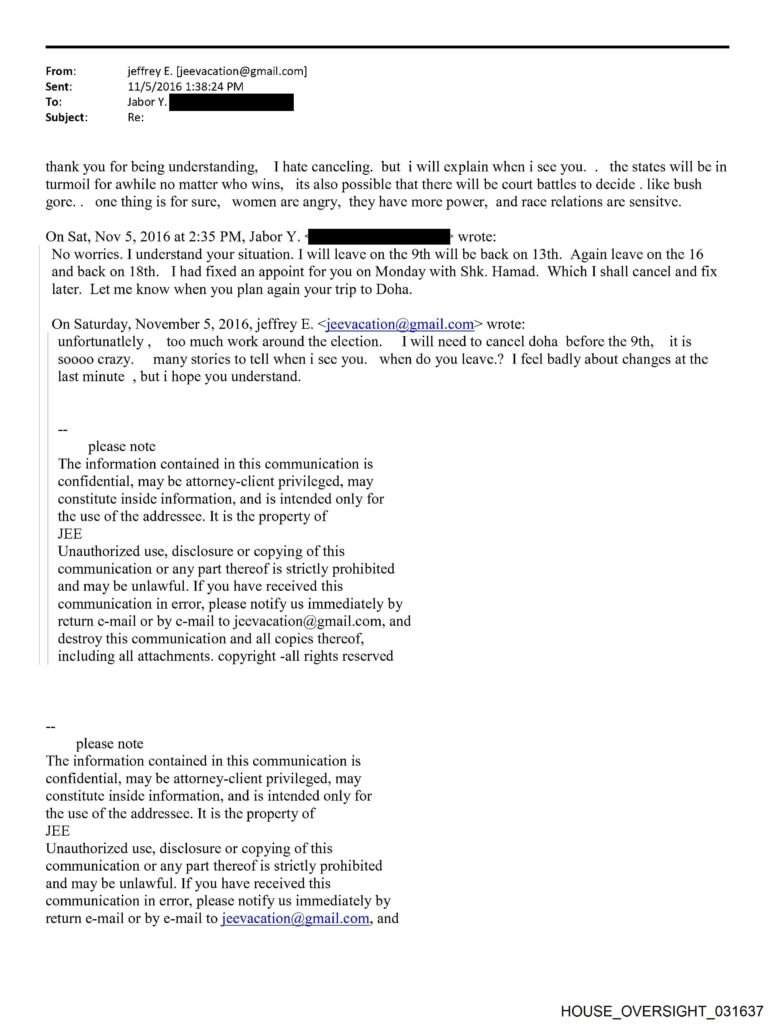
In November 2016, shortly before the U.S. election, Epstein apologized to Jabor for canceling an audience that Jabor had arranged with Hamad bin Khalifa Al Thani, the then-retired emir of Qatar. “[T]oo much work around the election,” Epstein wrote, adding that “the states will be in turmoil for awhile no matter who wins” and promising to “explain when i see you.”
House Oversight Committee

It’s unclear whether he ever rescheduled the meeting. The exact identity of the Qatari man is also unclear. However, a group of influential names that Epstein sent to himself with the title “list for bannon steve” includes “HBJ,” a nickname commonly used for Hamad bin Jassim bin Jaber Al Thani, the former prime minister of Qatar.

The Qatari foreign ministry and Qatari embassy in Washington did not immediately respond to requests for comment. 

The disclosures also touch on Epstein’s longstanding relationship with Thomas Barrack, a real estate investor close to Trump. During the 2016 election, Barrack was a major fundraiser for the Trump campaign. He now serves as U.S. ambassador to Turkey and Trump’s special envoy to Syria.

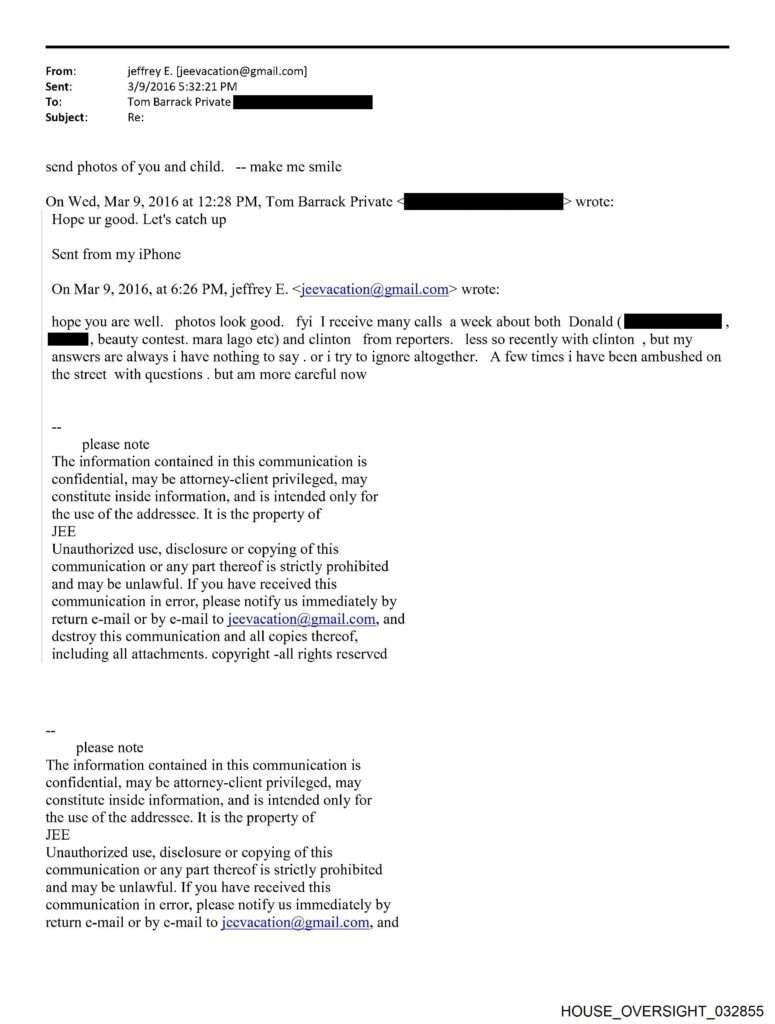
In March 2016, Epstein and Barrack made small talk via email. Barrack asked Epstein to “catch up,” while Epstein complained about the constant questions from the media about his relationships with Trump and former President Bill Clinton. “[S]end photos of you and child,” Epstein added. “[M]ake me smile.”

Barrack did not respond to a request for comment sent to him through the U.S. State Department’s Bureau of Near Eastern Affairs, where he works.
House Oversight Committee

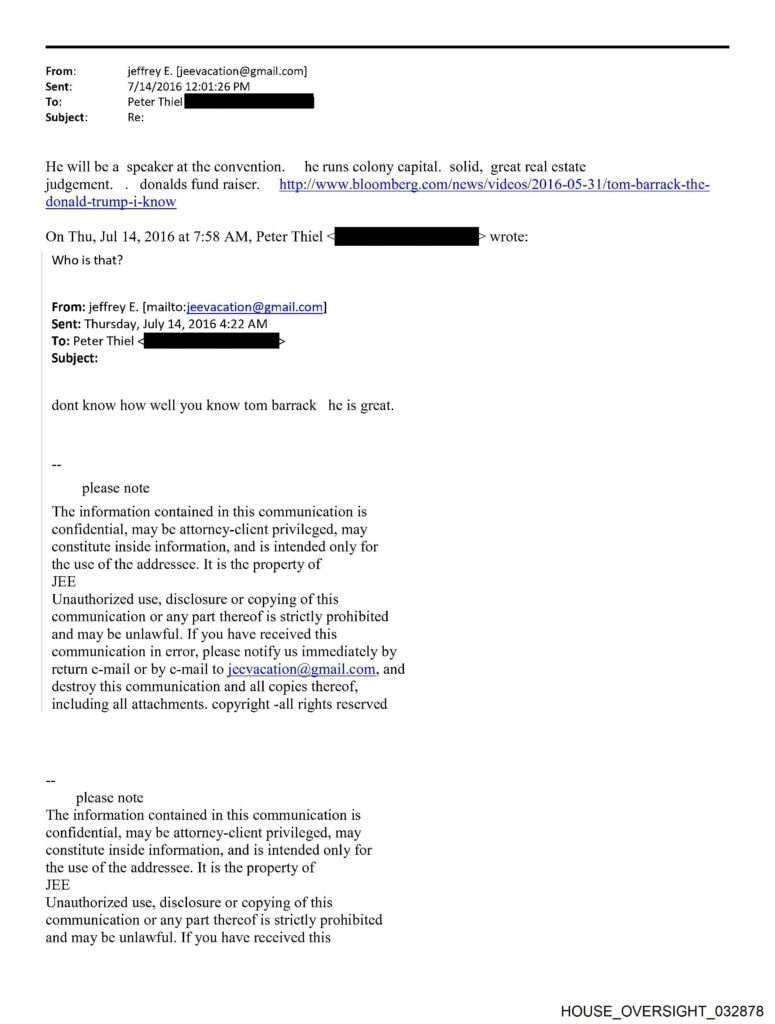
A few months later, Epstein wrote to businessman Peter Thiel, “dont know how well you know tom barrack he is great.” Epstein would go on to introduce Thiel and Barrack separately to Russian Ambassador to the United Nations Vitaly Churkin, according to schedules obtained by The Wall Street Journal. Thiel told the Journal that Epstein was “a crazed networker and low on substance,” adding, “I didn’t think enough about what Epstein’s agenda might have been.”
House Oversight Committee

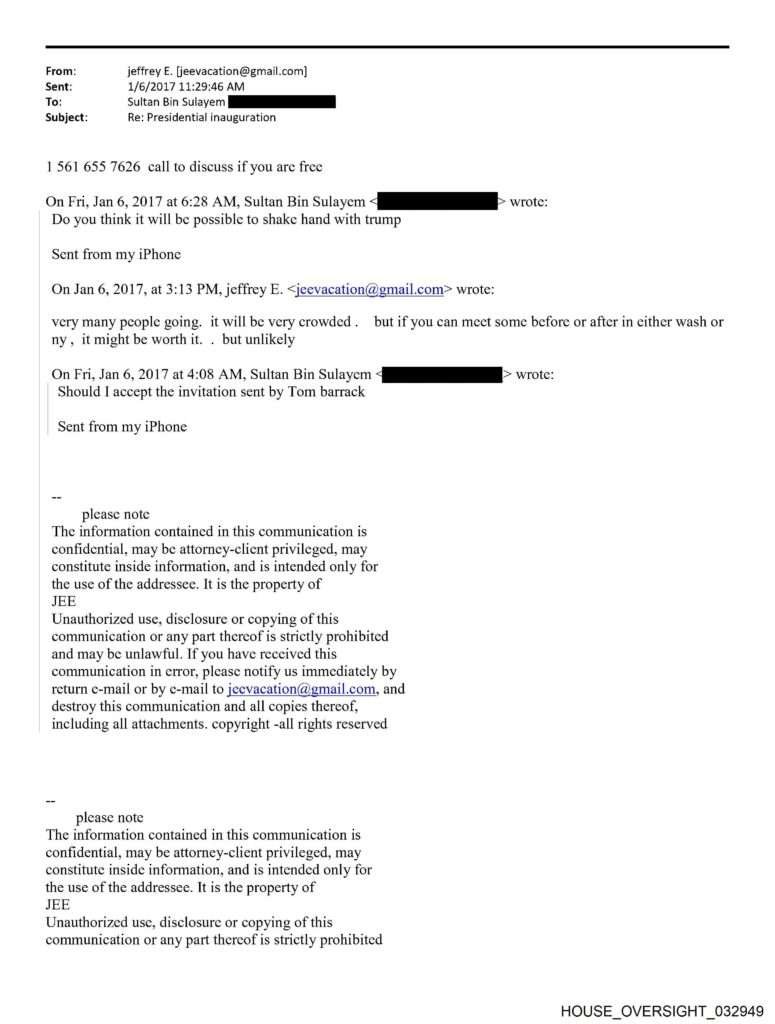
In January 2017, according to the House Oversight Committee emails, Epstein told Emirati businessman Sultan Ahmed bin Sulayem that “it might be worth it” to accept an invitation from Barrack to attend Trump’s inauguration. “Do you think it will be possible to shake hand with trump,” bin Sulayem wrote back. Epstein told bin Sulayem to call him on the phone.
House Oversight Committee

Emails from the Handala leaks show Epstein introduced Barak to bin Sulayem in 2013, describing bin Sulayem as “the right hand of maktoum,” the ruling family of Dubai. In 2015, bin Sulayem reached out to Epstein to arrange another meeting with Barak, for reasons unexplained. Epstein also kept a photo of himself with bin Sulayem in his apartment, according to images released by The New York Times.

Bin Sulayem’s company did not respond to a request for comment.

Epstein, a financial manager by trade, was interested in mixing business with politics. He frequently wrote to Barak about his excitement for military and intelligence affairs. The past two decades of chaos in the Middle East offered Epstein plenty of opportunities to get involved.

But the disclosures also underscore questions about the Epstein case. What value did so many influential political elites from around the world see in advice from a convicted sex offender? And what exactly was Epstein’s political endgame?

In a 2014 email, Epstein joked to a friend about the danger that her talk about “girls” will “renew an old habit.” Then he listed all the meetings he had lined up during the U.N. General Assembly in New York. They included power brokers from America, Europe, the Middle East, and beyond.

Read the full article here

Fact Checker

Verify the accuracy of this article using AI-powered analysis and real-time sources.

Get Your Fact Check Report

Enter your email to receive detailed fact-checking analysis

5 free reports remaining

Continue with Full Access

You've used your 5 free reports. Sign up for unlimited access!

Already have an account? Sign in here

Share. Facebook Twitter Pinterest LinkedIn Tumblr Email Telegram Copy Link
News Room
  • Website
  • Facebook
  • X (Twitter)
  • Instagram
  • LinkedIn

The FSNN News Room is the voice of our in-house journalists, editors, and researchers. We deliver timely, unbiased reporting at the crossroads of finance, cryptocurrency, and global politics, providing clear, fact-driven analysis free from agendas.

Related Articles

Cryptocurrency & Free Speech Finance

US Tech Giants Unite to Battle China’s Open-Source AI Dominance

27 minutes ago
Media & Culture

No Injunction Against Prosecution for Taking Photo of Transgender Politician Washing Hands in Women’s Restroom

59 minutes ago
Cryptocurrency & Free Speech Finance

Bitcoin ‘After Dark’ ETF Would Bet on BTC as Wall Street Sleeps

1 hour ago
Media & Culture

Get Ready To Enter A New Decade With The Next Public Domain Game Jam: Gaming Like It’s 1930!

2 hours ago
Media & Culture

Trump Is Still Claiming He Saves ‘25,000 American Lives’ When He Blows Up a Suspected Drug Boat

2 hours ago
Debates

Olivia Nuzzi’s Career Collapse: A Journalist’s Downfall

2 hours ago
Add A Comment
Leave A Reply Cancel Reply

Editors Picks

Real Finance secures $29M to build institutional rails for tokenized assets

22 minutes ago

US Tech Giants Unite to Battle China’s Open-Source AI Dominance

27 minutes ago

No Injunction Against Prosecution for Taking Photo of Transgender Politician Washing Hands in Women’s Restroom

59 minutes ago

Honduran journalist hospitalized after reported home invasion by local mayor, accomplice

1 hour ago
Latest Posts

Dogecoin Surges 6% as Ether Jump Creates Memecoin Run

1 hour ago

Blockchain trial on Canton Network tests collateral reuse with tokenized US Treasurys

1 hour ago

Bitcoin ‘After Dark’ ETF Would Bet on BTC as Wall Street Sleeps

1 hour ago

Subscribe to News

Get the latest news and updates directly to your inbox.

At FSNN – Free Speech News Network, we deliver unfiltered reporting and in-depth analysis on the stories that matter most. From breaking headlines to global perspectives, our mission is to keep you informed, empowered, and connected.

FSNN.net is owned and operated by GlobalBoost Media
, an independent media organization dedicated to advancing transparency, free expression, and factual journalism across the digital landscape.

Facebook X (Twitter) Discord Telegram
Latest News

Ether Surges 8%, Outpacing Bitcoin Gains Amid Staking ETF, Tokenization Optimism

20 minutes ago

Real Finance secures $29M to build institutional rails for tokenized assets

22 minutes ago

US Tech Giants Unite to Battle China’s Open-Source AI Dominance

27 minutes ago

Subscribe to Updates

Get the latest news and updates directly to your inbox.

© 2025 GlobalBoost Media. All Rights Reserved.
  • Privacy Policy
  • Terms of Service
  • Our Authors
  • Contact

Type above and press Enter to search. Press Esc to cancel.

🍪

Cookies

We and our selected partners wish to use cookies to collect information about you for functional purposes and statistical marketing. You may not give us your consent for certain purposes by selecting an option and you can withdraw your consent at any time via the cookie icon.

Cookie Preferences

Manage Cookies

Cookies are small text that can be used by websites to make the user experience more efficient. The law states that we may store cookies on your device if they are strictly necessary for the operation of this site. For all other types of cookies, we need your permission. This site uses various types of cookies. Some cookies are placed by third party services that appear on our pages.

Your permission applies to the following domains:

  • https://fsnn.net
Necessary
Necessary cookies help make a website usable by enabling basic functions like page navigation and access to secure areas of the website. The website cannot function properly without these cookies.
Statistic
Statistic cookies help website owners to understand how visitors interact with websites by collecting and reporting information anonymously.
Preferences
Preference cookies enable a website to remember information that changes the way the website behaves or looks, like your preferred language or the region that you are in.
Marketing
Marketing cookies are used to track visitors across websites. The intention is to display ads that are relevant and engaging for the individual user and thereby more valuable for publishers and third party advertisers.