

 Freedom Index
Listen to the article
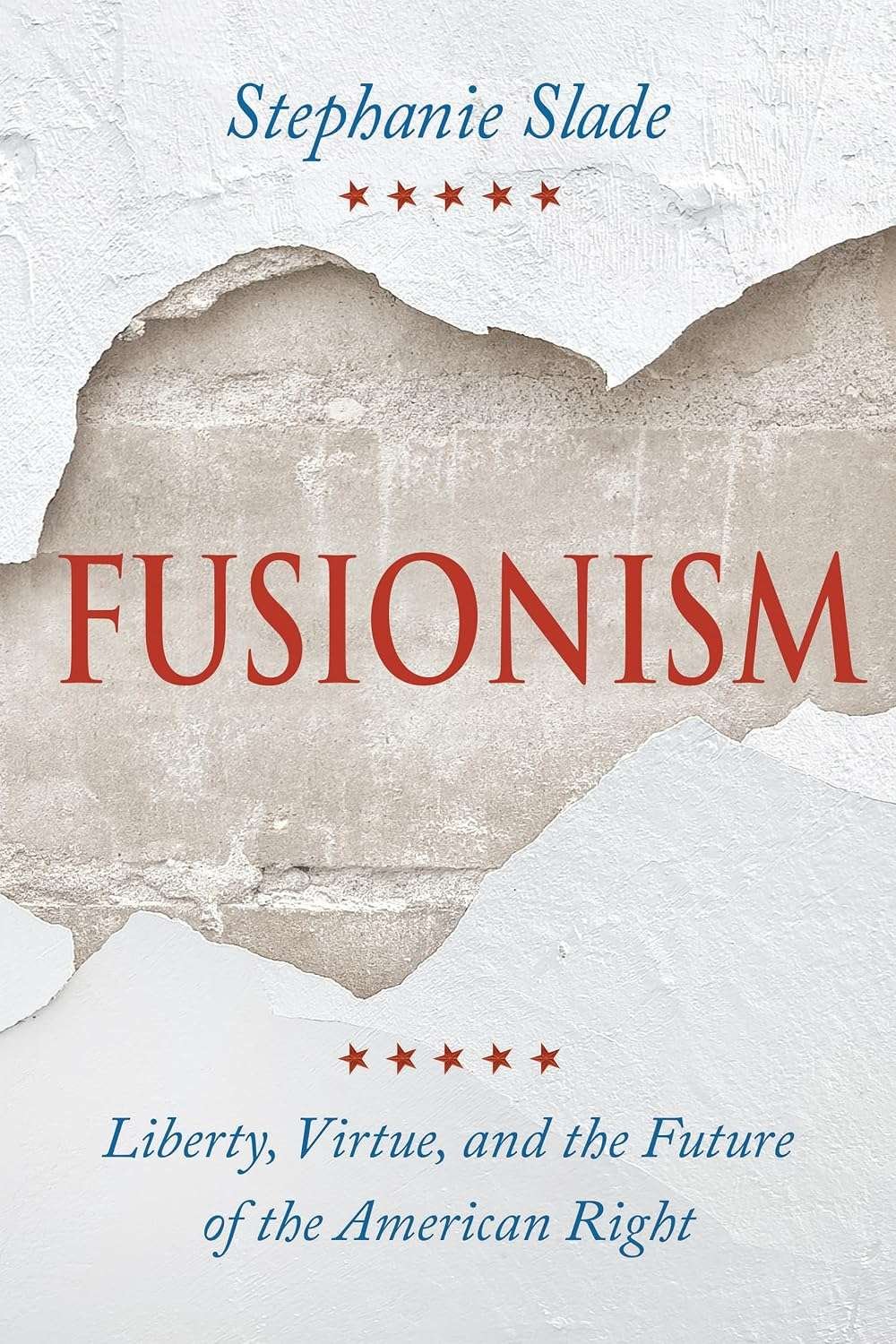
This essay is adapted from Fusionism: Liberty, Virtue, and the Future of the American Right by Reason Senior Editor Stephanie Slade, by permission of University of Notre Dame Press. Get your copy here.
In September 2021, when he was still a long-shot candidate for the Republican Senate nomination in Ohio, J.D. Vance made an appearance on Fox News’ Tucker Carlson Tonight. At the time, it was widely understood that Vance’s chances were limited in the bright-red state by his earlier refusal to support Donald Trump for president.
“My god what an idiot,” he had tweeted of Trump in 2016. “I find him reprehensible. God wants better of us,” he posted the same month. In the wake of Trump’s infamous “grab ’em by the pussy” Access Hollywood tape, Vance implored his “fellow Christians” to realize that “everyone is watching us when we apologize for this man.”
By the time of his Senate race, those comments had become a political liability. He deleted them and began an apology tour. “I’ve been very open that I did say those critical things and I regret them,” he told Fox News. “I regret being wrong about the guy.”
Still struggling in the polls that autumn, Vance needed a way to endear himself to the former president and his fans. His solution was to launch a culture-war offensive against the American left, rule of law be damned. And so, in a crisp white button-up and navy blazer, no tie, Vance laid out for Carlson his proposal to use the powers of the federal government to punish private universities and nonprofits for promoting “radical left-wing ideology.”
“Why are we allowing the companies that are destroying this country to receive tax preferences?” he asked. “Why don’t we seize the assets of the Ford Foundation, tax their assets, and give it to the people who’ve had their lives destroyed by their radical open-borders agenda?” Carlson had until then maintained an expression of earnest concern, but at the suggestion of punitive wealth redistribution, he was no longer able to restrain himself. He broke into an elated grin.
The conservative columnist Ross Douthat later likened Vance’s strategy to “burning his ships”—an attempt to earn the trust of conservatives by so offending establishment mores that he could never go back to being an elite in good standing with his former friends. It was a bet that paid off bigly. Through a campaign of high-octane grievance mongering, Vance’s poll numbers in Ohio improved. He traveled to Mar-a-Lago to beg for the former president’s endorsement; when he succeeded, it was enough to propel him to a last-minute victory in the primary and, six months later, a seat in the U.S. Senate. Two years after that, he was Trump’s running mate and presumptive successor.
Vance might be a Republican, but his political ascendancy is no triumph for the limited-government cause that was once associated with the GOP. As his comments to Carlson made clear, Vance is not the least bit squeamish about embracing state power. Whereas the American right for years saw itself as a champion of individual liberty and the rule of law, he represents a new “Dissident Right” united not primarily by fears of tyranny but by a willingness to dispense with free market pieties, procedural norms, and even basic civility en route to destroying their political foes.
Conservatives also once prided themselves on having nothing but scorn for left-wing “victimhood culture,” in which people disclaim responsibility for their failures or seek unearned social and professional benefits because of alleged disability, racial oppression, sex-based discrimination, and the like. Vance’s approach, on the other hand, leans in to the politics of victimhood by pronouncing that white, Christian, and working-class Americans have been preyed on by powerful left-wing entities, which will now be compelled by a righteous state to make recompense for their sins.
It’s a head-spinning reversal in tone and policy alike.
* * *
Five months after he proposed that politicians seize the assets of the Ford Foundation, Vance delivered a speech at the 2022 Conservative Political Action Conference in Orlando, Florida. The thrust of his message was summed up in the very first sentences he spoke.
“For those of you who don’t know who I am, I want to tell you just a little about myself,” Vance began. “I grew up in Middletown, Ohio, in a steel town that was devastated by the policies of the Democrats.” When his grandparents moved there from the hill country of Kentucky in the late 1940s, he said, “it was the land of opportunity.” But then Washington politicians “decided that we didn’t need to make anything in this country anymore,” and the good-paying manufacturing jobs that once sustained small cities like Middletown were shipped off to Mexico and China.
The striking thing about this characterization of the plight of his hometown is how different it is from the story he told in Hillbilly Elegy, the smash-hit 2016 memoir that put Vance on the map.
According to his book, Rust Belt communities struggle and suffer because their cultures have become degraded. Outsiders assume that the problems in these places are the result of the evaporation of factory jobs. “I once held this opinion myself, and I very desperately wanted to believe it during my youth,” Vance wrote. Experience taught him otherwise: Poor public policy can make a difficult situation worse, but too many of the people he grew up with never learned to make good decisions or to accept the consequences of bad ones. They convinced themselves that all the blame for their troubles lay elsewhere, as did all the responsibility for providing them with the good things in life. “These problems were not created by governments or corporations or anyone else,” Vance concluded.
In one anecdote, widely shared in the aftermath of his selection as Trump’s running mate in 2024, Vance described his employment stacking pallets at a floor tile distribution business during the summer before he left for law school: “One guy, I’ll call him Bob, joined the tile warehouse just a few months before I did. Bob was nineteen with a pregnant girlfriend. The manager kindly offered the girlfriend a clerical position answering phones. Both of them were terrible workers. The girlfriend missed about every third day of work and never gave advance notice. Though warned to change her habits repeatedly, the girlfriend lasted no more than a few months. Bob missed work about once a week, and he was chronically late. On top of that, he often took three or four daily bathroom breaks, each over half an hour….Eventually, Bob, too, was fired. When it happened, he lashed out at his manager: ‘How could you do this to me? Don’t you know I’ve got a pregnant girlfriend?’ And he was not alone.”
Later in the book, Vance recounted running into a Middletown acquaintance who admitted “he had recently quit his job because he was sick of waking up early.” Incredibly, the same person then took to “complaining on Facebook about the ‘Obama economy’ and how it had affected his life.”
Reckless overspending was another recurring theme: Despite the fact that Vance’s mom, a registered nurse, and his stepfather, a truck driver, together earned six figures—an excellent income in Ohio in the early 1990s—they were constantly fighting about money. “This was my world: a world of truly irrational behavior,” Vance explained. “We spend our way into the poorhouse. We buy giant TVs and iPads. Our children wear nice clothes thanks to high-interest credit cards and payday loans. We purchase homes we don’t need, refinance them for more spending money, and declare bankruptcy, often leaving them full of garbage in our wake. Thrift is inimical to our being.”
Vance attributed his escape from such a life to his grandparents, who “had an almost religious faith in hard work and the American dream,” he wrote. “They knew that life was a struggle, and though the odds were a bit longer for people like them, that fact didn’t excuse failure. ‘Never be like these fucking losers who think the deck is stacked against them,’ my grandma often told me.” They pushed him to do well in school and to make a better life for himself. Believing he could, he did.
* * *
The No. 1 thing Vance wished he could change about white working-class culture, he said in his memoir, was the lack of a sense of personal agency—the comforting but false excuse that one’s “choices don’t matter.” Such themes were entirely absent when he joined Trump’s 2024 presidential ticket.
Instead, Vance’s message was that Trump’s loss four years earlier to Joe Biden was illegitimate, that Haitian refugees were invaders who ate their neighbors’ house pets and corrupted the American way of life, and that hardworking people in places like Kentucky and Ohio were being screwed by liberal cosmopolitan elites. It was a campaign of righteous anger, filled with promises that Trump alone could solve voters’ problems if they would only return him to the White House.
In 2014, the sociologists Bradley Campbell and Jason Manning published a journal article that shed light on the rise of “call-out culture” on college campuses. They posited that the phenomenon in which young people constantly call people out for committing “microaggressions”—that is, brief, commonplace, and often unintentional slights on the basis of race, ethnicity, gender, sexual orientation, disability, or religion—reflected a new form of competitive status seeking.
Environments where call-outs and cancellations were prevalent had undergone a shift from a “culture of dignity” (in which status comes from treating others with respect, to include behaving graciously toward those who insult you, because it shows you know that human worth doesn’t depend upon anyone’s opinion) to a “culture of victimhood” (in which status comes from demonstrating that your grievances are more severe than other people’s or, if that’s impossible, from being a “good ally” who sides with those who have suffered the worst injustices). In practice, the authors observed, victimhood culture often takes the form of “documenting, exaggerating, or even falsifying offenses” and dogged attempts to sanction the supposed offenders.
Vance’s evolution from repeating his grandmother’s dictum that “God helps those who help themselves” to blaming Middletown’s struggles on Democratic Party malfeasance should be seen as an innovative example of the same phenomenon. Like the identitarian left, he is engaging in “competitive victimhood” by holding himself out as an ally of the working class, which assumes the place of an underprivileged or oppressed group in our modern globalized social order, “pitiable and blameless.” Immigrants (who he paints as collectively responsible for driving down native-born wages and trafficking in deadly drugs such as fentanyl) and coastal elites (as evangelists for an amoral secularism that is hostile to faith and family) are the victimizers, deserving of punishment for their sins.
Back in July 2016, Vance published an essay in The Atlantic titled “Opioid of the Masses,” in which he likened Trump to “cultural heroin.” The reality star’s candidacy “promises a quick escape from life’s cares, an easy solution to the mounting social problems of U.S. communities and culture,” even as it “demands nothing” from voters, Vance wrote. No wonder people were flocking to it. Yet this was a “false euphoria”—a “quick high” that “makes some feel better for a bit” but ultimately “cannot fix what ails” places like Middletown.
Eight years later, as he joined the Trump campaign, Vance was no longer issuing prophetic warnings about that working-class victimhood narrative. By 2024, he was dealing the drug himself.
And just as cancel culture produced a rash of people exaggerating or even fabricating offenses they had supposedly suffered, Vance was more than willing to bend the truth to justify his allies’ anger. When the CNN anchor Dana Bash confronted him about dubious claims that Haitian immigrants in Springfield, Ohio, were stealing and eating local pets, the vice presidential hopeful was defiant. “If I have to create stories so that the American media actually pays attention to the suffering of the American people,” he declared, “then that’s what I’m going to do.”
* * *
The terminal stage of victimhood culture occurs when people begin to reflexively blame their own shortcomings on someone else’s supposed ill treatment of them or to dismiss legitimate criticism as an artifact of bigotry. That tendency too is on the rise on the Dissident Right.
With the 2028 presidential election now on the horizon, some conservatives have begun to grumble at the prospect that Vance will be the next standard-bearer for their party. As the sitting vice president, he certainly is in the pole position for the Republican nomination. But he lacks the mass appeal that Trump enjoys and carries the additional ideological baggage of having explicitly identified himself with the “postliberal” faction of the modern American right.
Roughly speaking, postliberalism is the idea that the liberal order associated with the American Founding is a morally bankrupt project whose time is coming to an end. It hopes to replace that order with a new, less constrained governing regime that is more willing to use coercive force in the name of achieving a Christian understanding of the common good. Although there are self-described Protestant postliberals, many of the most prominent advocates are Catholic. They include the Notre Dame political scientist Patrick Deneen, the Harvard Law School professor Adrian Vermeule, and the journalist Sohrab Ahmari—all of whom have social and professional ties to Vance, who is himself a recent convert to Catholicism.
Vance’s conservative critics have no shortage of reasons for objecting to his presumptive candidacy, from his hostility to free markets to his disdain for rule of law to the hypocrisy and dishonesty that have repeatedly been on display during his short political career. So it took more than a shred of hubris for The Daily Wire‘s Michael Knowles to lash out at those critics in July on the grounds that “the sudden and seemingly coordinated invective against ‘post-liberalism'” allegedly represents “a neo-Know-Nothing contempt for Catholics.”
In fact, many of the leading opponents of postliberalism (and its cousin, Catholic integralism) are themselves practicing Catholics.
Start with Cardinal Christophe Pierre, the Vatican’s equivalent of an ambassador to the United States, who argued in an admirably clear-eyed 2025 speech that both woke culture on the left and postliberalism on the right amount to “incomplete or problematic alternatives” to liberalism. The latter “seeks to overcome the liberal moral vacuum by revaluing the common good, tradition, and the role of religion in public life,” he said, but ends up attempting “to impose in an authoritarian way a single code of behavior” on society.
Pierre also made a point of critiquing those who invoke the Christian concept of ordo amoris, or “order of love,” to justify concern for “first me, then my family, and then my country, not worrying much about the fate of the rest of the world”—an obvious allusion to Vance.
Or look to Thomas Howes (a former Catholic seminarian) and James Patterson (a political scientist recently of Ave Maria University, now of the University of Tennessee), whose new book, Why Postliberalism Failed, traces the disastrous consequences of various attempts to integrate church and state during the last century, and features forewords by a conservative archbishop as well as the executive director of the James Cardinal Gibbons Institute for Human Ecology at the Catholic University of America.
Eminent Catholic thinkers such as Princeton legal scholar Robert George, Pope John Paul II biographer George Weigel, Ethics and Public Policy Center President Ryan Anderson, and Pontifical Academy of Social Sciences member Russell Hittinger have likewise been conspicuously skeptical of postliberal ideas, warning that such a path risks violating human dignity by trampling individual rights. While Knowles no doubt knows better than to think any of these figures is acting from anti-Catholic animus, he apparently hopes his followers are less informed.
Vance is part of a community of intellectuals and influencers who are self-consciously working to construct and promote an anti-liberal approach to conservative politics. In that effort, they have embraced a strategy of making themselves and their allies out to be victims of nefarious forces that can be brought to heel only through the muscular use of government. The gambit is a clever one, but by paving the way for greater concentrations of state power, Vance and the postliberals are likely enabling many worse tyrannies to come.
Fusionism: Liberty, Virtue, and the Future of the American Right by Stephanie Slade is available now.
Read the full article here
Fact Checker
Verify the accuracy of this article using AI-powered analysis and real-time sources.