

 Freedom Index

Listen to the article
Water, water everywhere and not a drop to drink may be the sentiment of the crypto industry, lobbyists and lawmakers who’ve spent the last year trying to get the CLARITY Act over the line.
No shortage of negotiations, amendments or political wrangling; yet not enough to get the bill moving through the Senate.
The CLARITY Act may have rammed into a Senate-shaped hurdle this week, but it isn’t dead on arrival yet — let’s go with walking wounded.
There’s still a chance for the digital asset market structure bill to scramble together the 60 votes it needs to clear the Senate.
When Republican Senator Thom Tillis switched his vote from yes to no at the last minute, he did so on procedural grounds. It may have looked like a swing against CLARITY, but it was really a parliamentary maneuver, allowing him to file a motion to reconsider and preserve a route back to the Senate floor.
The Crypto Council for Innovation (CCI)’s director of US federal affairs, Ryan Eagan, tells Magazine:
“Senator Tillis’s motion to reconsider would provide an opportunity to revisit CLARITY’s cloture vote at any point this session. Specific timing regarding next steps is not clear, but that desire to preserve that opportunity is in part due to the progress made over the past week.”
But the Senate is running out of time; both Democrats and Republicans remain divided over ethics provisions involving President Donald Trump, and even supporters of the bill say a more bipartisan negotiating process may now be necessary.
So can CLARITY still be resuscitated, and if it can, how much of the bill will need serious CPR to get there?
CLARITY isn’t dead, but the clock is running down
The failed cloture vote, a procedural vote to end debate on a bill and move it toward a final vote, doesn’t end CLARITY’s journey through Congress just yet. It requires 60 votes in the Senate, and CLARITY fell 49-50 on Tuesday.
Tillis’ motion to reconsider means the vote can be revisited during the current session, but that route is running into a much more practical problem: a ticking clock.
Related: Coinbase faces greater fallout from CLARITY Act setback: Saxo
The Senate is scheduled to leave for recess on October 2 before returning after the midterm elections, and the House of Representatives has already recessed for the election period, complicating any attempt to move legislation through both chambers before the end of the year.
Congressman Shri Thanedar, a Democrat who supported CLARITY when it passed through the House in July 2025, tells Magazine that timeline presents a “major barrier” to reaching an agreement:
“There are only 20 legislative days left in this Congress, all of them after the midterms, making odds of a 2026 compromise, unfortunately, very low.”
Very low doesn’t mean impossible, and the crypto industry has a precedent in the Guiding and Establishing National Innovation in US Stablecoins (GENIUS) bill, which failed cloture 48-49 in May 2025 before clearing a second cloture vote 66-32 just 11 days later. It passed the Senate the following month. However, Kyle Chassé, founder of crypto investment firm MV Global, tells Magazine:
“GENIUS came back from a failed cloture in 11 days. But GENIUS had a deal. This one has a calendar and no votes. Miss Jan. 3, and it restarts from zero in 2027 with a House that is probably Democratic.”
While a lame-duck session after the November elections could give CLARITY another shot, that’s not the same as having a ready-made deal waiting to go.
The 60-vote problem is a negotiating problem
Of the 49 votes for CLARITY, not a single one came from the Democratic camp. Chassé says:
“Every one of the 49 was a Republican. Zero Democrats voted to even open debate.”
While that’s clearly less than ideal, it doesn’t necessarily mean the Democrats have abandoned the bill entirely.
On Wednesday, seven Democratic senators — all of whom had voted a day earlier against advancing the bill — said they “remain committed” to enacting the legislation. Among them was Sen. Angela Alsobrooks, who backed moving the bill out of the Banking Committee in May before voting no on cloture. She said it’s “clear that now is the time to regulate digital assets” and that she’s willing to negotiate over the ethics provisions, adding:
“We were ready to strike a deal today and in discussions right up until the vote. Republican leadership shut it down at the very last minute after it became clear that we were on a path to a successful vote.”
Tillis said Wednesday he now wants to “convince the Democrats to get on board,” and “put pressure on them to own it,” and his procedural vote switch was designed to keep that possibility alive. “I feel very strongly that this is an unregulated marketplace and that we need some guardrails on,” he added.
Related: Bernstein expects ‘aggressive’ rulemaking from SEC, CFTC, following CLARITY Act failure
The divide isn’t over whether Congress should establish rules for crypto anymore, but whether the current package goes far enough to secure bipartisan support.
Seven Democratic senators “remain committed” to enacting the legislation. Source: Kirsten Gillibrand, Senate
While Congressman Thanedar says he supports the bill in its current form, he acknowledges that Tuesday’s result shows the need for both parties to work together further on the draft:
“I do believe that the failed CLARITY vote on Tuesday demonstrates that a more bipartisan drafting process would lead to a higher likelihood of creating the bipartisan, supermajority coalition that passing this legislation into law would require.”
If saving CLARITY means rewriting it, what survives?
Chassé says the problem has moved beyond the technical drafting of crypto policy and is now centered on President Trump’s crypto interests and the ethics provisions around them:
“This stopped being a drafting problem. It’s a referendum on the President’s crypto holdings six weeks before an election, and the text as written can’t survive that.”
Republicans had already made 126 substantive changes requested by Democrats ahead of Tuesday’s vote, including tighter restrictions on public officials profiting from crypto ventures, and giving state attorneys general a role in enforcing some of the ethics provisions.
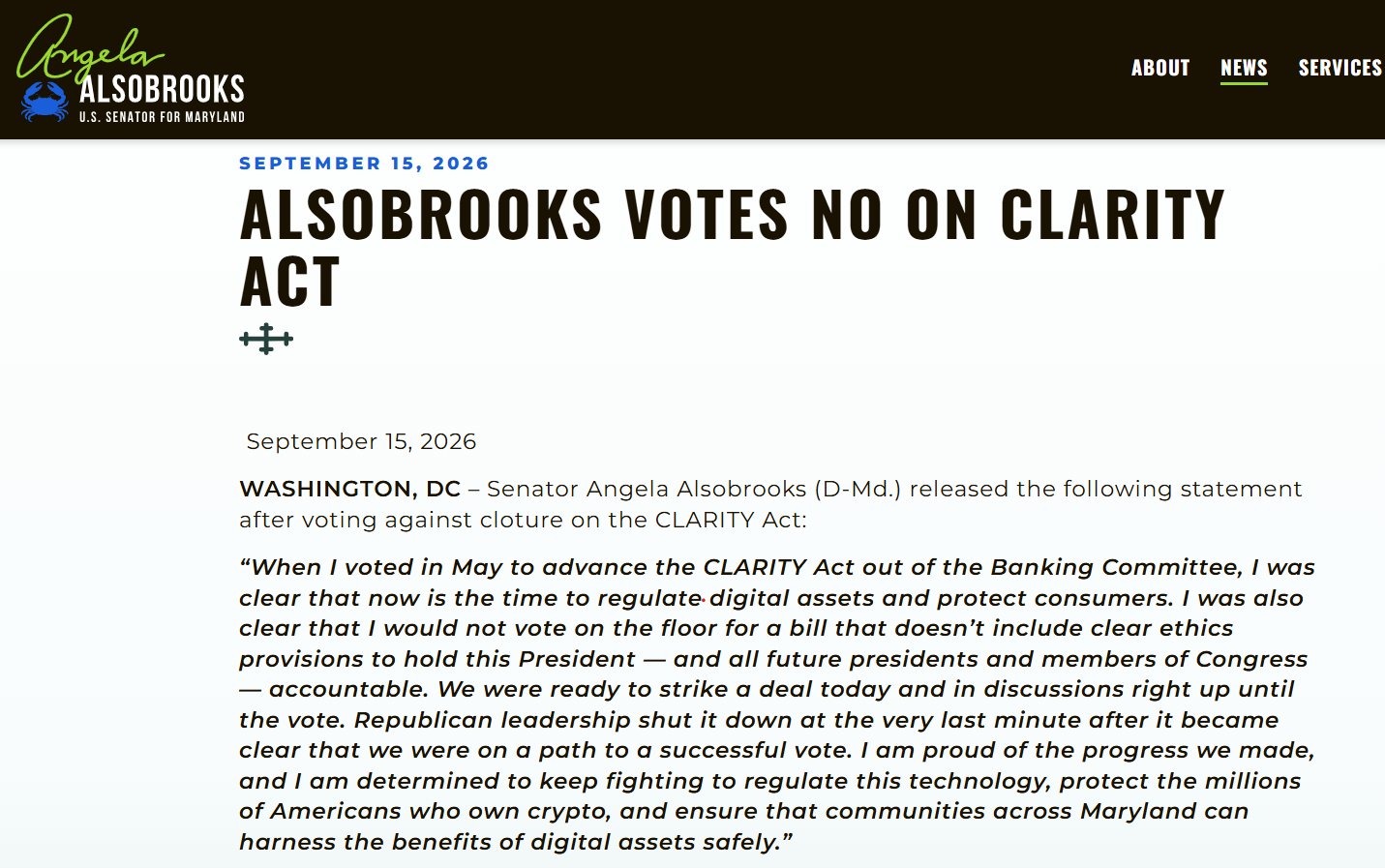
Alsobrooks votes no on CLARITY. Source: Angela Alsobrooks, Senate.
Despite the concessions, Thanedar says the Democrats want more restrictions “on the President’s ability to use his office for personal gain.” He says the at least $1.4 billion in crypto earnings Trump reported for 2025 in his annual financial disclosure shows that “guardrails are necessary to both hold the President accountable and protect the long-term health of the digital asset market.”
Ethics is not the only potential fault line, though, and Chassé says the industry “should stop dying on that hill.” He points instead to stablecoin rewards, saying “some kind of cap or circuit breaker on yield” would likely be “the price of the bank-side senators and a chunk of Democrats,” along with “tighter illicit finance and state enforcement language.”
He says self-custody and developer protections are areas the crypto industry should be reluctant to trade away. Those protections have been bitterly defended throughout the negotiations, with lawmakers and industry groups debating how far the bill should go in shielding non-custodial developers from financial and anti-money-laundering (AML) requirements.
Congress may stall, crypto regulation doesn’t have to
Even if CLARITY remains stuck in Congress, US crypto regulation is not standing still. Eagan says the Securities and Exchange Commission (SEC) and the Commodity Futures Trading Commission (CFTC) have “demonstrated commitment to reduce uncertainty” through guidance, rulemaking, no-action relief and exemptions.
“CCI expects that agencies’ crypto agenda will proceed in robust fashion regardless of the CLARITY Act,” he says, adding that the GENIUS Act implementation continues at Treasury and the banking regulators.
Strategy executive chairman Michael Saylor also pointed out that the SEC, CFTC and Treasury could continue to advance rules under existing laws:
“Progress need not wait for Congress.”
That may be true, but agency action is not the same as getting CLARITY over the finish line. Regulatory guidance can be swept out with administrations, but legislation is harder to unwind.
CLARITY may still have a way to limp back to the Senate, but whether lawmakers can find 60 votes without changing the bill beyond recognition is another matter.
Magazine: Revolut ID thefts highlight KYC’s dangers: Here’s how to fix it
Cointelegraph publishes long-form journalism, analysis and narrative reporting produced by Cointelegraph’s in-house editorial team with subject-matter expertise. All articles are edited and reviewed by Cointelegraph editors in line with our editorial standards. Some articles contain affiliate links, from which Cointelegraph may earn a commission. These relationships do not influence which products we review or our editorial conclusions. Content published in here does not constitute financial, legal or investment advice. Readers should conduct their own research and consult qualified professionals where appropriate. Cointelegraph maintains full editorial independence.
Read the full article here
Fact Checker
Verify the accuracy of this article using AI-powered analysis and real-time sources.