Close Menu
FSNN | Free Speech News NetworkFSNN | Free Speech News Network
  • Home
  • News
    • Politics
    • Legal & Courts
    • Tech & Big Tech
    • Campus & Education
    • Media & Culture
    • Global Free Speech
  • Opinions
    • Debates
  • Video/Live
  • Community
  • Freedom Index
  • About
    • Mission
    • Contact
    • Support
Trending

Trump Is Back To Seeking Regime Change in Iran

1 minute ago

Crypto made new friends in U.S. primaries, but focus now shifts to general election

28 minutes ago

Bitcoin Drops to $76.4K as Demand Turns Negative, Asian Stocks Slide

33 minutes ago
Facebook X (Twitter) Instagram
Facebook X (Twitter) Discord Telegram
FSNN | Free Speech News NetworkFSNN | Free Speech News Network
Market Data Newsletter
Wednesday, September 2
  • Home
  • News
    • Politics
    • Legal & Courts
    • Tech & Big Tech
    • Campus & Education
    • Media & Culture
    • Global Free Speech
  • Opinions
    • Debates
  • Video/Live
  • Community
  • Freedom Index
  • About
    • Mission
    • Contact
    • Support
FSNN | Free Speech News NetworkFSNN | Free Speech News Network
Home»News»Media & Culture»Is Republican Nominee Curtis Sliwa a Spoiler in NYC?
Media & Culture

Is Republican Nominee Curtis Sliwa a Spoiler in NYC?

News RoomBy News Room10 months agoNo Comments6 Mins Read3 Views
Share Facebook Twitter Pinterest Copy Link LinkedIn Tumblr Email VKontakte Telegram
Is Republican Nominee Curtis Sliwa a Spoiler in NYC?
Share
Facebook Twitter Pinterest Email Copy Link

Listen to the article

0:00
0:00

Key Takeaways

Playback Speed

Select a Voice

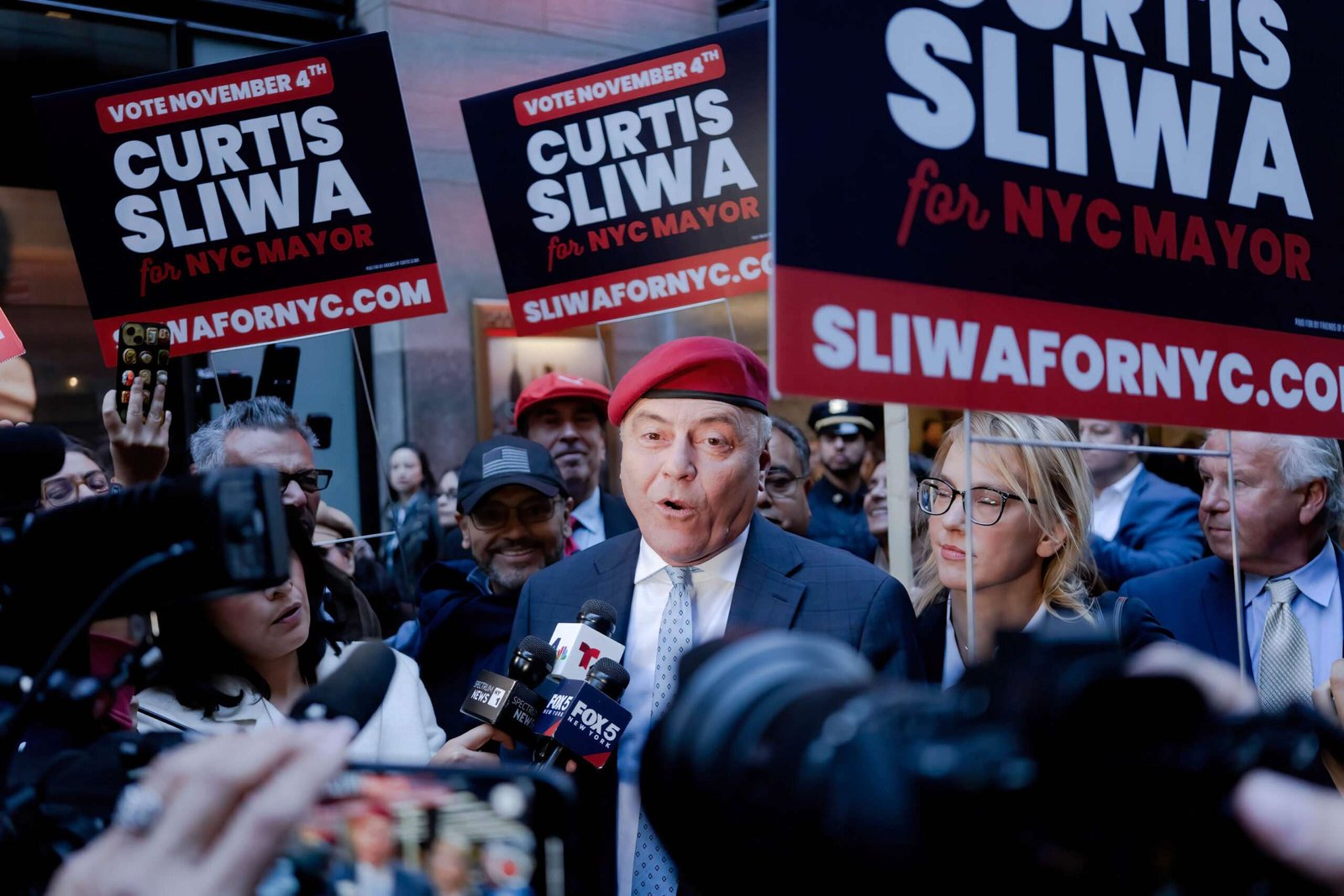
Covering third-party politics for a quarter-century accustoms one to the accusation that such-and-such marginal electoral candidate is a “spoiler,” queering what would be the results of a one-on-one contest between the front-runners. What’s new in New York City this fall is that the putative turd in this mayoral punch bowl is not some splinter/indie rando but the Republican, Curtis Sliwa.

“Just Walk Away, Beret!” thundered the cover editorial in Tuesday’s New York Post, nodding both to the candidate’s trademark haberdashery and the age demographic of those panicking over democratic socialist Zohran Mamdani. Sliwa’s longtime boss at WABC Radio, the politically influential Red Apple Media CEO John Catsimatidis, declared Monday that while “Curtis would make the best mayor of all the candidates,” his third-place ranking in the polls means he “has to realize that he should love New York more than anything else.” Former New York GOP finance chair Arcadio Casillas told The New York Sun this week that some of the party’s biggest donors are threatening to cut off future funding unless the nominee withdraws.

Billionaire busybody Bill Ackman, whose sophistication in politics rivals mine with hedge fund management, cited a single unnamed source Wednesday to assert that Sliwa won’t drop out because his “wife, friends and others are on the campaign payroll, and he and they are enjoying living off the city taxpayers who are funding his race/lifestyle.”

“Follow the money,” the Pershing Square Capital Management CEO tweeted. “When I asked why he doesn’t care about NYC? my source said: ‘He doesn’t give a sh-t.'”

You can accuse Curtis Sliwa of many, many things (while sourcing it straight from the horse’s mouth, too). But not giving a s-h-i-t about New York? Fuhgeddaboudit.

Not to be outdone, hedge fund smart-aleck Cliff Asness, who unlike Ackman at least has a visible sense of humor, accused me this week of murdering Gotham: “The beret itself should’ve been disqualifying but at this point it’s anyone voting for him, and automatically electing the Jihad-loving real-life communist (not the ‘we like Denmark and Sweden’ type liberals) who are responsible for killing this city.”

Leaving aside the old-timey notion that any candidate’s quirks can be “disqualifying” in the age of Donald Trump, let us take seriously the question of responsibility. I am not now nor have I ever been a Republican. However, as a moderately aware voter in this great and terrible city, I have known for years that the Democratic mayoral nominee would be awful, and not just as the default party setting.

At this time last year, the betting money for the Dem nomination was either on the laughably corrupt incumbent Eric Adams or the repellent City Comptroller Brad Lander—a character who should have been very well known to Wall Street, given his serial advancement of Environmental, Social, and Governance (ESG) activism while managing the city’s vast pension funds.

In other words, the time to get “serious” about a quality Republican challenger was at the very latest 2024, long before Mamdani began haunting the nightmares of us non-socialists. So who did our political gadflies put up against Sliwa’s silly beret?

Nobody. He ran unopposed.

OK, a more humble interlocutor may retort, but we thought (disgraced former governor) Andrew Cuomo had the thing locked up! First of all, being OK with the nursing-home malefactor suggests a level of constituent forgiveness that I’m unable to muster. Second, the last 18 years have been absolutely brutal for candidates who mistakenly thought their name-recognition alone entitled them to political victory (see Clinton, Hillary). Most pertinently, as Cuomo, Adams, and Sliwa acted upon this spring, all it took to get an insurance-policy ballot line for November was the collection of 3,750 valid petition signatures by May 27. You could have freaked out at the sound of the socialist’s footsteps on May Day, and still had plenty of time to ballot-qualify…well, who, exactly?

This is where the vote-for-Cuomo-instead-of-the-commie coalition really loses the plot, at least when it comes to declaring Sliwa as disqualifyingly frivolous. The locally ubiquitous radio host and Guardian Angels founder, who won an actually competitive GOP primary for mayor in 2021, did better in that general election (losing by a mere 39 percentage points) than did in 2013 the most normal and competent local Republican politician I have seen in my tenure here, Joe Lhota.

At a moment when voting even in local elections is all too often an opportunity to express how much you hate the other major party in Washington, it’s damnably difficult to find the non-Democratic candidate around these parties with enough name recognition and political charisma to break this dullard cycle. Campaign strategizing in such an environment takes more than just a few months of expressed irritability on Twitter, or idle pining for some fantasy centrist.

The “spoiler” sobriquet toward Sliwa, which is being slung around by the nominee of the (checks notes) Fight and Deliver Party, runs up against the same logical obstacle as does its traditional deployment against third-party and independent candidates: One contender’s votes do not automatically map onto a higher-polling competitor. Voting preferences are a bit weirder than all that, and always (in the case of marginal candidates) include a large percentage of people who, if deprived of their first choice, just wouldn’t vote.

As a sample size of one (albeit with a couple of other friends who think similarly), I intend to vote for Sliwa, because I would rather slurp sludge from the Gowanus than vote either for a socialist or an entitled retread who has already misgoverned me. Does this make me and my cohort responsible for the DSA hell coming next?

Voting rationales are like sphincters: Everyone’s got one, and they all stink. If I had cash on hand equal to my antipathy for statism, maybe I’d spend some of it on producing better anti-statist candidates, rather than berating the guy who has competed in and won two successive major-party primaries. In the meantime, I’ll enjoy the admittedly limited satisfaction of voting against whichever asshole comes next.

Read the full article here

Fact Checker

Verify the accuracy of this article using AI-powered analysis and real-time sources.

Get Your Fact Check Report

Enter your email to receive detailed fact-checking analysis

5 free reports remaining

Continue with Full Access

You've used your 5 free reports. Sign up for unlimited access!

Already have an account? Sign in here

Share. Facebook Twitter Pinterest LinkedIn Tumblr Email Telegram Copy Link
News Room
  • Website
  • Facebook
  • X (Twitter)
  • Instagram
  • LinkedIn

The FSNN News Room is the voice of our in-house journalists, editors, and researchers. We deliver timely, unbiased reporting at the crossroads of finance, cryptocurrency, and global politics, providing clear, fact-driven analysis free from agendas.

Related Articles

Media & Culture

Trump Is Back To Seeking Regime Change in Iran

1 minute ago
Cryptocurrency & Free Speech Finance

Crypto Groups Push SEC for Tailored Rules on Novel ETFs

36 minutes ago
Media & Culture

Why the Right Is Embracing State Power

1 hour ago
Cryptocurrency & Free Speech Finance

OpenAI’s Astra Becomes Its First AI Model With ‘Critical’ Hacking Abilities

2 hours ago
Media & Culture

Invasion of the Robot Teachers

2 hours ago
Cryptocurrency & Free Speech Finance

Tether Sued Over Alleged Unlawful Freeze of $42.4 Million in USDT

3 hours ago
Add A Comment

Comments are closed.

Editors Picks

Crypto made new friends in U.S. primaries, but focus now shifts to general election

28 minutes ago

Bitcoin Drops to $76.4K as Demand Turns Negative, Asian Stocks Slide

33 minutes ago

Crypto Groups Push SEC for Tailored Rules on Novel ETFs

36 minutes ago

In China and Hong Kong, remembrance is a crime

55 minutes ago
Latest Posts

Texas and Florida Step Back from ALPRs

58 minutes ago

Why the Right Is Embracing State Power

1 hour ago

Joshua Wong has spent more than 2,000 consecutive days behind bars More than a decade ago, Hong Kong watched a bespectacled teenager emerge from a student movement and become one of the most recognisable voices of his generation. Joshua Wong was barely old enough to vote when much of the world learned his name. He devoted his adolescence and then his twenties to arguing that Hong Kong people should have a say in their own future. Today, he is 29. He has spent more than 2,000 consecutive days behind bars. And after pleading guilty to another national security charge, he once again doesn’t know when – or whether –he will be free. I met Joshua in 2013, when he was 16 and I was 14. He had recently helped lead a student movement opposing the Hong Kong government’s attempt to introduce Chinese nationalist education into our schools. He was sharp, stubborn, and unapologetic. Most importantly to those of us who were younger, he seemed entirely unconvinced by the idea that being young meant we should remain quiet. Joshua Wong speaks to US congressmen in 2019 Joshua believed we had every right to speak about the future because it was our future too. He went on to become one of the student leaders of the 2014 Umbrella Movement and later co-founded Demosistō, a political party advocating self-determination for Hong Kong. Arrests, court appearances, and prison sentences gradually became part of his life. Then, in November 2020, Joshua entered prison and didn’t come home. The Hong Kong outside his cell has changed almost beyond recognition since then. Newspapers have been forced to close down. Civil society organisations and political groups have disbanded. Democracy activists have been imprisoned or driven into exile, like me. Books disappeared from shelves. People have deleted old social media posts, withdrawn from political life, and learned to choose their words more carefully. Hong Kong’s freedoms haven’t disappeared only through arrest and prosecutions. They’ve disappeared through the fear those prosecutions create. And slowly, Joshua himself has been made to disappear from everyday life. In January 2021, while already detained, he was arrested under the National Security Law for participating in an unofficial primary election held the previous year. He was eventually sentenced to four years and eight months in that case. He had been expected to complete his existing prison term in January 2027. But the authorities weren’t finished with him. In June 2025, while Joshua was still incarcerated, police arrested him again. This time, prosecutors accused him of conspiring to “collude with foreign forces” through international advocacy. He has now pleaded guilty to the charge. His sentencing remains ahead of him, and in cases deemed sufficiently grave, the offence can carry life imprisonment. It would be easy to regard this as simply another prosecution of a prominent Hong Kong democracy activist. That would miss the larger point. Joshua’s case matters not only because the authorities have deprived one man of his freedom. It matters because of what his prosecution tells everyone who once exercised the freedoms Hong Kong was supposed to protect. The prosecution has reached back into Joshua’s public life: his speeches, media interviews, campaigns, social media posts, and meetings with foreign politicians – all before the NSL existed – and presented them as the background to the charge. These weren’t secret acts. They were part of Hong Kong’s public political life. Joshua spoke openly. He met politicians openly. He gave interviews openly. He advocated internationally in full view of the government and the world. A society doesn’t have to formally outlaw every opinion to make people afraid to express one. All it has to do is demonstrate what might happen to those who speak too loudly. This is what makes Joshua’s prosecution bigger than Joshua. The authorities don’t need to imprison every young Hong Konger who attended a protest, who campaigned for democracy, spoke to a journalist or posted on social media. They only need to make an example of someone everybody remembers doing so. They know this well. Joshua was proof to my generation that a teenager’s voice could matter. His imprisonment risks being turned into proof of the opposite: that speaking can follow you for years; that yesterday’s advocacy can become tomorrow’s evidence; and that even after one sentence ends, another can be waiting in the docks. This is how censorship moves beyond newspaper offices and political organisations and takes up residence in people’s minds. People learn to silence themselves, beating the authorities to the punch. For those of us who knew Joshua when we were kids, that transformation is particularly painful. We grew up believing that using our voices was an act of citizenship, and Joshua taught us that. Joshua’s case now poses another question for us: will we learn the lesson his jailers want to teach us – or will we remember the one Joshua taught us first. Frances Hui is the policy and advocacy manager at the Committee for Freedom in Hong Kong Foundation. READ MORE

1 hour ago

Subscribe to News

Get the latest news and updates directly to your inbox.

At FSNN – Free Speech News Network, we deliver unfiltered reporting and in-depth analysis on the stories that matter most. From breaking headlines to global perspectives, our mission is to keep you informed, empowered, and connected.

FSNN.net is owned and operated by GlobalBoost Media
, an independent media organization dedicated to advancing transparency, free expression, and factual journalism across the digital landscape.

Facebook X (Twitter) Discord Telegram
Latest News

Trump Is Back To Seeking Regime Change in Iran

1 minute ago

Crypto made new friends in U.S. primaries, but focus now shifts to general election

28 minutes ago

Bitcoin Drops to $76.4K as Demand Turns Negative, Asian Stocks Slide

33 minutes ago

Subscribe to Updates

Get the latest news and updates directly to your inbox.

© 2026 GlobalBoost Media. All Rights Reserved.
  • Privacy Policy
  • Terms of Service
  • Our Authors
  • Contact

Type above and press Enter to search. Press Esc to cancel.

🍪

Cookies

We and our selected partners wish to use cookies to collect information about you for functional purposes and statistical marketing. You may not give us your consent for certain purposes by selecting an option and you can withdraw your consent at any time via the cookie icon.

Cookie Preferences

Manage Cookies

Cookies are small text that can be used by websites to make the user experience more efficient. The law states that we may store cookies on your device if they are strictly necessary for the operation of this site. For all other types of cookies, we need your permission. This site uses various types of cookies. Some cookies are placed by third party services that appear on our pages.

Your permission applies to the following domains:

  • https://fsnn.net
Necessary
Necessary cookies help make a website usable by enabling basic functions like page navigation and access to secure areas of the website. The website cannot function properly without these cookies.
Statistic
Statistic cookies help website owners to understand how visitors interact with websites by collecting and reporting information anonymously.
Preferences
Preference cookies enable a website to remember information that changes the way the website behaves or looks, like your preferred language or the region that you are in.
Marketing
Marketing cookies are used to track visitors across websites. The intention is to display ads that are relevant and engaging for the individual user and thereby more valuable for publishers and third party advertisers.