

 Freedom Index
Listen to the article
On 28 February 2026, in broad daylight, surgical US–Israeli strikes eliminated Iran’s supreme leader Ayatollah Ali Khamenei and at least forty senior regime figures in a matter of moments. The operation swept across 24 of Iran’s 31 provinces and obliterated naval headquarters. Nine vessels were sunk, including a Jamaran-class corvette. On 1 March, Israel confirmed that more than a thousand Basij paramilitaries, the IRGC’s shock troops, had also been killed. After years of failed negotiations, a full-scale military confrontation with the Islamic Republic had begun.
Iran’s retaliation did not seriously target Israel initially. Having learned from last year’s Twelve Day War that most missiles and drones were likely to be intercepted while Israelis sheltered in bunkers and security rooms, Tehran redirected its fire at the Gulf states hosting US military assets: the UAE, Bahrain, Qatar, Kuwait, Saudi Arabia, and even mediator Oman. Hundreds of ballistic missiles and drones hammered civilian and commercial targets, on the apparent assumption that fear of regional and economic instability would force America to stand down before Iran’s command chain and missile stocks collapsed.
That calculation has spectacularly backfired. The Iranian barrage has vaporised the last pretence of Gulf neutrality, demolished decades of hedging between Tehran and Washington, and fused Israel, the Gulf Cooperation Council, and the United States into a cohesive Abrahamic security architecture. In a suicidal gamble for survival, the Islamic Republic has turbocharged the very realignment it spent the normalisation wars of May 2021 and 7 October 2023 trying to strangle.
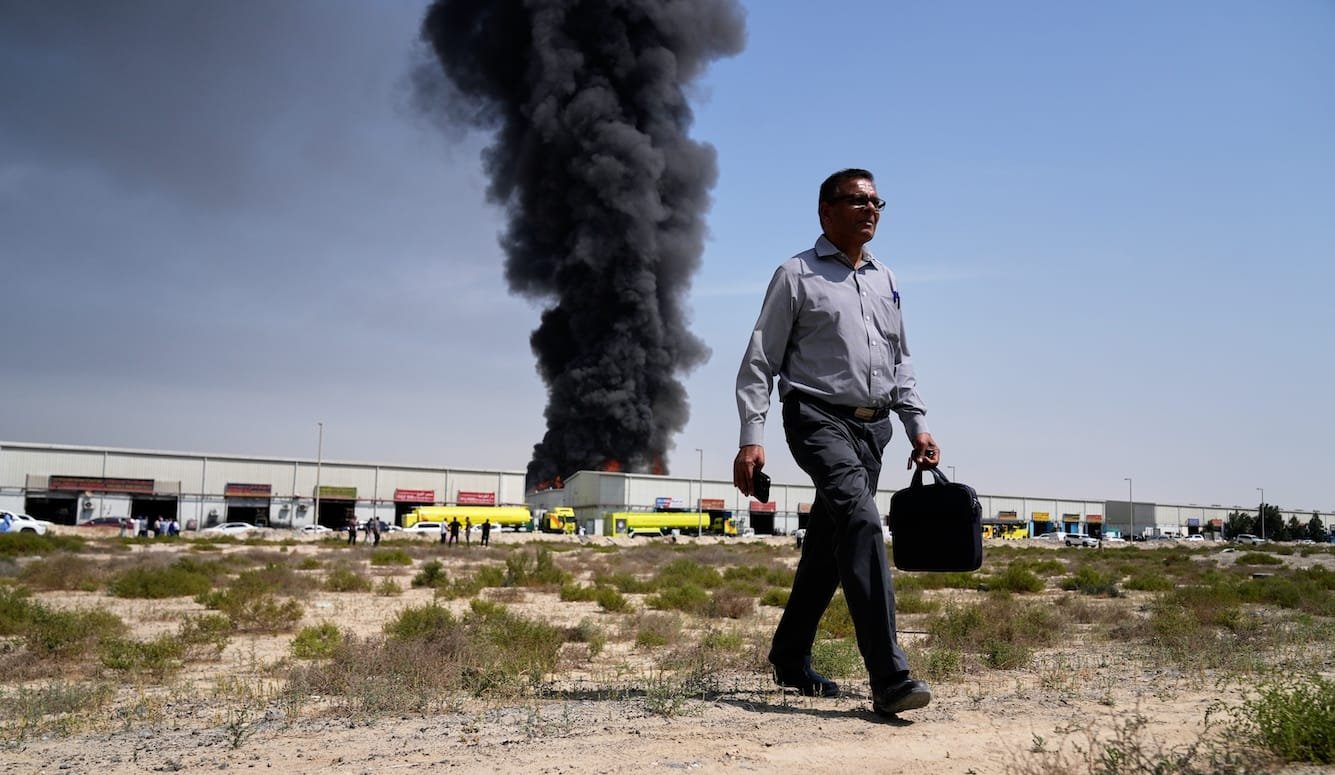
I took off from Dubai twenty minutes before the airspace closed. Flights behind me were rerouted north through Dammam as the skies over the Gulf contracted in real time. By the time I landed in London, my phone was convulsing with missed calls, along with clips of intercepts and burning infrastructure. Dubai International, the world’s busiest airport for international traffic with 90 million passengers a year, suspended all flights, stranding 20,000 souls and costing an estimated US$100 million in losses per day. Jebel Ali port fires snarled twenty percent of regional container traffic and global shipping rates spiked fifteen percent overnight. In Abu Dhabi, drone debris at Zayed Airport killed one and injured seven. The Burj Al Arab hotel and Fairmont on the Palm both blazed, and black smoke billowed over Palm Jumeirah. Explosions rocked Manama’s commercial districts.
This was not random terror. It was a deliberate strike at the Gulf’s economic nervous system, where tourism accounts for thirteen percent of UAE GDP and logistics underpin 39 percent of the Saudi non-oil economy. More importantly, this was also an assault on the Islamic Republic’s antithesis. The UAE has built a defiant alternative to the region’s permanent ideological war: a hypermodern oasis that quarantines extremism at the border and offers millions an Arabic-and-English-speaking sanctuary where families can live and let live. Dubai is proof that another Middle East, peaceful and prosperous, is possible.
In the past 56 hours alone, the UAE recorded 174 incoming ballistic missiles, 689 drones, and two cruise missiles. Most were intercepted, yet the barrage was still lethal enough to kill three civilians (Pakistani, Nepalese, Bangladeshi), wound 58 people from fifteen nationalities, and send every school online. The Emirates absorbed roughly half the total volume. Thirteen missiles and thirty-five drones got through. One drone was downed near the compound housing the Israeli embassy. Shrapnel fires spread into homes and offices, terror magnified far beyond what was imaginable.
Against this background, the Iranian regime’s centre seemed to disintegrate. Foreign Minister Abbas Araghchi’s astonishing admission that strikes on Oman were “not our choice” and that units are now firing on “pre-set instructions” is the unmistakable sound of a system in free-fall. Simultaneous attacks across ten countries in hours indicate the execution of a pre-authorised plan rather than real-time direction from Tehran. The implication is grim: even if surviving regime figures wished to stand down the military offensive, the command and control mechanism may no longer exist. In this activation of doomsday protocol, nothing should surprise us.
What emerges from this fire is not endless chaos but the genuine possibility of sustainable peace: an Abrahamic security order built on mutual deterrence, shared prosperity, and the final defeat of genocidal revolutionary ideology.
Iran began this round of hostilities with perhaps 1,000–1,200 ballistic missiles, their stocks already depleted by prior Israeli strikes on solid-fuel lines. Launches will likely continue until the shelves are bare, and the war may not end at the negotiating table. It will end in a few weeks—perhaps a month or two—when the arsenals run dry. The longer it burns, the more Hezbollah, the Houthis, and every IRGC node will be exposed to relentless coalition fire. Hezbollah’s fresh northern barrage of fifty rockets, fired at Kiryat Shmona from the Golan, has already triggered Israeli lasers that knock missiles out of the sky at launch and a firm response from the IDF calling it “a big mistake.” Today’s strikes on Saudi Aramco signal that full Houthi activation may be about to follow. Escalation is the trajectory. However, escalation is also the path to decisive victory. The more Iran throws its axis into the fight, the more every node, from IRGC command centres to Hezbollah depots and Houthi launch sites, becomes a target. What emerges from this fire is not endless chaos but the genuine possibility of sustainable peace: an Abrahamic security order built on mutual deterrence, shared prosperity, and the final defeat of genocidal revolutionary ideology.
Read the full article here
Fact Checker
Verify the accuracy of this article using AI-powered analysis and real-time sources.