

 Freedom Index
Listen to the article
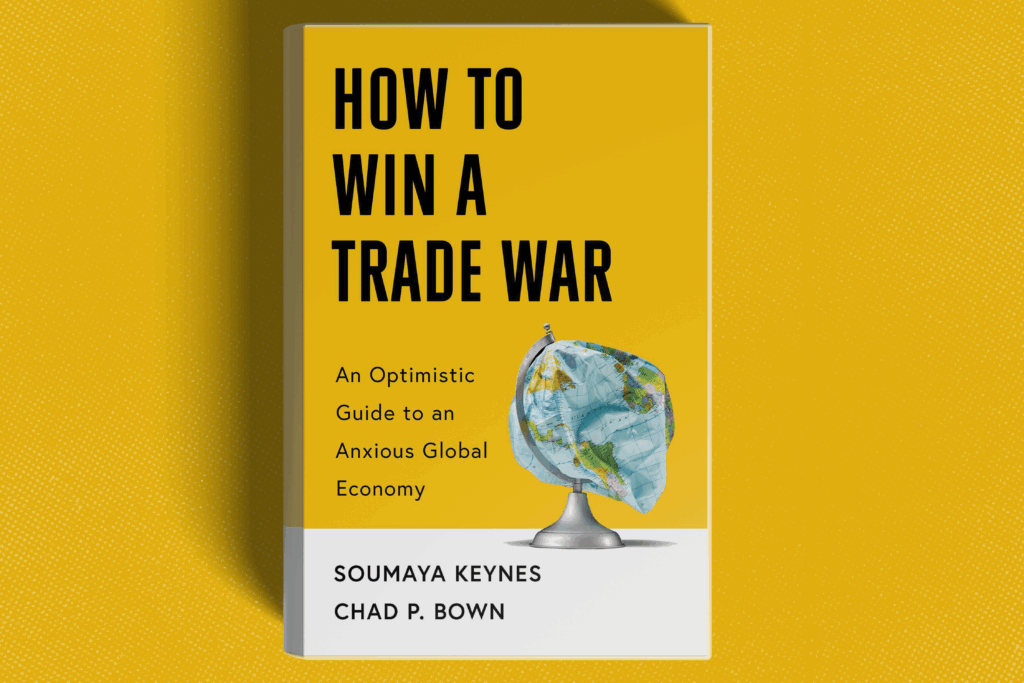
How To Win a Trade War: An Optimistic Guide to an Anxious Global Economy, by Soumaya Keynes and Chad Bown, Simon & Schuster, 288 pages, $30
The ancient Chinese military strategist Sun Tzu advised that “he who wishes to fight must first count the cost.” Joshua, the brilliant (for its time) computer in the 1983 film WarGames, did the counting and concluded that “the only winning move is not to play.”
Both lines find their way into How To Win a Trade War. This is no arid academic analysis, and it does not read like one. Instead, Soumaya Keynes, a journalist at the Financial Times, and Chad Bown, a senior fellow at the Peterson Institute for International Economics, have crafted a witty, fast-paced analysis of how the global trading system has unraveled in the aftermath of COVID, Brexit, and (most importantly) President Donald Trump’s electoral successes.
The book’s greatest strength is its accessibility. Trade policy can be difficult to explain and boring to read. How To Win a Trade War is neither difficult nor boring, as Keynes and Bown use a plethora of analogies both to guide the reader and to insert their perspective. Trade is like dancing, trade deficits are like video game consoles, and tariffs are like marijuana. OK, libertarians might object to that last one, but their point is that even when tariffs feel good, they inevitably obscure reality, cost money, and make you (or your economy, at least) more lethargic.
Or take the populist obsession with the idea that global trade has hollowed out America’s economy. “When a country has an unemployment rate of only 4 percent,” as the U.S. does, complaining that trade is responsible for a massive economic displacement is “a bit like a toddler screaming that he wants an apple when he quite clearly already has one in his hand.” That’s not the only time the authors analogize Trump’s behavior to that of Keynes’ young children.
The book’s most useful analogy may be the recurring motif that imagines the major players in the global trade wars as vessels making their way across the oceans. America used to be a naval ship, offering security and stability for the global order. It’s now being sailed by pirates—untrustworthy, potentially dangerous to friend and foe alike, and guided solely by short-term self-interest. China, meanwhile, is a warship eagerly brandishing its big guns. Europe is a cobbled-together merchant ship with little muscle, trying its best to keep the pirates and warriors happy at a distance. India is a boat built from an old car. (That last one makes more sense in context.)
Despite all the talk of pirates and toddlers, Keynes and Bown have more sympathy for America’s role in the trade wars than you might expect. While many observers have written off Trump’s obsession with America’s trade deficit as just a character flaw or evidence of his economic illiteracy, the authors argue that the U.S.-China relationship has become dangerously unbalanced.
That’s partially because America’s government has borrowed too heavily. But Keynes and Bown largely blame China.
China’s authoritarian regime has broken many of the price signals that should regulate markets, they argue in the book’s most compelling chapter. Normally, overproduction of industrial goods would cause prices to fall, harming profits and driving less efficient producers out of business. “But in China’s case, this mechanism can malfunction. When demand weakens, its system is bad at letting businesses fail” because local and national officials have a strong incentive to prop up underperforming companies. That willingness to burn cash in order to overpower price signals, along with China’s increasing desire to dictate trading terms to its partners (see the warship analogy), have created the conditions for the current mess. America’s response has been haphazard and often confuses friends for foes, but China, they say, is still ultimately to blame.
In examining the tactics and strategies of a trade war, Keynes and Bown evaluate subsidies, tariffs, and stockpiles (including a lengthy analogy drawn from the lessons of doomsday preppers on Reddit), while weighing the pros and cons of each.
They are skeptical of sweeping conclusions, and they encourage prospective trade warriors to think carefully about the long-term and possibly unintended consequences of any major interventions, as well as to focus their energies on industries that truly matter for national security. “You might be able to control how an economic weapon is deployed, but certainly not how the target responds,” they warn. In the same vein, governments cannot always control how domestic businesses will react. Hence, “these economic tools can be unwieldy, blunt, and prone to abuse.”
That approach occasionally comes across as working too hard to balance differing viewpoints. For a book that promises a “how to,” this offers few definitive conclusions. The authors do promise that the book is not meant to be “an ideological defense of free trade,” and they are right to advise policymakers to have more humility about what can be accomplished with various blunt instruments. Even so, I would have preferred a more pointed take on how various economic interventions often harm the people they are meant to help.
The one verdict that Keynes and Bown do deliver, repeatedly, is that there will be no return to the world of the late 20th and early 21st centuries, when a (mostly) stable set of rules guided the global trading system. The two authors may wish that Trump and other world leaders were more willing to take Joshua’s advice about not starting wars, but they are resigned to the fact that “trade wars are the new normal.”
“We worry,” they write, “that China’s system is so different from those of its competitors that there isn’t space for a common rules-based system” in the model of the World Trade Organization, whose influence has waned considerably. Meanwhile, “another challenge is that to work well, the rules rely on trust,” they write. The unspoken addendum: It is hard to trust pirates or toddlers.
Indeed, the sunny and lighthearted tone of the writing only barely masks the authors’ rather pessimistic view of the current situation. Even when they engage in a few flights of fantasy in the book’s final chapter—which imagines how the global trading system might look in 2050—the options veer between a Chinese-dominated reality and one where the U.S. has integrated “economic and security statecraft.” It’s hardly a vision for freer markets, either way.
Still, the alternative might be worse. “If we manage to avoid World War III, we all deserve a pat on the back,” Keynes and Bown conclude. The “winner” of the trade war might simply be “the team that loses less than a rival, or simply the one most adept at minimizing its own wounds.”
The book captures the anxiety that seems to be the defining mood of the moment. Old assumptions about globalization are no longer secure, but there’s no clarity about what might replace that order. Keynes and Bown want their readers to understand that there is nothing to be gained by wishing for the past to return, and that we should cheerfully (if not eagerly) try to find the best path forward.
How To Win a Trade War is not really about winning at all. It is, per Sun Tzu, about understanding the cost of the fight.
Read the full article here
Fact Checker
Verify the accuracy of this article using AI-powered analysis and real-time sources.