

 Freedom Index

Listen to the article
Key takeaways:
-
AI can process massive onchain data sets instantly, flagging transactions that surpass predefined thresholds.
-
Connecting to a blockchain API allows real-time monitoring of high-value transactions to create a personalized whale feed.
-
Clustering algorithms group wallets by behavioral patterns, highlighting accumulation, distribution or exchange activity.
-
A phased AI strategy, from monitoring to automated execution, can give traders a structured edge ahead of market reactions.
If you’ve ever stared at a crypto chart and wished you could see the future, you’re not alone. Big players, also known as crypto whales, can make or break a token in minutes, and knowing their moves before the masses do can be a game-changer.
In August 2025 alone, a Bitcoin whale’s sale of 24,000 Bitcoin (BTC), valued at almost $2.7 billion, caused a flash fall in the cryptocurrency markets. In just a few minutes, the crash liquidated over $500 million in leveraged bets.
If traders knew that in advance, they could hedge positions and adjust exposure. They might even enter the market strategically before panic selling drives prices lower. In other words, what could have been chaotic would then become an opportunity.
Fortunately, artificial intelligence is providing traders with tools that can flag anomalous wallet activity, sort through mounds of onchain data, and highlight whale patterns that may hint at future moves.
This article breaks down various tactics used by traders and explains in detail how AI may assist you in identifying upcoming whale wallet movements.
Onchain data analysis of crypto whales with AI
The simplest application of AI for whale spotting is filtering. An AI model can be trained to recognize and flag any transaction above a predefined threshold.
Consider a transfer worth more than $1 million in Ether (ETH). Traders usually track such activity through a blockchain data API, which delivers a direct stream of real-time transactions. Afterward, simple rule-based logic can be built into the AI to monitor this flow and pick out transactions that meet preset conditions.
The AI might, for example, detect unusually large transfers, movements from whale wallets or a mix of both. The result is a customized “whale-only” feed that automates the first stage of analysis.
How to connect and filter with a blockchain API:
Step 1: Sign up for a blockchain API provider like Alchemy, Infura or QuickNode.
Step 2: Generate an API key and configure your AI script to pull transaction data in real time.
Step 3: Use query parameters to filter for your target criteria, such as transaction value, token type or sender address.
Step 4: Implement a listener function that continuously scans new blocks and triggers alerts when a transaction meets your rules.
Step 5: Store flagged transactions in a database or dashboard for easy review and further AI-based analysis.
This approach is all about gaining visibility. You’re not just looking at price charts anymore; you’re looking at the actual transactions that drive those charts. This initial layer of analysis empowers you to move from simply reacting to market news to observing the events that create it.
Behavioral analysis of crypto whales with AI
Crypto whales are not just massive wallets; they are often sophisticated actors who employ complex strategies to mask their intentions. They don’t typically just move $1 billion in one transaction. Instead, they might use multiple wallets, split their funds into smaller chunks or move assets to a centralized exchange (CEX) over a period of days.
Machine learning algorithms, such as clustering and graph analysis, can link thousands of wallets together, revealing a single whale’s full network of addresses. Besides onchain data point collection, this process may involve several key steps:
Graph analysis for connection mapping
Treat each wallet as a “node” and each transaction as a “link” in a massive graph. Using graph analysis algorithms, the AI can map out the entire network of connections. This allows it to identify wallets that may be connected to a single entity, even if they have no direct transaction history with each other.
For example, if two wallets frequently send funds to the same set of smaller, retail-like wallets, the model can infer a relationship.
Clustering for behavioral grouping
Once the network has been mapped, wallets with comparable behavioral patterns could be grouped using a clustering algorithm like K-Means or DBSCAN. The AI can identify groups of wallets that display a pattern of sluggish distribution, large-scale accumulation or other strategic actions, but it has no idea what a “whale” is. The model “learns” to recognize whale-like activity in this way.
Pattern labeling and signal generation
Once the AI has grouped the wallets into behavioral clusters, a human analyst (or a second AI model) can label them. For example, one cluster might be labeled “long-term accumulators” and another “exchange inflow distributors.”
This turns the raw data analysis into a clear, actionable signal for a trader.
AI reveals hidden whale strategies, such as accumulation, distribution or decentralized finance (DeFi) exits, by identifying behavioral patterns behind transactions rather than just their size.
Advanced metrics and the onchain signal stack
To truly get ahead of the market, you must move beyond basic transaction data and incorporate a broader range of onchain metrics for AI-driven whale tracking. The majority of holders’ profit or loss is indicated by metrics such as spent output profit ratio (SOPR) and net unrealized profit/loss (NUPL), with significant fluctuations frequently indicating trend reversals.
Inflows, outflows and the whale exchange ratio are some of the exchange flow indicators that show when whales are heading for selling or moving toward long-term holding.
By integrating these variables into what is often referred to as an onchain signal stack, AI advances beyond transaction alerts to predictive modeling. Rather than responding to a single whale transfer, AI examines a combination of signals that reveals whale behavior and the overall positioning of the market.
With the help of this multi-layered view, traders may see when a significant market move might be developing early and with greater clarity.
Did you know? In addition to detecting whales, AI can be used to improve blockchain security. Millions of dollars in hacker damages can be avoided by using machine learning models to examine smart contract code and find vulnerabilities and possible exploits before they are implemented.
Step-by-step guide to deploying AI-powered whale tracking
Step 1: Data collection and aggregation
Connect to blockchain APIs, such as Dune, Nansen, Glassnode and CryptoQuant, to pull real-time and historical onchain data. Filter by transaction size to spot whale-level transfers.
Step 2: Model training and pattern identification
Train machine learning models on cleaned data. Use classifiers to tag whale wallets or clustering algorithms to uncover linked wallets and hidden accumulation patterns.
Step 3: Sentiment integration
Layer in AI-driven sentiment analysis from social media platform X, news and forums. Correlate whale activity with shifts in market mood to understand the context behind big moves.
Step 4: Alerts and automated execution
Create real-time notifications using Discord or Telegram, or take it a step further with an automated trading bot that makes trades in response to whale signals.
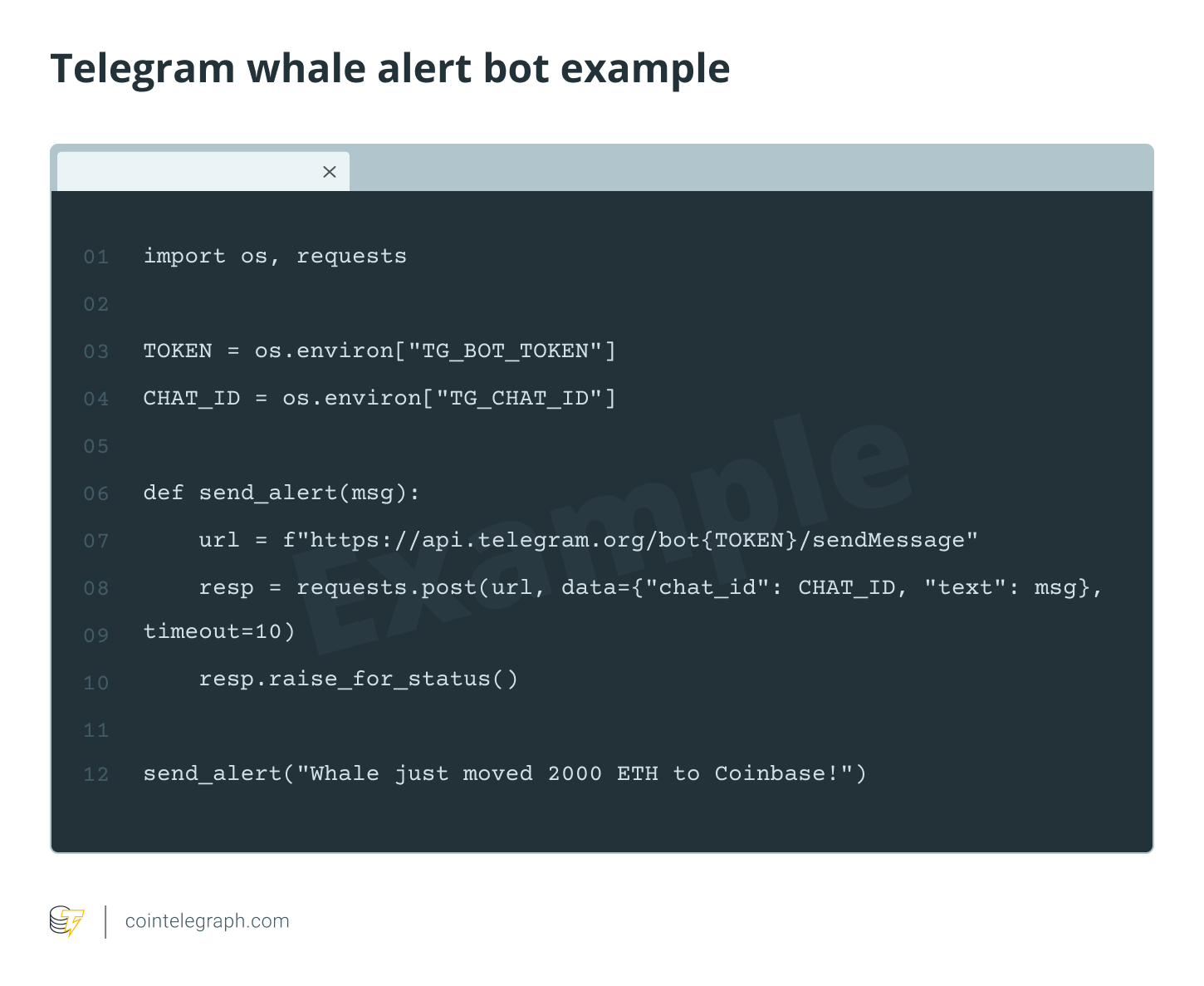
From basic monitoring to complete automation, this phased strategy provides traders with a methodical way to obtain an advantage before the overall market responds.
This article does not contain investment advice or recommendations. Every investment and trading move involves risk, and readers should conduct their own research when making a decision.
Read the full article here
Fact Checker
Verify the accuracy of this article using AI-powered analysis and real-time sources.