Close Menu
FSNN | Free Speech News NetworkFSNN | Free Speech News Network
  • Home
  • News
    • Politics
    • Legal & Courts
    • Tech & Big Tech
    • Campus & Education
    • Media & Culture
    • Global Free Speech
  • Opinions
    • Debates
  • Video/Live
  • Community
  • Freedom Index
  • About
    • Mission
    • Contact
    • Support
Trending

A massive stablecoin fragmentation war is brewing between tech giants and a startup is aiming to capitalize on it

52 minutes ago

Legacy crypto on-ramps and bridges will disappear as payments become invisible, Fun CEO says

2 hours ago

Strategy Holds Preferred STRC Dividend at 12% as Price Still Below Par

2 hours ago
Facebook X (Twitter) Instagram
Facebook X (Twitter) Discord Telegram
FSNN | Free Speech News NetworkFSNN | Free Speech News Network
Market Data Newsletter
Sunday, August 2
  • Home
  • News
    • Politics
    • Legal & Courts
    • Tech & Big Tech
    • Campus & Education
    • Media & Culture
    • Global Free Speech
  • Opinions
    • Debates
  • Video/Live
  • Community
  • Freedom Index
  • About
    • Mission
    • Contact
    • Support
FSNN | Free Speech News NetworkFSNN | Free Speech News Network
Home»AI & Censorship»How to File a Privacy Complaint in California
AI & Censorship

How to File a Privacy Complaint in California

News RoomBy News Room10 months agoNo Comments4 Mins Read1,598 Views
Share Facebook Twitter Pinterest Copy Link LinkedIn Tumblr Email VKontakte Telegram
How to File a Privacy Complaint in California
Share
Facebook Twitter Pinterest Email Copy Link

Listen to the article

0:00
0:00

Key Takeaways

Playback Speed

Select a Voice

Privacy laws are only as strong as their enforcement. In California, the state’s privacy agency recently issued its largest-ever fine for violation of the state’s privacy law—and all because of a consumer complaint.

The state’s  privacy law, the California Consumer Privacy Act or CCPA, requires many companies to respect California customers’ and job applicants’ rights to know, delete and correct information that businesses collect about them, and to opt-out of some types of sharing and use. It also requires companies to give notice of these rights, along with other information, to customers, job applicants, and others. (Bonus tip: Have a complaint about something else, such as a data breach? Go to the CA Attorney General.)

If you’re a Californian and think a business isn’t obeying the law, then the best thing to do is tell someone who can do something about it. How? It’s easy. In fewer than a dozen questions, you can share enough information to get the agency started.

Start With the Basics

First, head to the California Privacy Protection Agency’s website at cppa.ca.gov. On the front page, you’ll see an option to “File a Complaint.” Click on that option.

That button takes you to the online complaint form. You can also print out the agency’s paper complaint form here.
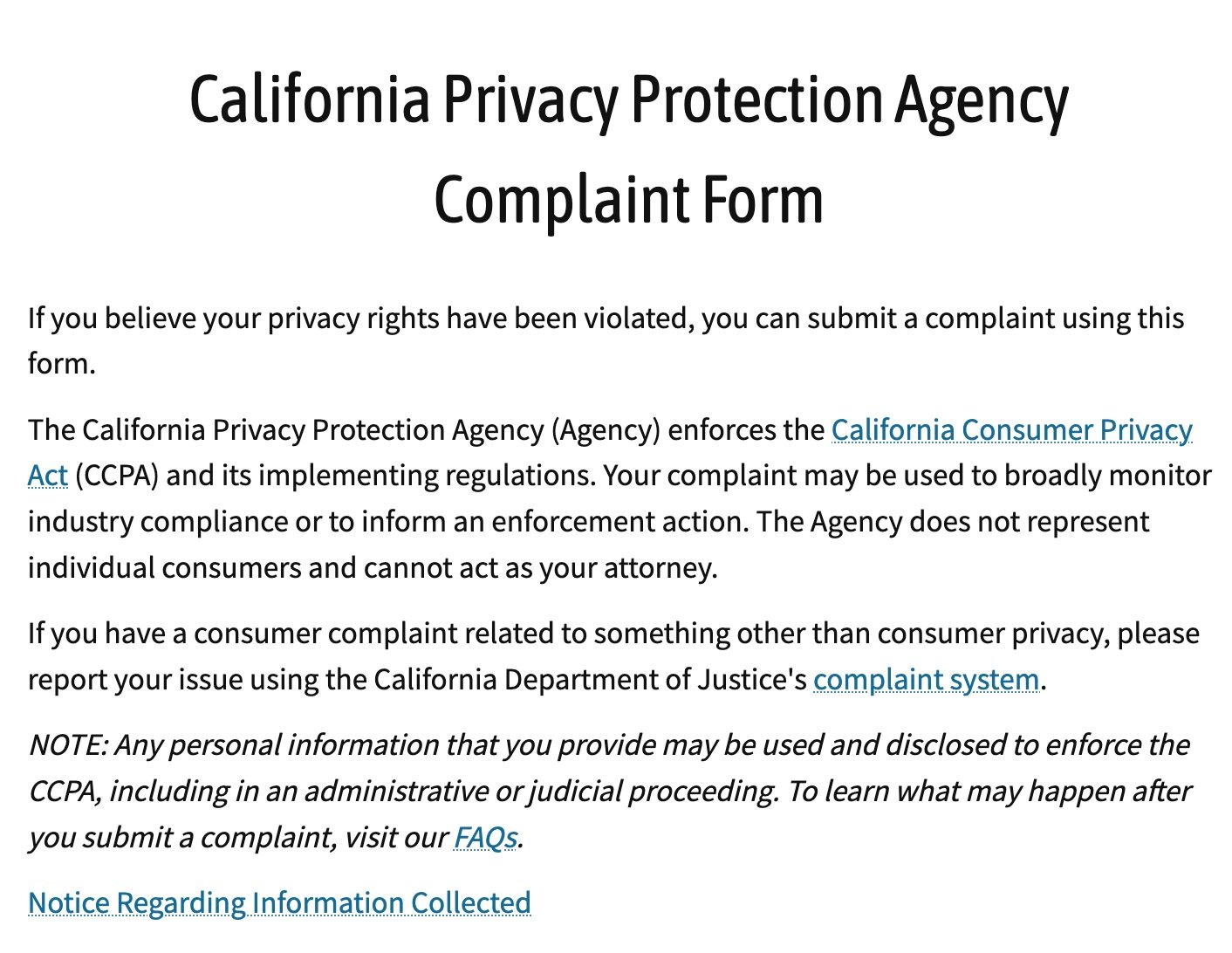
A screenshot of the CPPA's complaint page. It explains the agency's privacy policy.

The complaint form starts, fittingly, by explaining the agency’s own privacy practices. Then it gets down to business by asking for information about your situation.

The first question offers a list of rights people have under the CCPA, such as a right to delete or a right to correct sensitive personal information. So, for example, if you’ve asked ABC Company to delete your information, but they have refused, you’d select “Right to Delete.” This helps the agency categorize your complaint and tie it directly to the requirements in the law.  The form then asks for the names of businesses, contractors, or people you want to report.

It also asks whether you’re a California resident. If you’re unsure, because you split residency or for other reasons, there is an “Unsure” option.

Adding the Details

From there, the form asks for more detailed information about what’s happened. There is a character limit on this question, so you’ll have to choose your words carefully. If you can, check out the agency’s FAQ on how to write a successful complaint before you submit the form. This will help you be specific and tell the agency what they need to hear to act on your complaint.
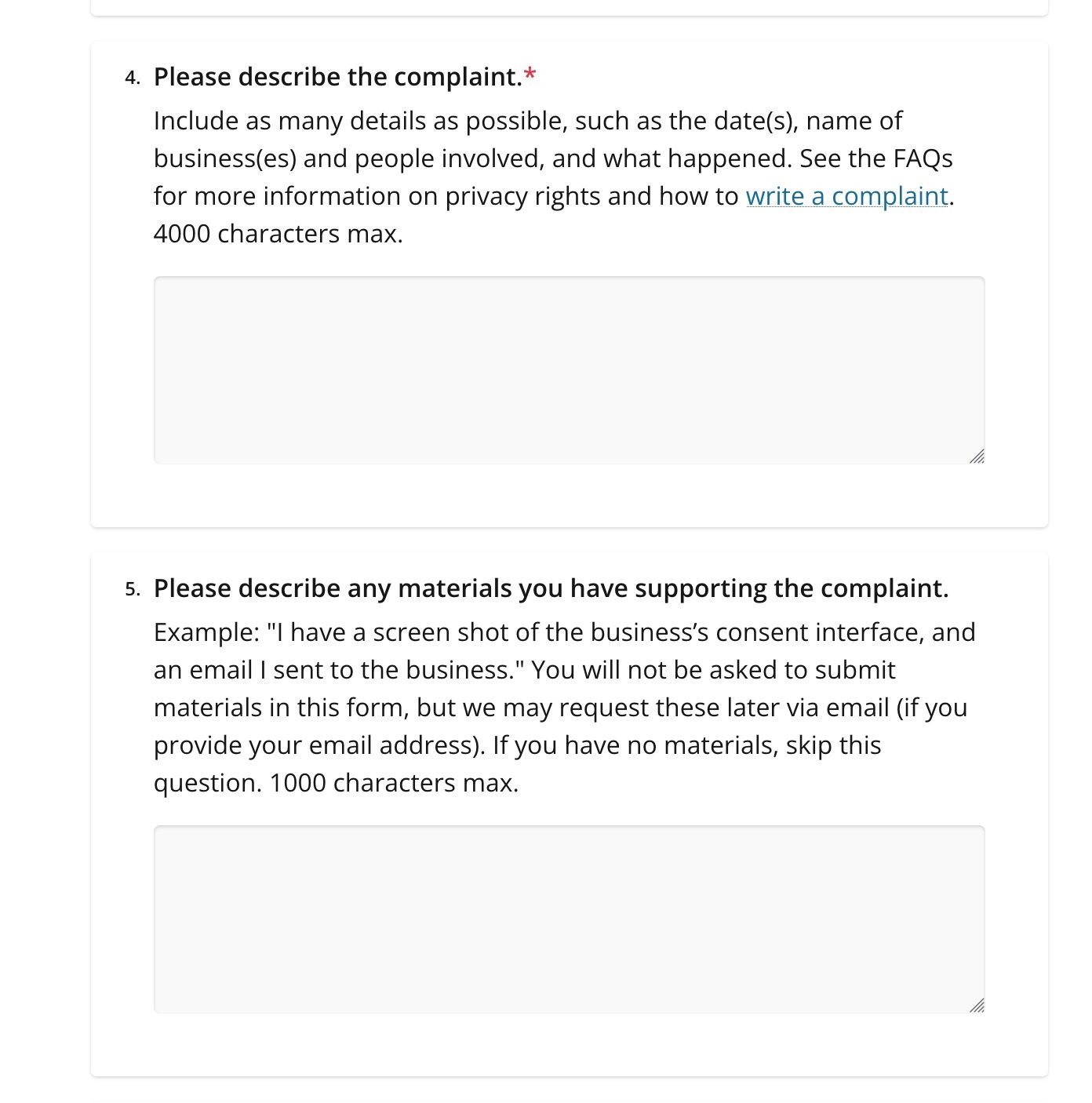
In the next question, include information about any proof you have supporting your complaint. So, for example, you could tell the agency you have your email asking ABC Company to delete your information, and also a screenshot of proof that they haven’t erased it. Or, say “I spoke to a person on the phone on this date.” This should just be a list of information you have, rather than a place to paste in emails or attach images.

The form will also ask if you’ve directly contacted the business about your complaint. You can just answer yes or no to this question. If it’s an issue such as a company not posting a privacy notice, or something similar, it may not have made sense to contact them directly. But if you made a deletion request, you probably have contacted them about it.

Anonymous or Not?

Finally, the complaint form will ask you to make either an “unsworn complaint” or a “sworn complaint.” This choice affects how you’ll be involved in the process going forward. You can file an anonymous unsworn complaint. But that will mean the agency can’t contact you about the issue in the future, since they don’t have any of your information.A screenshot of the CCPA's complaint page. This part of the form askes if you'd like to make a sworn or unsworn statement.
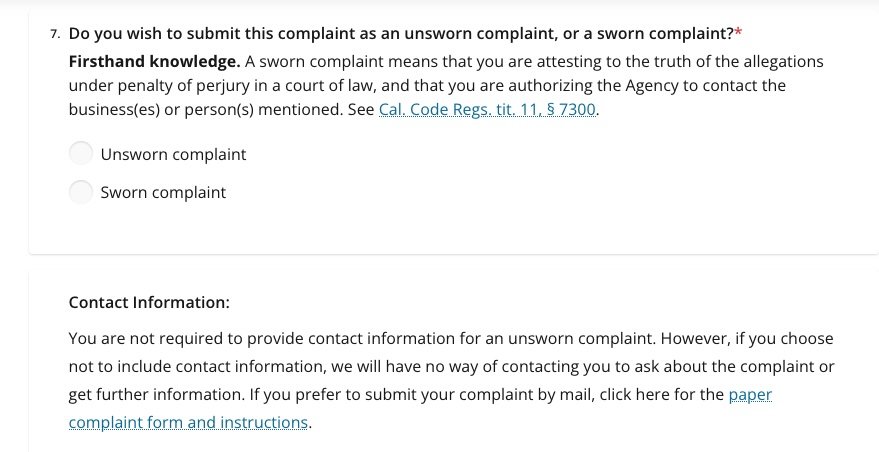
For a sworn complaint, you have to provide some contact information and confirm that what you’re saying is true and that you’d swear to it in court.

Just because you submit contact information, that doesn’t mean the agency will contact you. Investigations are usually confidential, until there’s something like a settlement to announce. But we’ve seen that consumer complaints can be the spark for an investigation. It’s important for all of us to speak up, because it really does make a difference.

Read the full article here

Fact Checker

Verify the accuracy of this article using AI-powered analysis and real-time sources.

Get Your Fact Check Report

Enter your email to receive detailed fact-checking analysis

5 free reports remaining

Continue with Full Access

You've used your 5 free reports. Sign up for unlimited access!

Already have an account? Sign in here

Share. Facebook Twitter Pinterest LinkedIn Tumblr Email Telegram Copy Link
News Room
  • Website
  • Facebook
  • X (Twitter)
  • Instagram
  • LinkedIn

The FSNN News Room is the voice of our in-house journalists, editors, and researchers. We deliver timely, unbiased reporting at the crossroads of finance, cryptocurrency, and global politics, providing clear, fact-driven analysis free from agendas.

Related Articles

Media & Culture

This Week In Techdirt History: July 26th – August 1st

22 hours ago
Media & Culture

RFK Jr., Who Is Definitely Not Checked Out Of His Job, To Host A Cooking Show

2 days ago
Media & Culture

What Ukraine’s Battlefield Openness Can Teach Washington About AI Access

2 days ago
AI & Censorship

The SCREEN Act Threatens Privacy Far Beyond Adult Websites

2 days ago
AI & Censorship

Amending AB 1709 Doesn’t Fix It: California’s Social Media Ban Still Threatens Free Speech and Privacy

2 days ago
Media & Culture

Ctrl-Alt-Speech: Zuck Starts Throwing His Weights Around

2 days ago
Add A Comment

Comments are closed.

Editors Picks

Legacy crypto on-ramps and bridges will disappear as payments become invisible, Fun CEO says

2 hours ago

Strategy Holds Preferred STRC Dividend at 12% as Price Still Below Par

2 hours ago

What’s the Deal With Meta’s ‘Pervert Glasses’?

2 hours ago

Unlike the FTX collapse, the $89 million Coldcard exploit has investors sending bitcoin back to exchanges

4 hours ago
Latest Posts

Crypto meets Wall Street using perps

5 hours ago

Today in Supreme Court History: August 2, 1923

6 hours ago

BNB Chain pursues legal action after ex-employee’s memecoin launch

6 hours ago

Subscribe to News

Get the latest news and updates directly to your inbox.

At FSNN – Free Speech News Network, we deliver unfiltered reporting and in-depth analysis on the stories that matter most. From breaking headlines to global perspectives, our mission is to keep you informed, empowered, and connected.

FSNN.net is owned and operated by GlobalBoost Media
, an independent media organization dedicated to advancing transparency, free expression, and factual journalism across the digital landscape.

Facebook X (Twitter) Discord Telegram
Latest News

A massive stablecoin fragmentation war is brewing between tech giants and a startup is aiming to capitalize on it

52 minutes ago

Legacy crypto on-ramps and bridges will disappear as payments become invisible, Fun CEO says

2 hours ago

Strategy Holds Preferred STRC Dividend at 12% as Price Still Below Par

2 hours ago

Subscribe to Updates

Get the latest news and updates directly to your inbox.

© 2026 GlobalBoost Media. All Rights Reserved.
  • Privacy Policy
  • Terms of Service
  • Our Authors
  • Contact

Type above and press Enter to search. Press Esc to cancel.

🍪

Cookies

We and our selected partners wish to use cookies to collect information about you for functional purposes and statistical marketing. You may not give us your consent for certain purposes by selecting an option and you can withdraw your consent at any time via the cookie icon.

Cookie Preferences

Manage Cookies

Cookies are small text that can be used by websites to make the user experience more efficient. The law states that we may store cookies on your device if they are strictly necessary for the operation of this site. For all other types of cookies, we need your permission. This site uses various types of cookies. Some cookies are placed by third party services that appear on our pages.

Your permission applies to the following domains:

  • https://fsnn.net
Necessary
Necessary cookies help make a website usable by enabling basic functions like page navigation and access to secure areas of the website. The website cannot function properly without these cookies.
Statistic
Statistic cookies help website owners to understand how visitors interact with websites by collecting and reporting information anonymously.
Preferences
Preference cookies enable a website to remember information that changes the way the website behaves or looks, like your preferred language or the region that you are in.
Marketing
Marketing cookies are used to track visitors across websites. The intention is to display ads that are relevant and engaging for the individual user and thereby more valuable for publishers and third party advertisers.