

 Freedom Index
Listen to the article
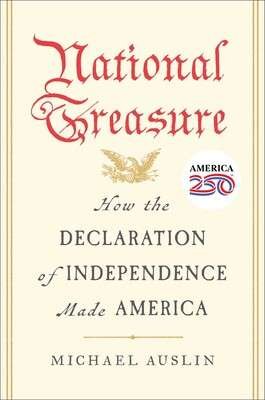
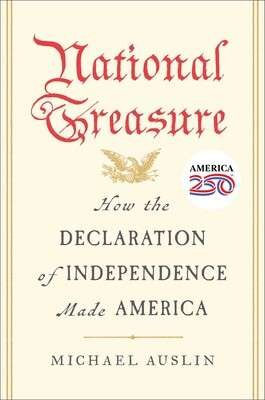
[This post is excerpted from the new book, National Treasure: How the Declaration of Independence Made America (Avid Reader Press/Simon & Schuster).]
That Abraham Lincoln, our most American of presidents, “never had a feeling politically that did not spring from the sentiments embodied in the Declaration of Independence,” our most American of documents, seems only appropriate. That Lincoln was both a political philosopher and political genius may be enough to explain why the lanky rail-splitter from Illinois repeatedly invoked the Declaration, even before entering the political arena and when he had no expectations of returning to political office. Like his contemporaries, however, Lincoln grew up surrounded by images of the Declaration, keeping it a living document in the minds of Americans. In this 250th year of Independence, understanding the Declaration’s prevalence as a cultural and material object in the first half of the 19th century may help explain how, after decades of relative obscurity, it became the undisputed expression of the American creed that we celebrate today.
The quote that opened this post is from Lincoln’s speech at Independence Hall, on February 22, 1861. Traveling by train from his home in Springfield, Illinois, Lincoln stopped in Philadelphia to address a crowd at the spot where the Declaration was signed. By now, with the Confederate States of America established, with their capital in Montgomery, Alabama, the Declaration was at the center of the great crisis that had been brewing at least since the Missouri Compromise of 1820, and more accurately, since July 4, 1776. By 1861, references and appeals to the Declarations principles came not just from the Republican president-elect, but from Confederate President Jefferson Davis and his Vice-President Alexander Stephens, in newspapers and polemicists in North and South. Though secession was a constitutional crisis, arguments both pro and con were infused with the spirit of the Declaration.
Such prominence for the Declaration would have surprised second-generation Americans. To them, the Declaration was a relic of the Revolution, an honored but largely ignored document. It had done its job announcing the Colonies’ separation from Great Britain; after that, the job of governing was the preserve first of the Articles of Confederation and then the Constitution. In the first decade of the 19th century, John Adams’ Federalists forbore from honoring the Declaration on July 4, while Thomas Jefferson’s Democratic-Republicans celebrated both the document and its drafter. Few on either side, however, saw it as having much of a role to play in an America a full generation away from Independence.
A closer sense of connection to the Declaration began after the War of 1812 and the near-miraculous rescue of the Declaration from the British during the invasion of Washington in August 1814. Saved from the flames that gutted the White House and incinerated the State Department building next door, the Declaration from the mid-1810s was covered in an aura of reverence, both for its survival and as the symbol of a young nation that had now twice defeated the greatest empire on earth. Yet few Americans had ever seen the Declaration beyond occasional reprints of its text in newspapers or collections of documents. The lucky ones who had actually seen the engrossed parchment signed by the Founding Fathers starting in August 1776 were but a handful of the population.
All that began to change in 1818. That year, when Abraham Lincoln was but nine years old, the first artistic reproduction of the Declaration went on sale. Created by Washington calligrapher Benjamin Owen Tyler, the facsimile so expertly reproduced the signatures of the members of the Continental Congress that the Secretary of State attested to their perfection. The next year an even more elaborate version was offered by John Binns, who had first proposed a facsimile, but took so long to bring his to market that he was beaten to the punch by Owen. The full-size prints brought to Americans for the first time an artistic interpretation of the document that remained hidden in the State Department library.
The same year that Tyler’s reproduction went on sale, John Trumbull’s masterpiece, The Declaration of Independence was first shown to the public. The massive painting, 18 by 30 feet, fancifully depicted the moment that Thomas Jefferson and the Committee of Five presented their draft of the Declaration to John Hancock and the Continental Congress. The original was hung in the Rotunda of the U.S. Capitol in 1826, where it has remained since. Soon available in both quality and inexpensive versions, Trumbull’s heroic vision of the birth of the United States became perhaps the most famous American painting of the 19th century, sold widely throughout the country.
As fascination with the Declaration grew, the parchment itself was beginning to deteriorate from mishandling. In 1820, Secretary of State John Quincy Adams commissioned engraver William J. Stone to create an exact facsimile, something neither Binns nor Tyler had attempted. Stone labored for three years, and in 1823 his copperplate engraving was completed. Several hundred parchment copies, followed by more paper copies, were run off and given to national and State officials and other prominent individuals. Though not yet widely available, the Stone Engraving nonetheless became the iconic image of the Declaration, the one from which all future copies would be made.
To the Stone and the various reproductions were now added popular biographies of the Signers of the Declaration, published first by John Sanderson in 1829, but followed by dozens more in succeeding decades. So ubiquitous was the Declaration in American life that a Hungarian visitor to the United States in the early-1830s saw it hung in houses and inns throughout his travels. It was, he noted, “the indispensable furnishing and handbook in the home of every citizen.”
This, then, was the milieu in which Abraham Lincoln grew up. The Declaration was reprinted in school primers and American history books, and biographies of the Signers crowded the shelves, while walls were adorned with replicas of the text and signatures or reprints of John Trumbull’s painting. By the time the actual parchment of the Declaration was put on display in the Patent Office in Washington in 1841, Americans of all classes and regions had brought the document into their homes, schools, and churches.
For many Americans, undoubtedly, facsimiles of the Declaration spurred no more than patriotic pride or interest in an era now all but faded from living memory. But for some, perhaps like Abraham Lincoln, the constant exposure to the Declaration invited a deeper reflection on its imperishable passages and philosophy. Indeed, John Binns himself had written that his “embellished edition…will have a tendency to spread the knowledge of its contents…and familiarize those principles which form, the very bond and cement of political society.”
Thus, it was that a twenty-eight-year-old Lincoln could invoke the Declaration to his listeners at the Young Men’s Lyceum of Springfield in January 1838 in urging them to continue to “uphold the proud fabric of freedom.” And later, when confronted with the moral and legal abominations that were the Kansas-Nebraska Act of 1854 and the 1857 Dred Scott ruling, Lincoln began refashioning the Declaration into a universal and eternal symbol of equality and freedom. With his entire political philosophy derived from the Declaration, Lincoln found the moral courage to link America’s destiny to the end of slavery, though his political pragmatism also recognized, at least until 1861 (and probably later) the limits on such a radical program.
There is, of course, no sure way to know how much of the inspiration for Lincoln’s intellectual engagement came from a material encounter with Declaration reprints, images, and the like. And yet, without the founding charter becoming such a fixture in the American imagination, it is certainly believable that Jefferson’s sonorous phrases may not have penetrated as deeply into the national consciousness, not least into the minds of men like Frederick Douglass, William Lloyd Garrison, and Abraham Lincoln. Nor might it have inspired others, like Elizabeth Cady Stanton, to write their own declarations calling for greater equality and liberty.
It would have been easy to refer to the legal framework of the Constitution, at least in some cases, but the moral argument, the passionate demand for justice, could only be provided by the Declaration. Gazing upon John Trumbull’s heroic scene inside Independence Hall, reading Jefferson’s words on copies hung on walls, reliving the experiences of the Signers, all prepared the American mind for the great struggles to create a more perfect Union. The Declaration is not just its timeless principles, but also its unique material history in American culture. Which, perhaps, is why parents still buy antiqued copies of the Declaration for their children and why we still frame Trumbull’s portrait on our walls. Like Lincoln and his contemporaries, the Declaration remains a living document, calling forth the better angels of our nature. May it continue to do so for another quarter-millennium.
Read the full article here
Fact Checker
Verify the accuracy of this article using AI-powered analysis and real-time sources.