

 Freedom Index
Listen to the article
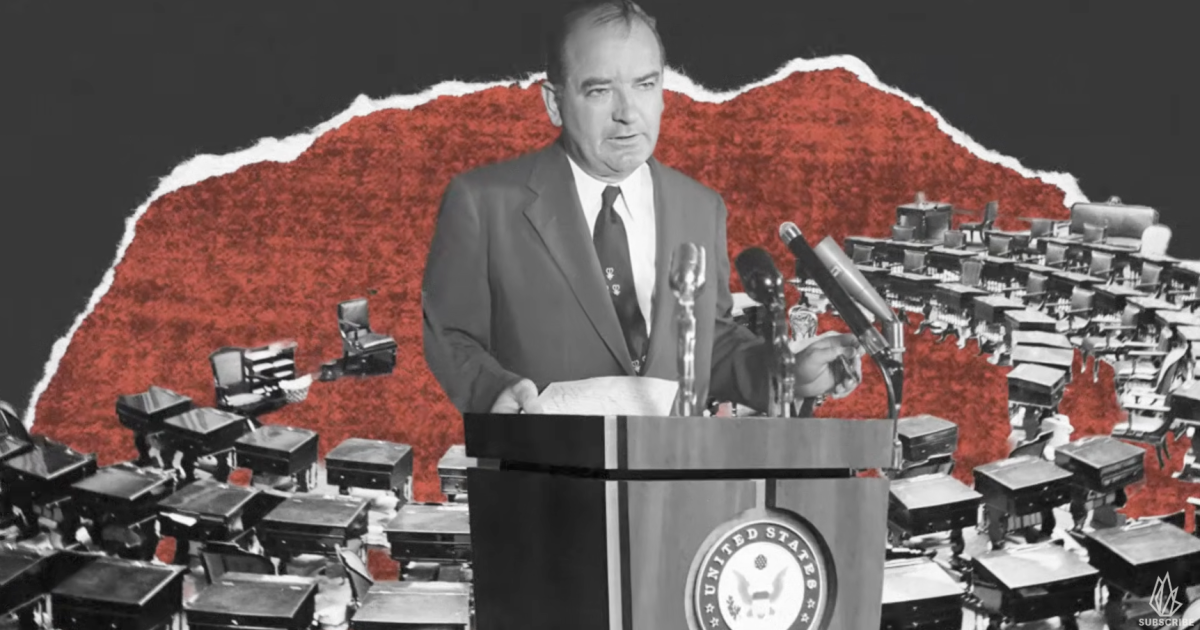
This year, the United States celebrates its 250th anniversary. To commemorate the occasion, FIRE is proud to present the limited series “Figures of Speech,” looking at the heroes and villains of free speech in American history. We begin with Joseph McCarthy, the senator who became our censor-in-chief and gave us a new term for political oppression: McCarthyism.
Senator Joseph McCarthy’s drinking was legendary in Washington. Among the Beltway elite, perhaps only President Ulysses Grant and Sen. Ted Kennedy had better claims to the title of the “Washington drunk.” McCarthy drank so much and so often that he even hid booze in soft-drink bottles, earning himself the nickname “Pepsi-Cola Kid.” Journalists and colleagues described him showing up visibly intoxicated, sometimes before hearings. The irony is almost too on-the-nose for fiction: the face of moral panic in the 1950s was, by many accounts, functioning through a fog of booze and rage.
Born in 1908 to a Catholic farming family, McCarthy started out as a county judge. In 1946, he became a Republican senator by attacking wartime shortages, labor unrest, and Democratic incumbents. But what turned him into a national phenomenon was not a legislative achievement so much as favorable timing. After World War II, the Soviet Union acquired atomic weapons faster than expected, China fell to Mao, and the United States discovered genuine communist spy networks within its borders, made famous by the cases of Klaus Fuchs and Julius and Ethel Rosenberg.
Into this atmosphere McCarthy catapulted himself with a single speech, delivered in 1950 in the steel town of Wheeling, West Virginia. “While I cannot take the time to name all of the men in the State Department who have been named as members of the Communist Party and members of a spy ring,” he declared, “I have here in my hand a list of 205 that were known to the Secretary of State as being members of the Communist Party and who, nevertheless, are still working and shaping the policy in the State Department.”
McCarthy had realized that in a media landscape of headlines and radio clips, allegations mattered more than proof. One could make terrifying accusations, keep them vague, and force everyone else to defend themselves. Social media was decades away, but spiritually, it had already arrived. As chairman of the Senate Permanent Subcommittee on Investigations, he was able to subpoena witnesses, demand loyalty information, and stage nationally publicized hearings. He used public accusation, guilt by association, and theatrical hearings, all amplified through nonstop media attention, to lay the groundwork for America’s Second Red Scare. Today, we refer to it as McCarthyism.
To be clear, there were authentic communist threats to American democracy. In addition to Fuchs and the Rosenbergs passing atomic secrets to the Soviets, there was also the Cambridge Five, British double-agents whose leaks impacted Western intelligence efforts. Kim Philby, one of their members, nearly became head of British intelligence in Washington. Then there was the Silvermaster Group, which had infiltrated U.S. government agencies, including the Treasury, the Board of Economic Warfare, and the White House. But McCarthy himself rarely uncovered major espionage himself, and historians generally agree that his actual investigative record was weak.

Nevertheless, he thrived because many establishment figures feared opposing him outright, and because many were willing to voluntarily do his dirty work for him — by firing people over opinions or, in some cases, over the mere suggestion of opinions that they might have. Universities, Hollywood studios, unions, publishers, and federal agencies often cooperated preemptively, creating blacklists and loyalty reviews to avoid becoming targets. The most damaging feature of McCarthyism was not simply government investigation, but the culture of fear that made institutions abandon free expression without being forced to do so. Newspapers who fired journalists, studios who blacklisted actors.
The irony was this was also how the Soviet Union and the East Germany Stasi operated — through voluntary compliance far more than coercion. Once dissent itself becomes professionally dangerous, formal censorship is almost unnecessary. McCarthy’s chilling effect on American intellectual and cultural life was profound. Teachers lost jobs, diplomats were purged, artists and screenwriters were ostracized, security clearances and publishing contracts were revoked. And often, the crime involved was nothing more than signing a petition, attending a left-wing meeting years before, criticizing U.S. policy, or refusing to name names. Major figures damaged or destroyed by McCarthy’s anti-communist crusade included diplomat and China expert Owen Lattimore, broadcaster Edward R. Murrow (who fought back publicly), playwright Arthur Miller, and countless lesser-known teachers, civil servants, and artists.
The First Amendment remained formally intact throughout the McCarthy era, but constitutional rights on paper proved less meaningful once employers, universities, and cultural institutions decided that controversial speech carried unacceptable risk. What McCarthy demonstrated was how easily a free society can punish expression without ever formally outlawing it. As Judge Learned Hand famously said, “Liberty lies in the hearts of men and women; when it dies there, no constitution, no law, no court can even do much to help it.”
At the peak of his powers, McCarthy seemed invincible. In fact, it seemed the only person who could really bring him down was himself. And that’s exactly what happened. Partly it was his drinking, but the fatal dagger came when he destroyed himself during the televised hearings in 1954. His decisive mistake was attacking the U.S. Army, an institution vastly more trusted than the State Department or Hollywood liberals. The key moment came when he attacked a young lawyer from a prestigious firm with supposed communist associations.
Army counsel Joseph Welch McCarthy had mastered newspaper-era sensationalism, but the televised hearings that made him a national phenomenon also exposed his personal demeanor in ways that print could conceal. It crystallized a growing public realization that his politics depended on endless escalation without moral restraint. Welch simply put into words what the public was already beginning to realize when, during their exchange he snapped back with the immortal line, “Have you no sense of decency, sir, at long last?”
So to Speak podcast: McCarthyism and The Red Scare
On today’s episode of So to Speak: The Free Speech Podcast, we explore how America’s fear of communism in the early- to mid-20th century led to firings and blacklists in Hollywood, government, and higher education.
Read More
Once his aggressive and often baseless accusations were exposed, many Americans turned against him. Journalists, fellow senators, even President Eisenhower began pushing back. The Senate launched an investigation and, that same year, formally censured him for conduct “contrary to senatorial traditions,” effectively stripping him of influence. He remained in office but became politically radioactive, increasingly isolated, and consumed by his love of the bottle. Ironically, his downfall was facilitated by the same technology that had contributed to his rise. But more importantly, once other people stopped voluntarily complying, his power was gone.
In 1957, McCarthy died at the age of 48, physically ruined and politically disgraced. Yet the larger significance of his legacy lies less in his personal fall than in the recurring pattern he revealed in democratic politics, one that might even feel familiar to Americans today: Fear can make institutions abandon procedural norms voluntarily, media ecosystems can reward accusation over verification, and demagogues often rise not because they create public anxiety from nothing, but because they weaponize reasonable fears more ruthlessly than their rivals.
As America approaches 250 years of independence, moments like this can still teach us something about free speech. The enduring lesson of McCarthyism is that free speech is most vulnerable not when societies abandon liberty outright, but when frightened institutions convince themselves that suppressing dissent is the responsible thing to do.
Read the full article here
Fact Checker
Verify the accuracy of this article using AI-powered analysis and real-time sources.