

 Freedom Index
Listen to the article
Lebanon was the birthplace of drone warfare. In a 1982 battle nicknamed the “Bekaa Valley turkey shoot,” the Israeli air force used drones to distract and destroy Syrian air defenses over Lebanon. Over the next two decades, Israel would occupy a “security belt” in southern Lebanon, pioneering the use of drone surveillance to root out local rebels.
But lately, “drone warfare” has meant something rather different to the southern Lebanese. Since April 2024, the Lebanese militia Hezbollah caught the Israeli army off guard with cheap fiber optic attack drones.
Yemen witnessed the first known CIA drone assassination outside the battlefield in November 2002, when the U.S. government tracked a member of Al Qaeda through his cell phone signals and executed him with a missile. Yemen—along with Pakistan and Somalia—would become a central focus of President Barack Obama’s “light footprint” air campaign. It was also the place where the Obama administration killed an American teenager by drone.
In Yemen as in Lebanon, the meaning of drone warfare has changed a lot. As the country’s civil war heated up this week, militias on both sides have been using similar cheap attack drones.
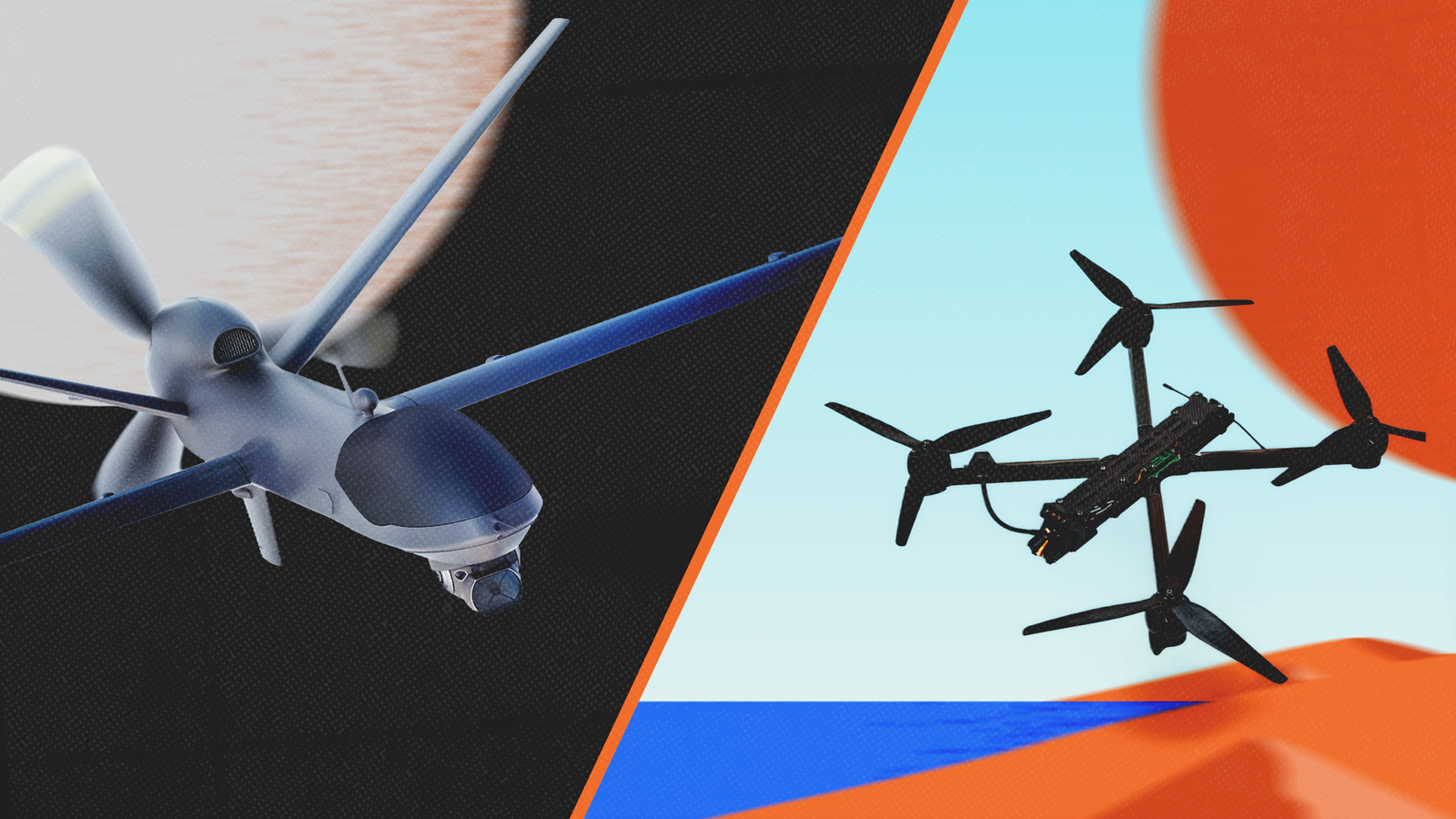
“Something darkly poetic about watching Yemen go from the frontline of drone-centric American [counterterrorism] policy to watching Yemeni conflict parties increasingly embrace drone warfare,” writes the journalist Adam Baron. But the “drone warfare” these fighters are embracing is very different from U.S. surveillance and targeted killings. “Drones” are now a big and diverse class of weapons, united only by the lack of a pilot inside the machine. Lumping them all together conceals a huge revolution in aerial warfare that has taken place over the past decade.
The first generation of military drones was a way to reinforce top-down power. They were expensive machines of use only to someone with the resources to conduct mass surveillance. The new generation of drones are a poor man’s air force. Built or adopted from consumer products, they allow anyone with the right set of skills to carry out air raids and overwhelm expensive air defenses.
In 2000, the American-Israeli anthropologist Jeff Halper wrote an essay about “the matrix of control.” Power, he wrote, “works like the Japanese game of Go. Instead of defeating your opponent as in chess, in Go you win by immobilizing your opponent, by gaining control of key points of a matrix so that every time s/he moves s/he encounters an obstacle of some kind.” His two examples were very different from each other: The Vietcong in South Vietnam used the matrix to overthrow their government in the face of “overwhelming firepower,” while the Israeli army in the Palestinian territories used the matrix to reinforce an incumbent regime. Unmanned aircraft can similarly serve either purpose.
Like airpower itself, drones’ original value to the military was in reconnaissance. Unlike a manned aircraft, a drone could stay in the air for a very long time; it also didn’t present any risk of a pilot getting shot down and killed. In the 1960s, the U.S. Air Force began experiments with using target practice drones for espionage. The original Lightning Bug, used to spy on China and North Vietnam, followed a pre-programmed route and took photos on physical film, which had to be recovered after the mission. The term “drone” came from the “dumb” nature of these machines.
The technology seemed promising—and potentially lifesaving, given the dangers that spy-plane pilots would otherwise face. (Ironically, the first human being killed by a drone was likely a U.S. copilot who was knocked out of the sky in 1965 when the experimental drone he had just launched crashed into his SR-71 Blackbird.) The Soviet Union independently developed a similar system. Israel purchased several Lightning Bugs for itself and soon became a pioneer in drone technology in its own right.
Militaries quickly developed the ability to talk to their unmanned aerial vehicles remotely, allowing for real-time surveillance. That not only allowed for more responsive targeting in wartime; it created the possibility of tracking individuals or monitoring entire populations. It was a “far less risky and far more versatile means of gathering data, and other nations like Israel set about using them,” former CIA director and then-Secretary of Defense Robert Gates told Air War College students in 2008.
The culmination of that era was Gorgon Stare, a U.S. technology that allowed a single drone to monitor an entire city at once, first rolled out in Afghanistan in 2011 and later imported to Baltimore. This kind of system is only useful for centralizing power. Who can afford such a system? Who can process all of the data it generates and synthesize it with other sources of information? (The new book Valley of Death points out that the U.S. military pushed the development of AI image recognition specifically to make use of Gorgon Stare.) And who can act on this information? The answer to such questions will always be a large and powerful institution and typically will be a government. And the best-resourced governments will be best-positioned to take advantage.
But something strange happened in the 2010s. First, drone technology proliferated from superpowers to smaller nations, whose governments learned how to make cheaper versions. Second, and perhaps more importantly, small drones became a product for civilian consumers.
Israel may have unintentionally sparked a proliferation of American drone technology in the Middle East. Iran, which had run its own experiments with small remote-control reconnaissance airplanes in the 1980s, began producing the Shahed-129 in 2012, widely speculated to be based on an Israeli drone that was captured and reverse-engineered by Iranian operatives. Meanwhile, Turkey was using Israeli surveillance drones operated by Israeli technicians to fight Kurdish rebels. When Turkish-Israeli relations broke down in 2010, Turkey turned to engineer Selçuk Bayraktar to build a domestic drone industry.
Then the DJI Phantom hit the market in 2013. DJI, a company founded by Hong Kong University of Science and Technology student Frank Wang in his dorm room, offered off-the-shelf drones for hobby photographers, something entirely new at the time. It wouldn’t be long before armed actors figured out how to use them. In late 2016, the Islamic State began menacing Iraqi troops with grenades strapped to DJI drones. A couple of years later, the police supply company Axon announced a partnership with DJI to equip American cops with drones.
Both developments came together in the Ukrainian war. Ukraine used Bayraktar drones and Russia used Shahed drones for long-range bombing. Ground troops on both sides of the front lines equipped themselves with DJI drones. (Despite DJI’s ban on selling its products in Russia or Ukraine in early 2022, middlemen were still able to buy the drones from retailers in third countries like the United Arab Emirates.) The battlefield has forced rapid-fire and sometimes bizarre innovations, including first-person view drones guided by miles of fiber optic cable, drones designed to stab other drones, and drones hidden inside cargo trucks. Ukrainian officials estimate that 70 to 80 percent of military casualties are caused by drones now.
The advantage in this war is not about intelligence, finding enemies hidden among a population, but about the volume of firepower each side can bring to bear. That incentivizes cheapness and flexibility over sophistication. The ease of air attacks now benefits defenders: Swarms of drones turn front lines into a “kill zone” that is impossible to cross, and countries under attack can retaliate deep inside the territory of aggressors.
In June 2025, the Ukrainian intelligence services pulled off Operation Spiderweb, using drones smuggled into Russia to attack military airfields and destroy a large part of the Russian bomber fleet on the ground. U.S. President Donald Trump reportedly applauded that as a “badass” operation. But a year later, he was worried about facing the same threat. This week, the U.S. Air Force hastily pulled its bombers out of Britain because of intelligence that Iranian spies were going to attack them with drones.
What a difference from the world of Gorgon Stare. Drones used to be a tool for making the powerful seem omniscient and omnipotent. Now they’re a weapon that makes everyone vulnerable, including the nuclear-armed superpowers of the world. Lumping these different kinds of drones together is like comparing a motorcycle to a bullet train. Just because they both have wheels and an engine doesn’t mean that their uses are the same.
Read the full article here
Fact Checker
Verify the accuracy of this article using AI-powered analysis and real-time sources.