

 Freedom Index
Listen to the article
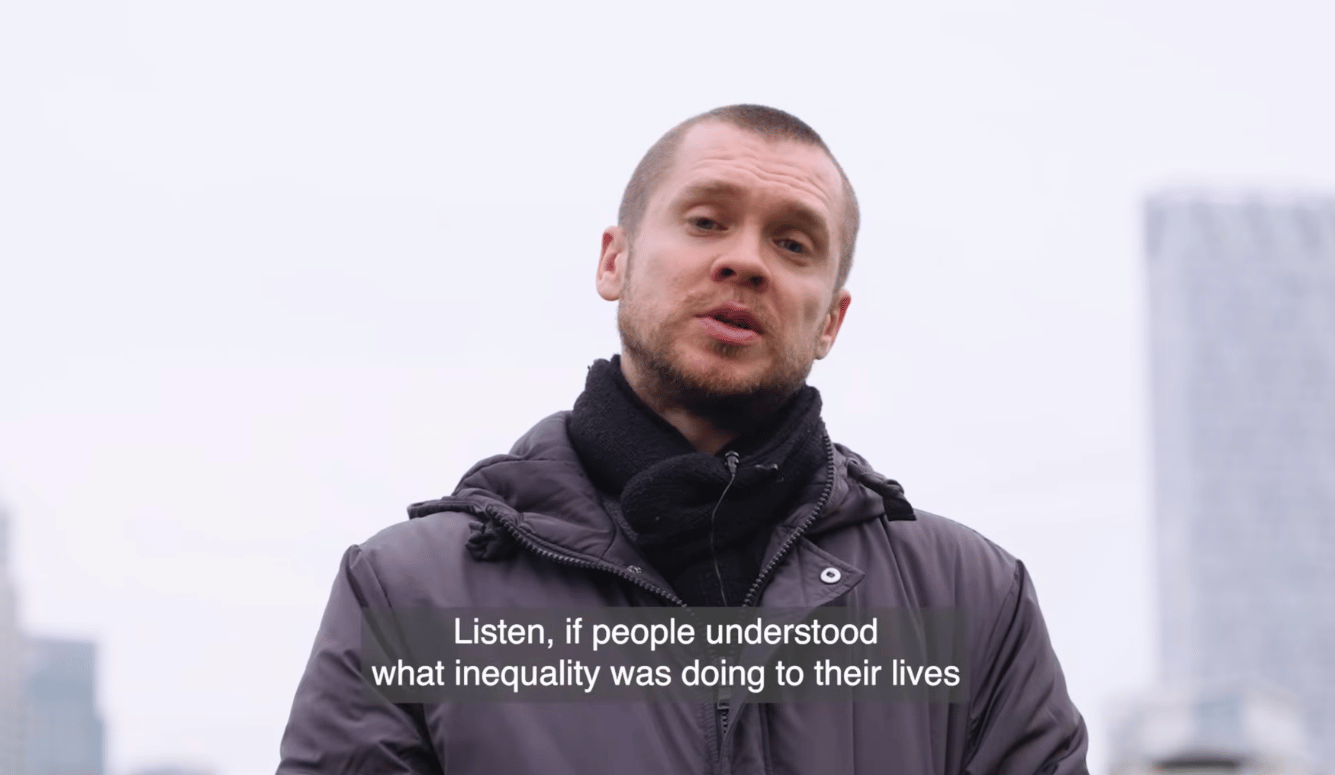
Four years ago, a colleague asked me whether I could chair a debate with some guy called ‘Gary Stevenson’, who was, apparently, an anti-inequality campaigner and a YouTube commentator of some description. I had never heard of Stevenson, but accepted. The debate went all right, even though it was mostly a case of talking past each other (which, given that I was the moderator, was probably my fault). It was otherwise not especially memorable. Britain does not exactly have a shortage of left-wing media figures and activists. In the first half of the 2010s, there was the campaign for a ‘Robin Hood Tax’, the anti-tax-avoidance campaign ‘UK Uncut’, the ‘People’s Assembly’ with its endless anti-austerity marches, the Occupy movement, and, later, the political cult around Russell Brand. From 2015, all of these movements coalesced around Corbynism, and while Jeremy Corbyn himself stepped down as Labour leader in 2020, the movement lingered.
Stevenson was slightly different because of his unusual backstory as a former City trader, and because of his singular focus on wealth inequality as opposed to, for example, income inequality, nationalisation, or price controls. Nonetheless, I saw him as just another minor character in Britain’s vast left-wing ecosystem.
Today, four years on, Gary Stevenson is everywhere. He is a best-selling author, his YouTube channel ‘Gary’s Economics’ has more than 1.6 million subscribers, he is all over the media, and Channel 4 have just released an entire documentary about him. Four years ago, the wealth tax, Stevenson’s flagship policy, was a niche idea that only a bunch of tax nerds were interested in. Today, it is the policy idea of the hour, with three-quarters of the public expressing support for it. Stevenson even sells T-shirts with pro-wealth-tax slogans.
While his book The Trading Game was more autobiography than economic manifesto, the Channel 4 documentary, How to Get Filthy Rich, is mostly about ‘Garynomics’. Stevenson’s economic theory, which he first set out in his Oxford dissertation, The Impact of Inequality on Asset Prices When Households Care About Wealth, goes roughly as follows:
Wealth inequality has a positive feedback loop. It feeds on itself. Wealth inequality leads to greater wealth inequality, which then leads to even greater wealth inequality. And in the process, it destroys the economy.
How so?
Imagine our starting point is a relatively egalitarian, relatively prosperous economy. Most people have some asset wealth, but hardly anyone is super-wealthy. Now, for whatever reason, inequality increases. The richest cannot spend all their extra money on consumer goods and services, because they already have everything that money can buy. So what do they do? They buy assets. In doing so, they push up asset prices, making those assets unaffordable to people at the opposite end of the wealth distribution. The economy as a whole suffers, because consumer spending decreases. People run down their savings, get into debt, sell off their assets. Who do they owe that debt to? Who do they sell their assets to? The wealthy, of course. Who become even wealthier in the process, and use their extra wealth to buy more assets, driving up asset prices further, causing an even greater concentration of wealth, while sucking consumer demand out of the economy. This triggers another round of the same process. And so on, until the bitter end, which is a neo-feudalist dystopia in which a few plutocrats own everything, while the rest of the population are immiserated.
The only way to break this vicious cycle, in Stevenson’s theory, is to constrain the wealth of the super-wealthy, ideally with a wealth tax, to give the rest of society a break. Stevenson is not a communist, and he is not ‘anti-rich’ either. But he is convinced that capitalism, left to its own devices, produces a wealth inequality death spiral. Stevenson thinks that the British economy is currently at an advanced stage of that spiral, and that things are only going to get worse unless corrected.
It’s an economic theory. It’s a good story.
Is it true, though? Does this actually happen?
That would have been a good question for a documentary of this kind to explore. How to Get Filthy Rich does not do that. At all. It simply treats Stevenson’s theories as self-evidently correct, and gives him all the airtime he needs to repeat his assertions about exploding wealth inequality.
It is not that there are no dissenting voices in the documentary: Stevenson does meet several people who disagree with him on policy, and has frank exchanges with them. But these are mostly ultra-rich people, who have an obvious self-interest in the matter. Some of them are quite unlikeable: their role, in the documentary, is clearly to enrage viewers, and make them support a wealth tax out of spite. But even the more likeable characters don’t really want to debate Gary Stevenson’s economic theories; they just don’t want to pay his wealth tax.
So viewers get the impression that the only reason someone could possibly disagree with Gary Stevenson is financial self-interest. The one exception is a brief discussion with tax expert Dan Neidle, who opposes wealth taxes on practical grounds. Still, the viewer comes away with the sense that Stevenson’s claims about the economy are unarguably correct, even if the solutions might be a bit more complicated than he thinks.
That sense is not remotely correct. There are much more fundamental problems with Stevenson’s economic ideas, which this documentary does not even begin to address.
Most importantly, while Stevenson keeps insisting that wealth inequality is exploding—it is not. It is simply not. Britain has, by European standards, relatively high levels of income inequality, but in terms of wealth inequality, Britain is actually remarkably egalitarian. The wealthiest 1 percent in Britain account for a bit less than 22 percent of total British wealth. That figure has been almost completely flat for over twenty years, and it has never been much lower than it is today. For most of the twentieth century, it was far higher. It is also one of the lowest levels in the world, three percentage points below the European average, and five points lower than in Sweden or Germany. This is why even inequality-obsessed left-wing think tanks, such as the Resolution Foundation or the Equality Trust, do not repeat Stevenson’s outlandish claims.
This is not some minor point. The claim that wealth inequality is exploding is the central premise of Stevenson’s entire economic theory, and, by extension, of this documentary. Take that away, and there is nothing left: Garynomics falls apart, and the entire documentary becomes pointless.
Because, remember, Stevenson’s argument is not simply that wealth inequality is too high. He makes a much, much stronger claim than that: that wealth inequality is spiralling out of control, and that this is the main reason for Britain’s economic problems, such as high house prices and low wage growth. How can you make a documentary about how runaway wealth inequality is destroying the country without ever bothering to check whether wealth inequality is actually increasing?
Or let’s put it this way. Imagine a right-wing populist social-media influencer obsessed with migrant crime, whose central claim is that migrant crime is spiralling out of control and ruining the country. Imagine Channel 4 commissioning a documentary about that influencer in which he gets to spell out his views, complemented by testimony from people negatively affected by migrant crime, and interviews with particularly unlikeable migrant criminals boasting about their offences. There is no way Channel 4, or any other high-status media outlet, would have let such a figure endlessly repeat his assertion that migrant crime is exploding without bothering to check whether this is actually true, or without including some information on what the crime statistics actually say.
One more time: the available evidence suggests that wealth inequality in Britain is not particularly high by either international or historical standards, and that it is not increasing. That fact is not mentioned, or even alluded to, in this documentary.
It would have been possible to include this information while still keeping the overall framing of the documentary heavily sympathetic to Stevenson. Channel 4 could have presented some basic information on Britain’s wealth distribution, on how it has changed over the years, and on how it compares to other countries. They could then have given Stevenson ample opportunity to challenge the data, and they could have given him the last word. Wealth statistics are highly imperfect, and can always be challenged. But the viewer would then have learned that Stevenson’s claims cannot simply be treated as self-evidently true—that well-informed, well-intentioned people, and not just unlikeable millionaires, can disagree with him.
If your aim is to persuade the British public that wealth inequality is too high, and that a wealth tax is the way to address it, you have the easiest job in the world. Two-thirds of the public already agree that ‘ordinary working people do not get their fair share of the nation’s wealth’, and almost everyone—including most people on the political Right—seems to support a wealth tax these days. With that in mind, there is no need for sensationalist, apocalyptic claims about how Britain is turning into The Hunger Games. You can acknowledge that wealth inequality is lower than it used to be, that it is lower than elsewhere, and that lowering it would not solve every problem. You can do all that, and still argue that wealth inequality is too high, and that a wealth tax would be a neat idea.
A documentary of that kind could still have had a heavy left-wing, progressive bias, and it could still have portrayed Stevenson in a very positive light. But unlike the actual documentary, it would have contained some information about wealth in Britain: its distribution, its composition, how it has evolved over the years, and how it compares to other economies.
There is a genuine educational gap in the market here. We know relatively little about wealth inequality, because it has so far been eclipsed by its more famous cousin, income inequality. It would have been easy to make a useful educational documentary about it: a fact-based primer on wealth inequality, with some political discussion around it. How to Get Filthy Rich is not that documentary.
Read More
Socialism’s Endless Refrain: This Time Will Be Different
This socialist revival is, of course, neither a homogenous movement, nor a fully worked-out policy program.
The Masses and the Market
If liberalism is to recover it must find a way to create the conditions for a better future.
Read the full article here
Fact Checker
Verify the accuracy of this article using AI-powered analysis and real-time sources.