

 Freedom Index

Listen to the article
The creator of Incognito Market, the online black market that used cryptocurrency as its primary payment rail, has been sentenced to 30 years in prison after blockchain transaction analysis cited by US authorities linked him to the platform.
The Justice Department said on Wednesday that a Manhattan court gave Rui-Siang Lin three decades behind bars for owning and operating Incognito, which sold $105 million worth of illicit narcotics between its launch in October 2020 and its closure in March 2024.
Lin, who pleaded guilty to his role in December 2024, was sentenced for conspiring to distribute narcotics, money laundering, and conspiring to sell misbranded medication.
Incognito allowed users to buy and sell drugs using Bitcoin (BTC) and Monero (XMR) while taking a 5% cut, and Lin was identified after the FBI traced the platform’s cryptocurrency transactions to an account in his name at a crypto exchange.
“Today’s sentence puts traffickers on notice: you cannot hide in the shadows of the Internet,” said Manhattan US Attorney Jay Clayton. “Our larger message is simple: the internet, ‘decentralization,’ ‘blockchain’ — any technology — is not a license to operate a narcotics distribution business.”
In addition to prison time, Lin was sentenced to five years of supervised release and ordered to forfeit more than $105 million.
Crypto tracing led FBI right to Lin
In March 2024, the Justice Department said Lin closed Incognito and stole at least $1 million from users who had deposited funds into their platform accounts.
Lin, known online as “Pharoah,” then attempted to blackmail Incognito’s users, demanding that buyers and vendors pay him or he would publicly share their user history and crypto addresses.
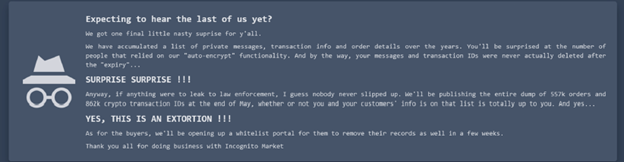
Months later, in May 2024, authorities arrested Lin, a Taiwanese national, at New York’s John F. Kennedy Airport after the FBI tied him to Incognito partly by tracing the platform’s crypto transfers to a crypto exchange account in Lin’s name.
The FBI said a crypto wallet that Lin controlled received funds from a known Incognito wallet, and those funds were then sent to Lin’s exchange account.
Related: AI-enabled scams rose 500% in 2025 as crypto theft goes ‘industrial’
The agency said it traced at least four transfers showing Lin’s crypto wallet sent Bitcoin originally from Incognito to a “swapping service” to exchange it for XMR, which was then deposited to the exchange account.
The exchange gave the FBI a photo of Lin’s Taiwanese driver’s license used to open the account, along with an email address and phone number. The agency then tied the email and phone number to an account at the web domain registrar Namecheap.
The Namecheap account also used funds from Lin’s crypto wallet and exchange account to buy a domain for a website that promoted Incognito, the FBI said.
The agency added that the size of Lin’s deposits at the exchange grew alongside Incognito, rising from around $63,000 in 2021 to nearly $4.2 million in 2023, while an account at a separate exchange saw $4.5 million deposited between July and November 2023.
Magazine: $3.4B of Bitcoin in a popcorn tin — The Silk Road hacker’s story
Read the full article here
Fact Checker
Verify the accuracy of this article using AI-powered analysis and real-time sources.