

 Freedom Index
Listen to the article
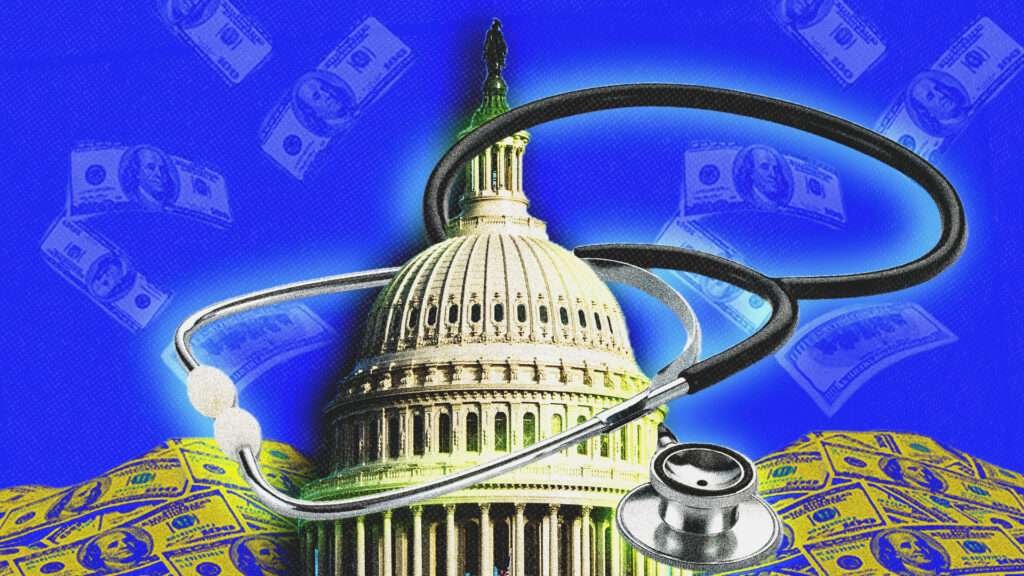
Getting government involved in any area of human life is an effective way to guarantee you spend gobs of money without improving the situation or making people especially happy. That’s clearly true of health care, a field in which government has increasingly intruded for years even as dissatisfaction becomes the norm and costs go through the roof. A recent report finds that health care now consumes almost one of every three dollars the federal government spends, with more to come.
You are reading The Rattler from J.D. Tuccille and Reason. Get more of J.D.’s commentary on government overreach and threats to everyday liberty.
Federal Health Spending Is Twice the Size of the Defense Budget
“The largest and fastest-growing category of federal spending is major healthcare programs, including Medicare, Medicaid, Affordable Care Act (ACA) subsidies, and the Children’s Health Insurance Program (CHIP),” William McBride and Guy Cardwell wrote last week for the Tax Foundation. “As this report shows, total federal healthcare spending, including smaller programs scattered across various agencies, is now nearly one-third of the federal budget.”
“In total, the fiscal cost of federal tax expenditures and spending for health care, as of 2025, is nearly $2.7 trillion, or 8.9 percent of GDP,” they add. At 31 percent of the budget, the combined cost of federal health programs was “more than twice the size of the defense budget” last year.
“Federal healthcare spending has grown at a staggering rate over the last several decades, mainly through expansions of Medicare and Medicaid beginning in the 1960s that increased benefits and eligibility for those programs, but also due to an aging population, increased income and ability to pay for health care, and rising healthcare costs.”
Federal Spending Produced a Health Care ‘Crisis’ and Poor Outcomes
Despite such vast amounts of tax (and borrowed) dollars flowing into healthcare, a Gallup poll published last December finds “a record-high 23% now saying the U.S. healthcare system is ‘in a state of crisis’ and another 47% saying the system has ‘major problems.'” The biggest problem respondents cited was cost, which you’d think all that spending would address, but which federal policy may be making worse.
Writing last year in The Wall Street Journal, Cato Institute health expert Michael F. Cannon warned that “Medicare and Medicaid impose rules that reduce healthcare quality. They increase prices for private-sector medical care and health insurance. They require taxes that reduce incomes, financial security and potentially economic growth. They have subsidy phaseouts that discourage upward mobility.”
Cannon added that there’s little evidence the supposed increased access to care produced by federal subsidies really improve anybody’s health.
A 2010 University of Virginia study of surgical patients who had, variously, Medicare, Medicaid, private insurance, or were uninsured, found that “after controlling for age, gender, income, geographic region, operation, and 30 comorbid conditions,” private insurance resulted in the lowest mortality, followed by Medicare, then the uninsured, with Medicaid producing the highest mortality. Plus, “Medicaid is further associated with higher postoperative in-hospital complications as well as the greatest adjusted length of stay and total costs despite risk factors or the specific major operation.”
In 2013, the much discussed “Oregon Experiment” concluded that “Medicaid coverage generated no significant improvements in measured physical health outcomes in the first 2 years.” Coverage did increase demand for health care services and “raise rates of diabetes detection and management, lower rates of depression.” It also reduced financial strain on patients—by shifting it to taxpayers.
Medicaid has been expanded in recent years, which extends coverage to more people and increases government spending. It’s not clear that it does much good, though.
For its part, Medicare is not only wildly expensive and consuming a growing share of federal spending; it’s also projected to become insolvent in less than a decade.
Federal Policies Harm Private Coverage and Boost Costs
Federal policies don’t just screw up government programs, they also damage what’s left of nominally private medicine. In April, Cato’s Cannon and Elizabeth J. Fowler pointed out that the federal government’s insistence on taxing wages but leaving employer-provided health benefits untaxed encourages businesses to pay employees in health coverage rather than money. “Economists across the political spectrum have noted that making employer coverage tax-free encourages more comprehensive plans than many workers might otherwise choose, which reduces price sensitivity. That means higher prices, higher premiums and more health care spending overall,” they wrote.
Indeed, the Congressional Budget Office noted in 2023 that “most Americans’ health insurance is subsidized by the federal government, either through a program, such as Medicare or Medicaid, or through tax provisions.”
As we know, you get more of anything you subsidize. Pushing people via the tax code to more comprehensive health plans doesn’t directly drive federal spending. But it helps increase the costs that have Americans so upset. And those rising costs increase federal health spending.
As a result, the federal government’s role in health care has metastasized. “In 1962, prior to the advent of Medicare and Medicaid, the federal government spent $2.3 billion for health programs, representing about 2.1 percent of the budget and about 0.4 percent of GDP,” emphasize McBride and Cardwell of the Tax Foundation. “Back then, healthcare spending from all sources, including state and local governments as well as private spending, was 5.4 percent of GDP, and the federal government’s share of that spending was 7.2 percent. Since that time, overall healthcare spending has grown to 18.4 percent of GDP, as of 2025, and the federal share has grown to 39.3 percent.”
As the federal role in health care has increased, so has the cost of that health care. Rising costs then fuel greater demand for federal subsidies to offset the financial burden on patients. Those subsidies drive prices higher still, and the cycle of rising costs and increased government intervention continues.
“Rather than continuing to subsidize inefficient healthcare programs, lawmakers should change course and institute market reforms, allowing more competition, innovation, and consumer choice to finally ‘bend the cost curve’ in health care downward,” recommend McBride and Cardwell.
Contrary to calls for an unaffordable “Medicare for All” total government takeover, they propose stripping much of the existing socialism out of health care and putting the market to work. That promises to increase liberty, improve satisfaction, and keep health care costs from completely consuming the federal budget.
Read the full article here
Fact Checker
Verify the accuracy of this article using AI-powered analysis and real-time sources.