

 Freedom Index
Listen to the article

Today, in AAUP v. Rubio, federal district Judge William G. Young (appointed by Ronald Reagan) ruled that speech-based deportations of foreign students and academics violate the First Amendment. Here is his summary of his long and detailed ruling (which runs to 161 pages in all):
This case -– perhaps the most important ever to fall within the jurisdiction of this district court –- squarely presents the issue whether non-citizens lawfully present here in United States actually have the same free speech rights as the rest of us. The Court answers this Constitutional question unequivocally “yes, they do.” “No law” means “no law.” The First Amendment does not draw President Trump’s invidious distinction [between citizens and non-citizens] and it is not to be found in our history or jurisprudence… No one’s freedom of speech is unlimited, of course, but these limits are the same for both citizens and non-citizens alike.
With this constitution ruling firmly undergirding its approach, the Court here held a full hearing and a nine-day bench trial on the issue of whether the rights of these
plaintiffs to constitutional freedom of speech have been unconstitutionally chilled by the deliberate conduct of any or all of these Public Official defendants. The Court heard 15 witnesses and admitted 250 exhibits consisting of documents, photographs, and video clips.Having carefully considered the entirety of the record, this Court finds by clear and convincing evidence that the Secretary of Homeland Security Kristi Noem and the Secretary of State Marco Rubio, together with the subordinate officials and agents of each of them, deliberately and with purposeful aforethought, did so concert their actions and those of their two departments intentionally to chill the rights to freedom of speech and peacefully to assemble of the non-citizen plaintiff members of the plaintiff associations. What remains after issuing this opinion is to consider what, if anything, may be done to remedy these constitutional violations.
Much of the opinion is a long detailed recitation of the extensive evidence showing that the administration does indeed have a policy of targeting non-citizen students and university employees for deportation based on their anti-Israel or pro-Palestinian speech. One can quibble with some of the details here. But the combined weight of evidence is overwhelming, in so far as high officials from the president on down have openly said that is what they are doing. In several cases, such as that of Tufts graduate student Rumeysa Ozturk, they have indeed tried to deport people whose only offense was to engage in speech disapproved of by the administration. Thus, Judge Young is right to conclude there is a basis for a lawsuit by the AAUP and the Middle East Studies Association, both of which have members vulnerable to deportation under the policy.
The latter part of the opinion (beginning at pg. 116) has a solid explanation of why the First Amendment’s protection for freedom of speech applies to non-citizens present in the US, and why Supreme Court precedent supports that position, or at least does not preclude it. Here is one key point:
Lastly,…. this Court observes that, on its face, the First Amendment does not
distinguish between citizens and noncitizens; rather, it states simply, “Congress shall make no law . . . abridging the freedom of speech[.]” U.S. Const. amend. I. As the Supreme Court’s now frequently cited statement in Bridges v. Wixon confirmed, this text at least arguably implies that “[f]reedom of speech . . . is accorded aliens residing in this country.” 326 U.S. 135, 148 (1945). It also suggests something a little less obvious, but still worth saying, which is that its chief concern is with the character and quality of the “speech” that occurs on American soil, in what Justice Holmes called “free trade in ideas,” which is “the best test of truth,” Abrams v. United States, 250 U.S. 616, 630 (1919), and ensuring that Congress may not twist that speech in the federal government’s preferred direction….
As I have pointed out previously, the First Amendment, like most constitutional rights is phrased as a generalized limitation on government power, not a privilege limited to a specific group, such as citizens. A few rights, are explicitly confined to citizens (such as the Privileges or Immunities Clause of the Fourteenth Amendment) or to “the people” (such as the Second Amendment right to bear arms), which may be a euphemism for citizens. But that makes it all the more clear that rights not explicitly limited to citizens apply to everyone, without exception.
I have defended applying the First Amendment to non-citizens in greater detail elsewhere (e.g. here and here), including responding to the view that speech-based deportations are permissible because non-citizens have no inherent legal right to be in the US:
The text of the First Amendment is worded as a general limitation on government power, not a form of special protection for a particular group of people, such as US citizens or permanent residents. The Supreme Court held as much in a 1945 case, where they ruled that “Freedom of speech and of press is accorded aliens residing in this country.”
A standard response to this view is the idea that, even if non-citizens have a right to free speech, they don’t have a constitutional right to stay in the US. Thus, deporting them for their speech doesn’t violate the Constitution. But, in virtually every other context, it is clear that depriving people of a right as punishment for their speech violates the First Amendment, even if the right they lose does not itself have constitutional status. For example, there is no constitutional right to get Social Security benefits. But a law that barred critics of the President from getting those benefits would obviously violate the First Amendment. The same logic applies in the immigration context.
While Judge Young’s ruling – following Supreme Court precedent – applies a distinction between speech-based initial exclusions and speech-based deportations (allowing greater scope for the former), I would argue both are equally unconstitutional.
As Judge Young notes, today’s ruling follows a number of previous court decisions reaching similar conclusions about Trump’s speech-based deportations. But his analysis is particularly thorough and compelling.
Judge Young’s opinion includes a number of rhetorical flourishes that some might consider inappropriate for a judicial ruling. For example, the beginning and end are framed as a response to an anonymous postcard sent to the court:
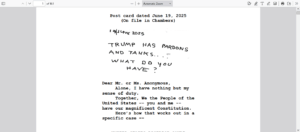
If I were in the judge’s place, I probably would not have done this. While I share Judge Young’s dismay at the administration’s illegal actions, these remarks are unlikely to persuade readers who aren’t otherwise inclined to agree with his reasoning. And the predictable controversy they engender could divert attention from the substantive reasoning underlying the court’s ruling. They might also provide critics with an excuse to dismiss that reasoning without seriously engaging with it, by claiming that the judge was acting inappropriately.
That said, the debate over the appropriateness of some of the rhetoric in the opinion should not detract from the substance of Judge Young’s reasoning, which is strong, and a good model for future court decisions on this issue.
In addition to the factual record and the constitutional questions, the ruling also covers claims under the Administrative Procedure Act, and a number of procedural questions (e.g. – associational standing for the plaintiffs), which I will not attempt to assess here.
The legal battle over speech-based deportations will continue. I hope higher courts will follow Judge Young’s and other district courts’ lead, and hold there is no immigration exception to the First Amendment.
Read the full article here
Fact Checker
Verify the accuracy of this article using AI-powered analysis and real-time sources.