

 Freedom Index
Listen to the article
Last March, U.S. District Judge Richard J. Leon ruled that President Donald Trump’s White House ballroom project is illegal because “no statute comes close to giving the President the authority he claims to have.” But even if higher courts ultimately agree with Leon, a Justice Department lawyer argued on Friday, they cannot stop the project.
The lawyer, Yaakov Roth, was asking the U.S. Court of Appeals for the D.C. Circuit to overturn Leon’s preliminary injunction, which it temporarily stayed in April, or block it while the case, National Trust for Historic Preservation v. NPS, is pending. Because the ballroom project serves national security interests and is already pretty far along, Roth said, it would be an “abuse of discretion” to order that it be halted pending congressional approval.
“When did it become impossible for courts to stop this project?” Judge Patricia Millett, a Barack Obama appointee, asked Roth. “I think it would’ve been improper to enjoin it even on day one,” he replied.
Even if “this were complete lawlessness by the government,” the project “couldn’t be stopped?” Millett asked. “I think that’s right,” Roth said. He conceded that Congress could pass a law prohibiting the project, in which case the Trump administration presumably would be obliged to obey.
“So this is really something that can’t be stopped [except] by Congress?” Millett asked. Correct, Roth said: “I think that’s right.” He allowed that the appeals court could “issue a declaratory judgment that it’s illegal,” after which Congress could “figure out how to deal with that, given the fact that we have these national security imperatives” and the project is “well on its way.”
Unsurprisingly, the lawyer representing the National Trust for Historic Preservation, which is trying to stop the project, had a different view. Under Marbury v. Madison, “it is emphatically the province of the judicial department to say what the law is,” Thaddeus Heuer said. “The government’s position apparently is that even a lawless action of this type could never be stopped by the court,” which is “entirely wrong,” he added. “This case is about who controls federal property. Is it the Congress, its owner, or the president, its temporary tenant? And the Constitution is clear: It is Congress.”
The defendants “don’t really have a persuasive argument on the merits,” Heuer told Millett and the two other members of the D.C. Circuit panel, Trump appointee Neomi Rao and Brad Garcia, who was nominated by Joe Biden. “If they did, I don’t think it would’ve taken them the amount of time it did to try to explain why” the project is legal.
The Trump administration is relying mainly on 3 USC 105(d)(1), which authorizes the president to use appropriated money for “the care, maintenance, repair, alteration, refurnishing, improvement, air-conditioning, heating, and lighting (including electric power and fixtures) of the Executive Residence at the White House.” Does that description cover the ballroom project? Leon thought not.
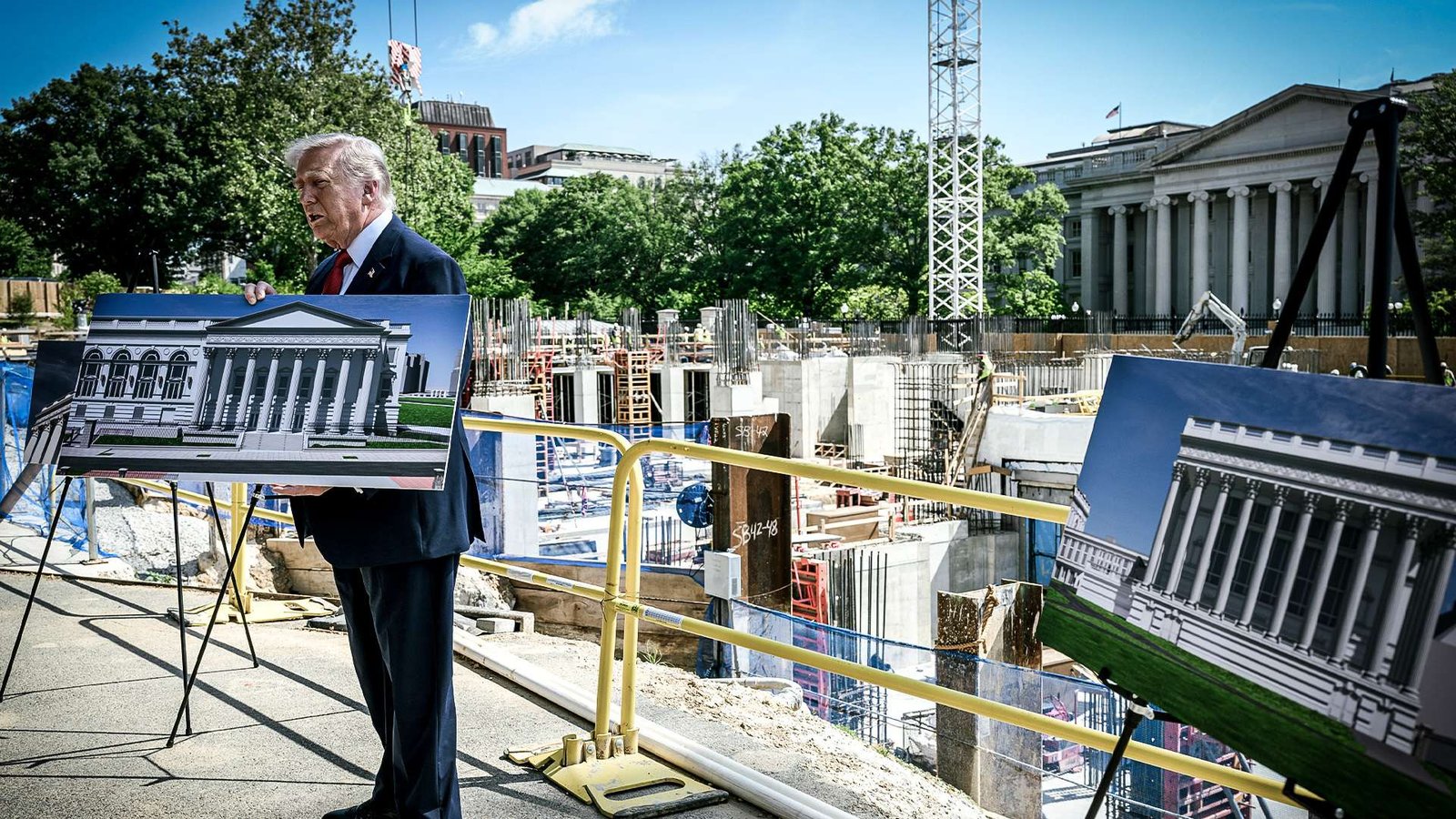
The project entails replacing the East Wing, which was demolished last October, with a structure that would be 60 percent larger than the White House residence in square footage and more than three times as large in cubic volume. “Section 105(d)(1) plainly authorizes the President to conduct ordinary maintenance and upkeep of the White House, and nothing more!” wrote Leon, a George W. Bush appointee. “The list of authorized actions—which includes words like ‘care, maintenance, repair’ and ‘air-conditioning, heating, and lighting’—bring to mind things like replacing the lightbulbs, fixing broken furniture, and changing the wallpaper, not wholesale demolition of entire buildings and construction of new ones.”
Although the government argued that alteration and improvement are commodious enough to authorize the project, Leon thought the statutory context made that interpretation untenable. In any event, recent congressional appropriations have not included those terms, and the money allocated under Section 105(d)(1) falls far short of the amount required for the ballroom project.
Section 105(d)(1) “is not a free-floating grant of authority,” Heuer told the D.C. Circuit. “We know this because that’s what history tells us….This provision goes back for at least a hundred years. And we know that Congress has used the same rough language, giving the president a maintenance allowance.”
When “there have been large public projects at the White House,” Heuer said, Congress has explicitly approved funding for them. That is what Congress did when the roof of the White House needed repairs during the Coolidge administration, he noted, and when Harry Truman complained that “the building’s falling apart,” requiring a “gut rehab.” Congress “didn’t put a lot of money into [the] 105(d) account,” Heuer said. Instead it approved “a separate capital appropriation.”
Congress did not approve such an appropriation in this case, and it allocated just $2.5 million under Section 105(d)(1), far less than the $400 million estimate of the ballroom project’s cost. To bridge that “gaping chasm,” Leon noted, the Trump administration is relying on private contributions funneled through the National Park Service (NPS). The NPS is authorized to accept gifts for the maintenance and improvement of national parks, which include the White House. According to the Trump administration, the NPS is in charge of the ballroom project and has contracted with the Office of the Executive Residence to carry it out, an arrangement that the government says is authorized by the Economy Act.
The Trump administration has had trouble sticking to that story, which portrays the White House office that is building the structure as a mere contractor. “You guys told the district court that you can’t have an APA [Administrative Procedure Act] claim against the Park Service because the Park Service is indisputably not directing the project and there’s no Park Service action that the court could set aside under the APA,” Millett noted. “That’s not true….That’s just wrong.” Roth ultimately conceded as much, saying, “I apologize if it was in imprecise language.”
Leon described the NPS end run as a “Rube Goldberg contraption” designed to escape the limits that Congress has imposed on the use of federal property. “This funding mechanism is, to say the least, a far cry from affirmative congressional authorization,” he wrote. “Defendants cannot evade the limitations of § 105(d)(1) and the 2024 appropriations act through a series of unrelated statutes that say nothing about the President, the White House, or the construction of a ballroom.”
Leon identified another problem. Under 40 USC 8106, “a building or structure shall not be erected on any reservation, park, or public grounds of the Federal Government in the District of Columbia without express authority of Congress.”
The president’s actions “run up against an explicit statutory prohibition,” Leon wrote. “Defendants’ reading of the statutes assumes that Congress has granted nearly unlimited power to the President to construct anything, anywhere on federal land in the District of Columbia, regardless of the source of funds. This clearly is not how Congress and former Presidents have managed the White House for centuries, and this Court will not be the first to hold that Congress has ceded its powers in such a significant fashion!”
It is not clear whether the D.C. Circuit will agree with Leon. One sticking point is whether the National Trust has standing to sue, which hinges on the injuries asserted by history professor Alison Hoagland, a member of the organization.
As Leon noted in February, Hoagland “asserts that construction of a ballroom of the form and scale proposed by the President would disrupt her enjoyment and use of President’s Park and cause her to ‘suffer both professional and personal injuries, including to [her] aesthetic, cultural, and historical interests.’ The President’s proposed ballroom would, in Hoagland’s words, ‘overshadow[]’ the White House and ‘diminish [its] primacy,’ thereby disrupting the message that ‘our president lives in a house.'”
Even if those concerns suffice for standing, Roth told the appeals court, they pale beside the government’s interests. “We have evidence here that the old East Wing was not adequate to protect the safety and security of the president and others in the White House leadership,” he said. “On the one side…we are talking about one person’s architectural preferences for the site. And on the other hand, we have senior officials in the military and the Secret Service saying, ‘We need to build this.'”
Millett corrected Roth: “They’re not one person. That’s simply the way standing is shown for the National Trust itself. So it’s the National Trust and its members.”
Leaving aside the issue of standing, there is an important principle at stake here that goes far beyond “architectural preferences.” Whatever you think of the ballroom project’s aesthetic merits, Trump should never have started it if Leon is right that he did not have the legal authority to do so. But now that it is underway, the government argues that it must be completed, even if it violates the rule of law and the separation of powers.
Read the full article here
Fact Checker
Verify the accuracy of this article using AI-powered analysis and real-time sources.