

 Freedom Index
Listen to the article
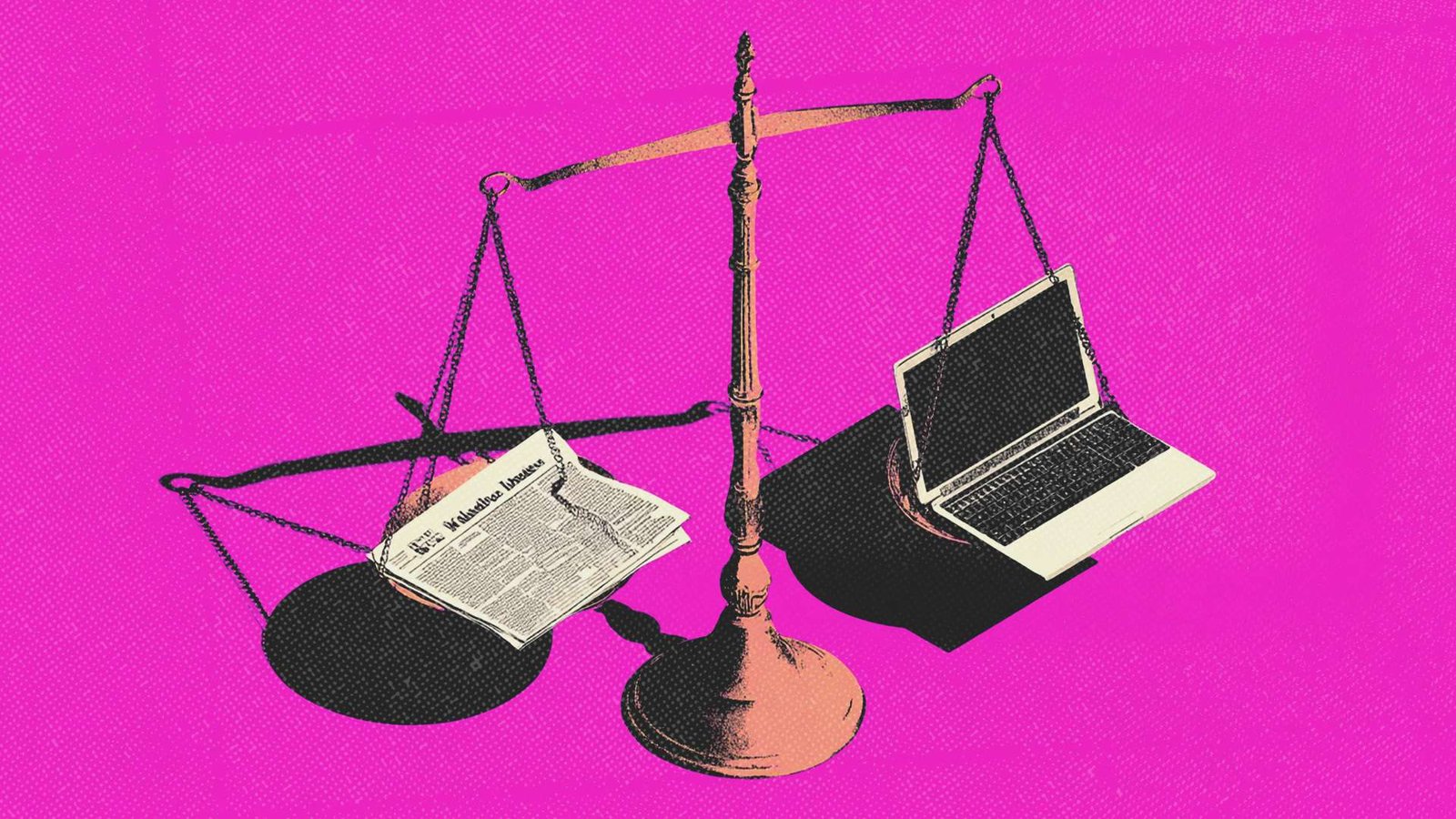
In 2023, The New York Times sued OpenAI—and its largest investor, Microsoft—for “systematic and competitive infringement,” accusing the companies of illegally using copyrighted material to develop their AI models. After other publishers filed their own lawsuits, the cases were consolidated last year in the U.S. District Court for the Southern District of New York.
On Tuesday, the Justice Department sent a statement of interest arguing the Times‘ position is “inconsistent with basic copyright law principles” and could “severely hamper ‘the Progress of Science and useful Arts.'” Training AI models on copyrighted material “in and of itself,” the administration says, is not a violation of copyright laws.
Section 107 of the Copyright Act of 1976 outlines the conditions of “fair use,” which allows anyone to use unlicensed copyright-protected works for criticism, comment, news reporting, teaching, scholarship, and research.
The Justice Department contends that any use by the AI companies should be considered fair use for a transformative purpose. The Times has rejected this argument, declaring there is nothing transformative about using its content “without payment to create products that substitute for The Times and steal audiences away from it.” The outlet claims that OpenAI’s generative AI models “compete with and closely mimic the inputs used to train them,” nullifying the fair use exemption for its copyrighted works.
Tori Noble, staff attorney at the Electronic Frontier Foundation, disagrees. She says training AI models on copyrighted works is “squarely what transformative use is.” These are “general purpose tools” and “exactly the kind of creation that copyright is designed to foster,” Noble adds. Satya Marar, research fellow at the Mercatus Center at George Mason University, tells Reason that while there’s “no blanket fair use exception for training generative AI,” the training itself is “highly likely to be deemed transformative.”
Graham James, a spokesman for the Times, said the government was “siding with a handful of ‘trillion-dollar A.I. companies’ at the expense of American creators,” the outlet reports. The statement might play well to a public skeptical of AI’s benefits. Still, it misrepresents the point of copyright law, which the Supreme Court—in Andy Warhol Foundation for the Visual Arts, Inc. v. Goldsmith (2023)—said is “namely, to promote the progress of science and the arts, without diminishing the incentive to create.”
In its filing, the Justice Department cites a 2nd Circuit ruling in Authors Guild v. Google, Inc. (2015) that states that the “more the appropriator is using the copied material for new, transformative purposes, the more it serves copyright’s goal of enriching public knowledge and the less likely it is that the appropriation will serve as a substitute for the original or its plausible derivatives, shrinking the protected market opportunities of the copyrighted work.”
The district court’s decision in this case could have serious ramifications on America’s burgeoning AI sector. Nathan Goodman, senior fellow at the Mercatus Center at George Mason University, tells Reason a ruling in the Times‘ favor could “substantially raise the direct financial costs and the transaction costs of forming a training data set.” Goodman believes that would “impede iterative innovation that builds on prior existing knowledge.”
Noble says that copyright holders “talk about the licensing potential as if it’s a transactional cost of doing business,” but for smaller developers who’d be forced to individually contact each rights holder for permission, paying out potentially billions for copyrighted works would be prohibitively costly.
AI is certainly a transformative technology, and newsrooms of all sizes are integrating the technology nationwide. This includes the Times, which uses generative AI models in its newsroom and opinion section. In a message to its newsroom, Semafor reports that the Times argued its generative AI will help it “become more accessible to more people” through the use of “digitally voice[d] articles” and “translations into other languages.” The outlet also reportedly stated the technology “helps us report stories we couldn’t otherwise.”
Generative AI models don’t write original stories, pursue leads, or contact sources. They don’t independently research facts or propose ideas for new articles. As the Times itself states, these models are no more than “powerful tools” incapable of competing with the company as the nation’s newspaper of record.
With several pending copyright lawsuits against AI companies and their investors, this likely won’t be the last time the government weighs in on this issue. Noble says there’s a “real risk in these cases that courts will misunderstand the technology and use those misunderstandings or negative perceptions of AI to drive rulings that are factually grounded in hype or stigma and not the reality of how [the technology] works.”
According to Goodman, regardless of how the Times‘ case shakes out, the ruling will “reshape the creative and innovative activity that occurs in our society, and alter what pattern of innovation and creativity we see.”
Read the full article here
Fact Checker
Verify the accuracy of this article using AI-powered analysis and real-time sources.