

 Freedom Index
Listen to the article
American courts have a long tradition of public access to judicial proceedings — access that is protected by the First Amendment. Because of it, journalists are able to attend hearings to inform the public about what litigants say and how judges make decisions.
But what about hearings in immigration court?
In those courtrooms, judges employed by the U.S. Department of Justice — that is, not “Article III” judges confirmed by the Senate — carry out the administration’s immigration policies and decide whether noncitizens will be detained or deported.
What happens in those immigration proceedings is a matter of immense public interest and is regularly covered by reporters. Earlier this month, for example, a New York Times investigation found that the Trump administration has purged an unprecedented number of immigration judges as part of its effort to speed up deportations.
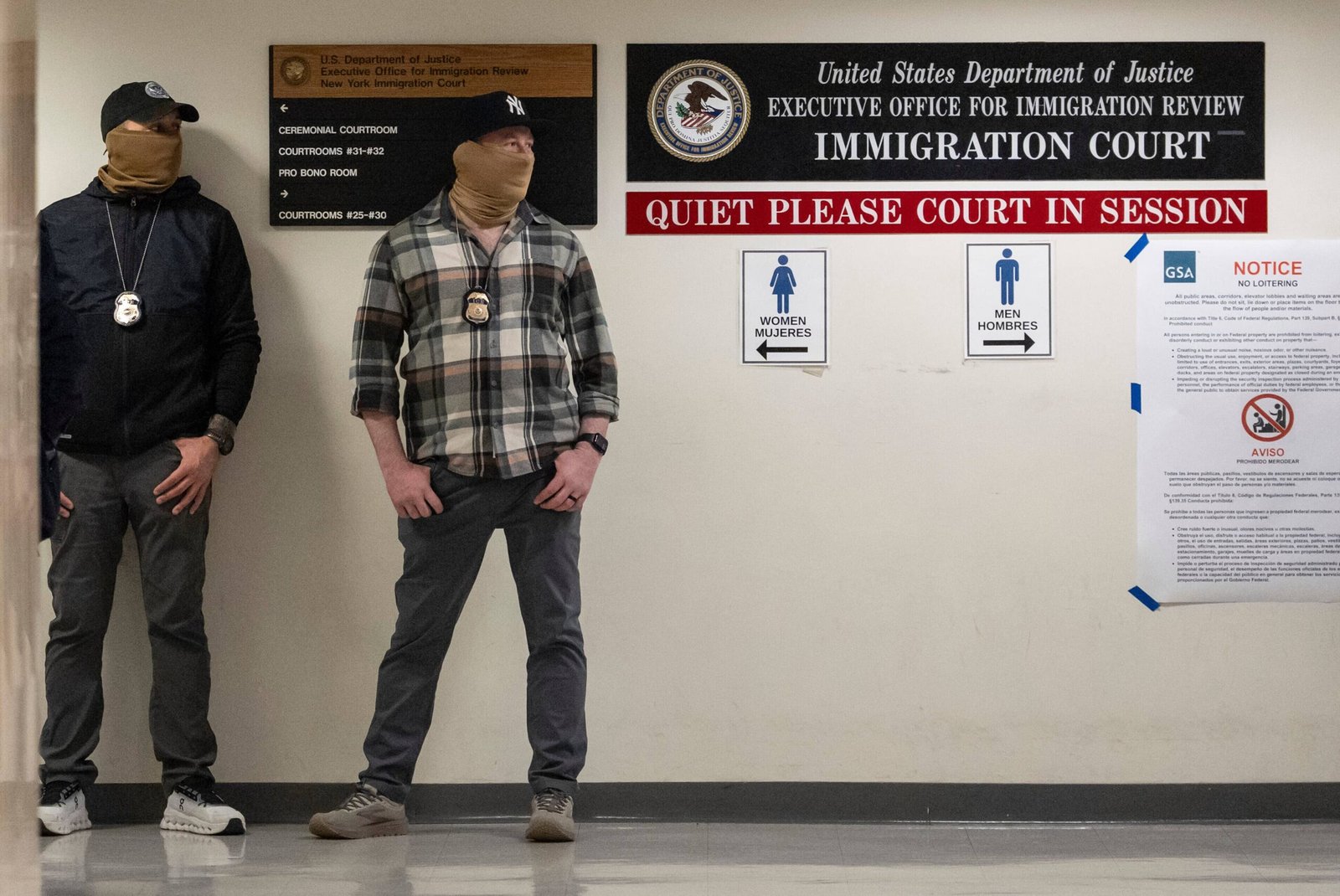
These immigration courts should be open to the public and the press, but too often they are not.
This problem is highlighted in a lawsuit recently filed in Washington, D.C., by The Advocates for Human Rights, a Minnesota-based nonprofit that has run an immigration court observation project in the Minneapolis area since 2017. For years, AHR observers were able to witness local immigration court hearings without issue, the complaint states.
In early 2025, however, AHR observers began to face new obstacles to accessing hearings. According to the complaint, one immigration judge began locking her courtroom door. As the months went on, more and more courtrooms were closed to the public for no apparent reason, and observers were prohibited from observing hearings conducted virtually.
After more than a year of these issues, AHR filed suit against then-U.S. Attorney General Pam Bondi and immigration court officials, arguing that the DOJ had violated the First Amendment, the Administrative Procedure Act, and its own regulations by continually blocking public access to immigration court proceedings.
The issues raised in AHR’s lawsuit are not limited to one immigration court in Minnesota, nor to one organization’s court observation project. Journalists across the country have contacted the Reporters Committee for Freedom of the Press’s free Legal Hotline because they have had trouble accessing various immigration courtrooms in the course of their newsgathering work.
For example, last May, a California-based reporter was improperly kicked out of a hearing in the San Diego Immigration Court. The Reporters Committee wrote a letter to immigration court officials documenting the incident and urging the court to ensure public access to hearings moving forward, but never received a response.
And AHR’s suit is correct: Preventing the press and public from accessing immigration court proceedings writ large is unlawful.
In fact, the DOJ itself says so. A regulation in place since 2003 requires that “[a]ll hearings, other than exclusion hearings, shall be open to the public,” with limited exceptions. When immigration judges or other staff members fail to follow that rule by expelling observers and reporters from courtrooms, they violate the law.
But even absent that regulation, the government should be required to let the public and press observe immigration court hearings under the First Amendment. In the landmark 1980 case Richmond Newspapers, Inc. v. Virginia, the U.S. Supreme Court explained that public and press access to criminal trials is a qualified right dating back to English common law, and is protected by the Constitution. And for good reason: “The explicit, guaranteed rights to speak and to publish concerning what takes place at a trial would lose much meaning if access to observe the trial could … be foreclosed arbitrarily.”
However, the Supreme Court has never addressed whether those same rules apply to hearings in immigration court. Immigration proceedings are somewhat different than a criminal trial. For example, as noted above, they are overseen by DOJ-employed judges rather than a jury or independent judicial officer nominated by the president and confirmed by the Senate, and immigration judges generally determine whether someone is deportable under civil immigration laws, not whether that person committed a crime.
Those differences, however, seem less and less significant as the number of people detained in the course of immigration proceedings has gone up almost 75 percent since January 2025, while immigration arrests have increased by 600 percent. As at a criminal trial, an immigration hearing puts an individual’s personal liberty at risk.
Making matters more uncertain, only two appellate courts have directly analyzed the question of whether the First Amendment right of access applies to immigration courts. They reached opposite conclusions.
Both cases were decided more than 20 years ago, in the wake of the 9/11 attacks. The government had passed a new rule completely closing immigration proceedings in “special interest” cases involving a noncitizen suspected of “connections with” terrorist activity. Media organizations in Michigan and New Jersey separately challenged the rule, arguing it violated their First Amendment right to observe immigration court proceedings.
The Michigan plaintiffs won, as the U.S. Court of Appeals for the Sixth Circuit looked closely at the history, tradition, and policy underlying the First Amendment right of access and held that it did apply to immigration proceedings, for a number of reasons. For instance, the court noted that a “deportation proceeding, although administrative, is an adversarial, adjudicative process, designed to expel non-citizens from this country,” and “public access acts as a check on the actions of the Executive by assuring us that proceedings are conducted fairly and properly.” As a result, the rule restricting access was subject to “strict scrutiny,” and the government failed to show that it was narrowly tailored to a compelling interest, thus failing that test.
The U.S. Court of Appeals for the Third Circuit disagreed in the New Jersey case, finding that the “historical evidence” of access to deportation proceedings was not strong enough to make it a constitutional right. Though it acknowledged that “deportation proceedings look very much like judicial trials” and “openness in deportation hearings performs … salutary functions,” the Third Circuit deferred to the government’s assertion that open hearings could threaten national security and so found it “doubtful that openness promotes the public good in this context.” One of the three Third Circuit judges dissented from that ruling and would have adopted the Sixth Circuit’s view instead.
The court’s analysis in the Michigan case is the better one. Vague gestures toward national security and public safety are not sufficient to support closures of immigration courtrooms nationwide, where the rights of noncitizens are being decided every day.
Today’s immigration court landscape demonstrates why. In 2025 alone, there were reportedly nearly 3.4 million cases pending in immigration courts, and only a small percentage of them involved a criminal charge, let alone a terrorism or national security charge. Yet as AHR’s complaint explains, the press and the public are routinely kept out of the courtrooms where these cases are heard, with little or no justification (national security or otherwise).
This lack of access prevents the public from understanding how the process of deporting a noncitizen works, making sure the proceedings are fair, and holding officials accountable if they are not. It is the very thing the Supreme Court warned against in Richmond Newspapers.
AHR’s lawsuit provides an opportunity for the U.S. District Court for the District of Columbia to halt this troubling practice.
Read the full article here
Fact Checker
Verify the accuracy of this article using AI-powered analysis and real-time sources.