

 Freedom Index

Listen to the article
Across mobile platforms, advertising companies provide developers with software development kits (SDKs) that make it easy to monetize their apps. But those same SDKs can automatically feed users’ location data into ad systems that location data brokers use to track people. Many developers may not even be aware of this privacy violation, let alone the users who are directly affected.
When developers let advertising SDKs collect location data, they’re putting users at risk of more than just creepy ads. Location information sourced from the advertising industry has been used for ICE investigations, global spy tools, outing a gay priest, tracking union organizers, and tracking US military personnel.
Defaults matter, not just for users, but for app developers as well.
An EFF investigation has identified several advertising SDKs that publicly acknowledge collecting and sharing users’ location by default when embedded in Android apps granted location permissions. Defaults matter, not just for users, but for app developers as well. If app developers don’t pay close attention to the location-sharing settings of their advertising tools, they could inadvertently expose users’ location information.
This report explains how advertising SDKs can facilitate and encourage location data sharing through privacy-invasive defaults, financial incentives, and unclear documentation.
Contents:
Data Brokers Harvest Location Information From Advertising Systems
When an advertising SDK collects and shares location data, it becomes part of a larger ecosystem that can include advertisers, ad tech companies, and location data brokers. EFF began investigating the location-sharing practices of various advertising SDKs to better understand the pipeline from mobile apps to location data brokers.
Location data brokers sell information on the precise movements of billions of people without their knowledge or meaningful consent. This data is primarily sourced from apps on people’s phones. Some apps partner with data brokers directly, using data-broker-developed SDKs or server-to-server transfers to sell users’ location data. Other apps leak users’ location data through advertising SDKs serving behaviorally-targeted ads through “real-time bidding” (RTB). In the process of auctioning off ad space, ad tech companies can broadcast user data to thousands of potential advertisers. Location data brokers have participated in these auctions not just to bid on ad space, but to collect personal information contained in bid requests.
Indiscriminate data sharing through RTB can lead app developers to unknowingly share their users’ location with data brokers. In 2025, a hack of location data broker Gravy Analytics revealed thousands of apps that may have been sources of its data. When journalists reached out to the app developers, many claimed they had no relationship with or knowledge of Gravy Analytics. To prevent location information from being shared with data brokers through RTB, developers must understand the location-sharing practices of their advertising SDKs.
How Advertising SDKs Leak Location Data
Developers don’t have to manually, or even intentionally, share location data for it to be broadcast through RTB auctions. Once a user grants an app permission to access their location, SDKs embedded in the app receive the same access—there are no SDK-specific location permissions. That means advertising SDKs can automatically collect users’ location data and share it in bid requests.
While apps and SDKs can estimate a users’ approximate location from their IP address without requesting any permissions, location permissions provide access to estimates that are more accurate and revealing. Precise location permissions give apps (and their embedded SDKs) access to location estimates within about 160 feet, but sometimes as accurate as 10 feet. Approximate location, a separate permissions level, gives apps access to a location estimate within about 1.2 square miles.
Developers and advertising SDKs also have a financial incentive to share location data, since it can increase bid prices for an app’s ad space. While many advertising SDKs require developers to configure a setting before collecting and sharing users’ location data in ad requests, this is not always the case. EFF found several advertising SDKs who publicly acknowledge sharing users’ location data by default when embedded in apps granted location permissions.
EFF Identified Advertising SDKs That Share Location Data by Default
EFF reviewed the public developer documentation of dozens of widely-used advertising SDKs to identify how they handle and communicate with developers about location data. In the following sections, we highlight four advertising SDKs who engage in a particularly egregious practice: collecting a user’s location by default for ad targeting whenever a user has given an app location permissions. We reached out to each SDK company and the referenced app developers for comment. One company responded, and as detailed below, subsequently updated its documentation in response to our questions. Another company responded with clarifications to its developer documentation.
We chose to focus on SDKs with this privacy-invasive default because it increases the risk of developers leaking users’ location data without realizing it. Several studies have found that developers tend to stick to SDKs’ default settings. If an advertising SDK transmits location data by default, users’ precise location can end up in advertising systems without the developer intentionally enabling location sharing. These SDKs have separate documentation pages that instruct developers to flag users covered by privacy laws like GDPR and COPPA for restricted data processing, but these modes are not the default.
By analyzing how these four SDKs present their location sharing practices to developers, we hope to illustrate how the design and documentation of advertising SDKs can facilitate location data sharing at scale. Although the advertising SDKs we highlight are not the most prevalent SDKs used, they are embedded in thousands of apps and reach billions of users.
InMobi Encourages Keeping Location Sharing Enabled By Highlighting Financial Incentives
InMobi claims to reach “2B+ users across 150+ countries” and is the 10th most popular advertising SDK on Android (according to AppBrain and Appfigures at the time of publication).
InMobi’s “Getting Started with Android SDK Integration” suggests that location sharing is enabled by default, stating “The InMobi SDK automatically forwards location signals when available.” InMobi provides developers with a setting to opt out, but explicitly recommends sharing location data. Developer documentation highlights the financial incentive for location sharing, stating “location-enriched impressions typically yield higher revenue.”
[Observed on “Getting Started with Android SDK Integration,” 7/31/26]
Apps that use InMobi may not need location information to function or may only need access to approximate location information, but InMobi highly recommends that developers request precise location permissions “to enable accurate ad targeting.” They even encourage developers to request Wi-Fi network information permissions, which (when paired with precise location permissions) provide Wi-Fi access point identifiers that can also be used for location tracking.
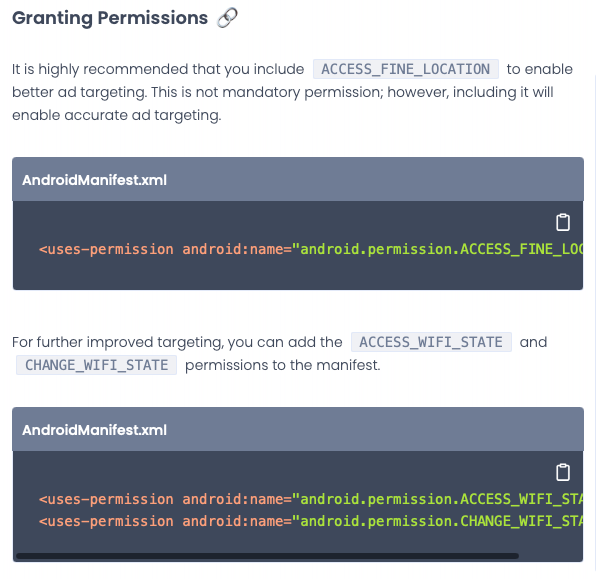
[Observed on “Getting Started with Android SDK Integration,” 7/31/26]
InMobi has been accused of misleading developers over location sharing practices in the past: In 2016, they settled with the FTC over charges that they bypassed users’ location permissions for apps and tracked their precise locations through WiFi network data (Android now requires apps to request location permissions to access this WiFi data too).
BidMachine Updates Previously Inaccurate Developer Documentation After EFF’s Technical Analysis Observed Precise Location Data Collection
BidMachine claims to reach over 600 million “direct SDK users.”
BidMachine reveals that it collects location data by default on the “Advanced Settings” page of its Android SDK Integration guide, stating that the “SDK can automatically track user device location to serve better ads” as long as developers request location permissions for their app. Before publication, EFF reached out to BidMachine for comment, notifying them of our plan to highlight their Android SDK location sharing practices.
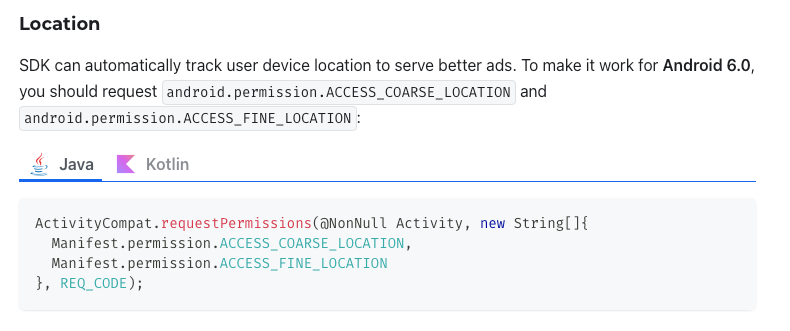
[Observed on “Advanced Settings” on 7/31/26, before EFF asked BidMachine for comment]
After EFF reached out, BidMachine changed their documentation to clarify the practice, but not their default collection of location information once app-level permissions are granted. This updated section still fails to explain how developers can opt out of BidMachine location tracking, which is critical for app developers that require location access for core features but wish to prevent user data from being shared with advertisers.
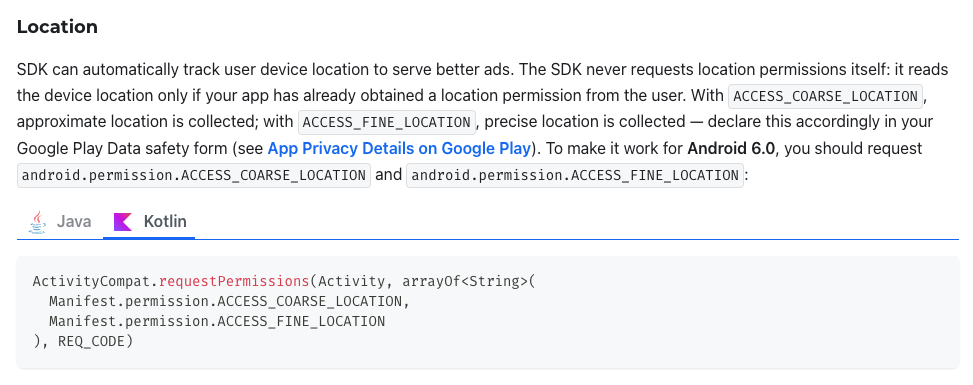
[Observed on “Advanced Settings” on 8/3/26, after EFF asked BidMachine for comment]
Before EFF reached out, BidMachine’s “App Privacy Details On Google Play” page had stated that they only collected coarse location data and precise location data was “not collected.” However, our technical analysis of two apps, which Exodus Privacy determined include the BidMachine SDK, contradicted this claim: Network requests from the apps QR Scanner and GPS Speedometer to a BidMachine domain include precise location coordinates.
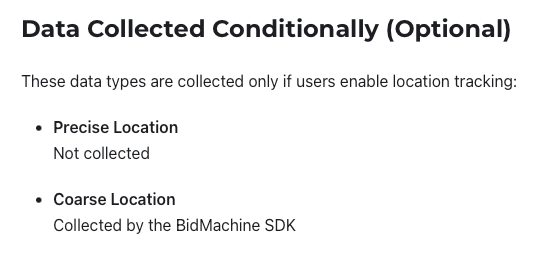
[Observed on “App Privacy Details On Google Play” on 7/31/26, before EFF asked BidMachine for comment]
After EFF reached out, BidMachine also corrected its documentation to make it clear precise location is collected by the SDK whenever the app-level permission is granted:
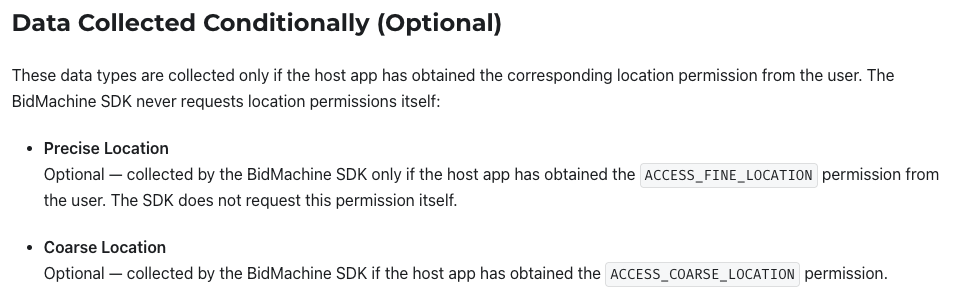
[Observed on “App Privacy Details On Google Play” on 8/3/26, after EFF asked BidMachine for comment]
com.appswing.qr.barcodescanner.barcodereader_bidmachine.flows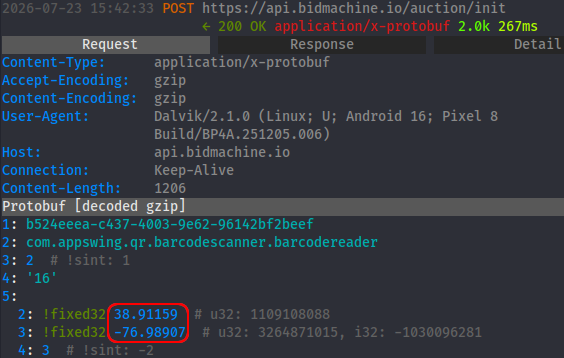
com.ktwapps.speedometer_bidmachine.flows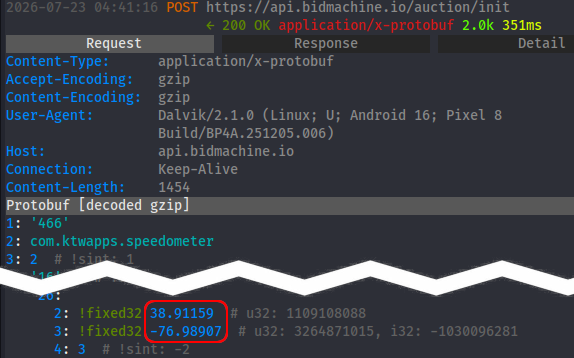
In response to our request for comment, BidMachine stated that it wasn’t possible for them to get location information “unless the user has granted the app the relevant permission through the operating system.” They also stated that“publishers are responsible for configuring their apps’ permission and consent flows.”
Verve Emphasizes Consent More in its Play Store Language Than its Configuration Guide
Verve has claimed its HyBid SDK reaches “over 1.5 billion users across more than 10,000 apps worldwide.”
Verve’s configuration guide for its HyBid Android SDK (formerly called Pubnative HyBid) makes clear that location tracking is “enabled by default,” stating, “If the user has given location permissions, HyBid SDK will use the available user location to provide better targeted ads.”
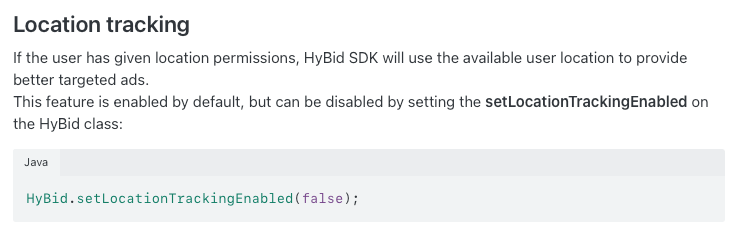
[Observed on “HyBid Android SDK – HyBid Configuration,” 7/31/26]
Verve’s guidance for data disclosure to the Google Play Store tells a more careful story. Despite the fact that location tracking is enabled by default, the Google Play Data Safety Guidance states that the SDK “does not collect or attempt to collect [location] information independently.”
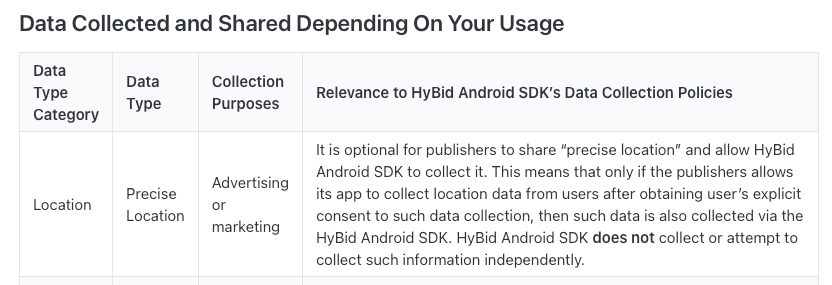
[Observed on “Google Play Data Safety Guidance,” 7/31/26]
It also emphasizes user consent, claiming the SDK will only collect location data “if the publishers allows its app to collect location data from users after obtaining user’s explicit consent to such data collection” (emphasis added). The configuration guide lacks recommendations or instructions for obtaining user consent to share location data with Verve, beyond app-level access. Instead, the configuration guide highlights the financial incentives for developers to add location permissions to their app.
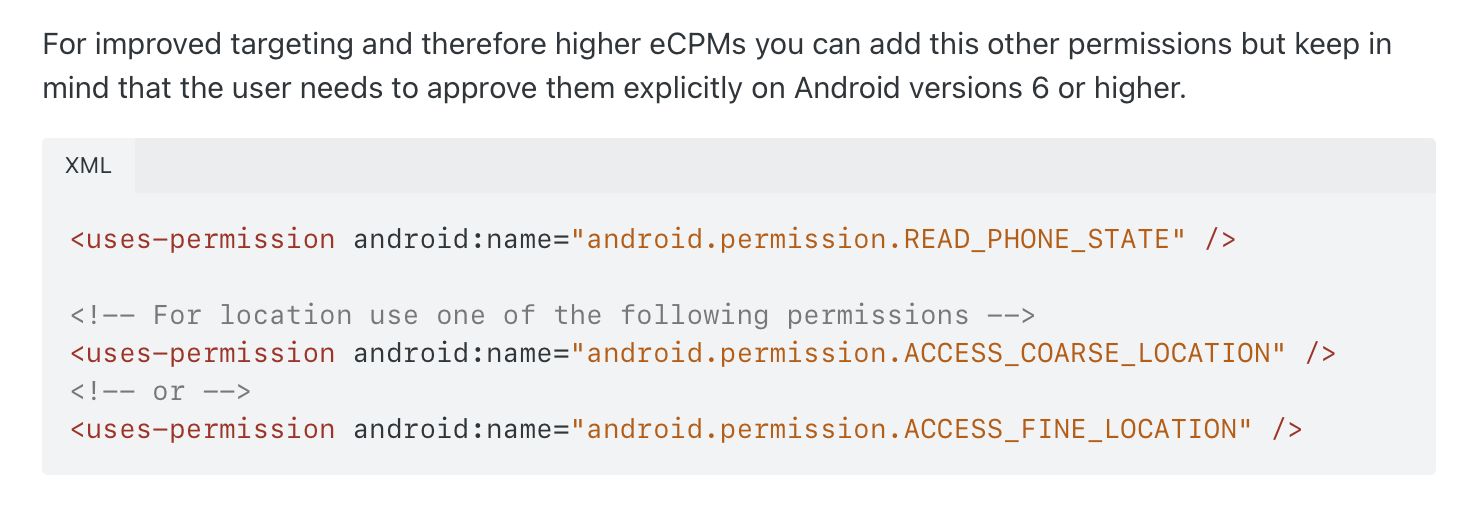
[Observed on “HyBid Android SDK – HyBid Configuration,” 7/31/26]
When reached for comment, Verve clarified that “in its current Android implementation, the SDK reads the cached network-provider location and does not use the GPS data of the end user’s device. Furthermore, any geolocation data is coarsened prior to processing, ensuring that location is limited to an accuracy radius of no less than 1,850 feet.” It also said that it contractually requires apps to comply with data protection laws.
To Verve’s credit, the HyBid SDK is open source, so careful developers can check the code instead of relying on documentation alone. HyBid’s open-source code shows that latitude and longitude coordinates are rounded to two decimal places, and that it does only collect and share network-derived location data, confirming the statement the company sent to us. If an app has precise location permissions, networked-derived location data rounded to two decimal places could be accurate within approximately 0.5 square miles, which is still more precise than the 1.2 square miles typically revealed with Android’s approximate location permission. But even coarse location data, especially when collected repeatedly over time, can reveal movements that should remain private by default.
Verve’s response also conveyed a willingness to revise their documentation: “As part of our ongoing commitment to providing clear and comprehensive developer resources, we continually review and enhance our documentation, and we will take your observations into account as part of that process.”
Huawei Highlights Financial Incentives for Location Data Sharing Before Showing Developers How to Opt Out
Huawei has claimed its Petal Ads SDK is embedded in more than 85,000 apps worldwide.
Huawei’s “Integrating the Petal Ads SDK into an Android App” guide begins with a recommendation that developers obtain location permissions to increase app revenue and an acknowledgement that location sharing will happen by default in apps with location permissions.
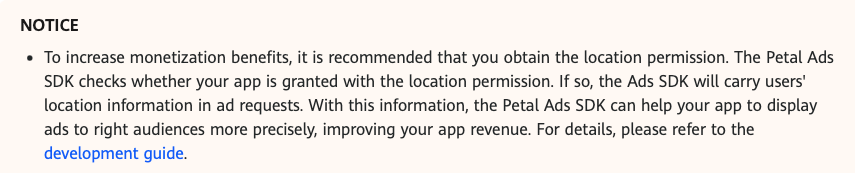
[Observed on “Integrating the Petal Ads SDK into an Android App,” 7/31/26]
A separate “Use of Location Data for Ads” page repeats that the Petal Ads SDK will include users’ location information in ad requests if an app has access to location information. Neither of those pages mention that developers can use the setRequestLocation method to disable the default collection of location information (this setting is referenced in the last section of the Ads SDK Compliance Guide). Huawei’s Ads SDK Privacy Statement states that “The SDK and its services will not store precise location information, and will only use it to determine the approximate device location.” However, the guide does not specify how Huawei defines approximate versus precise location data.
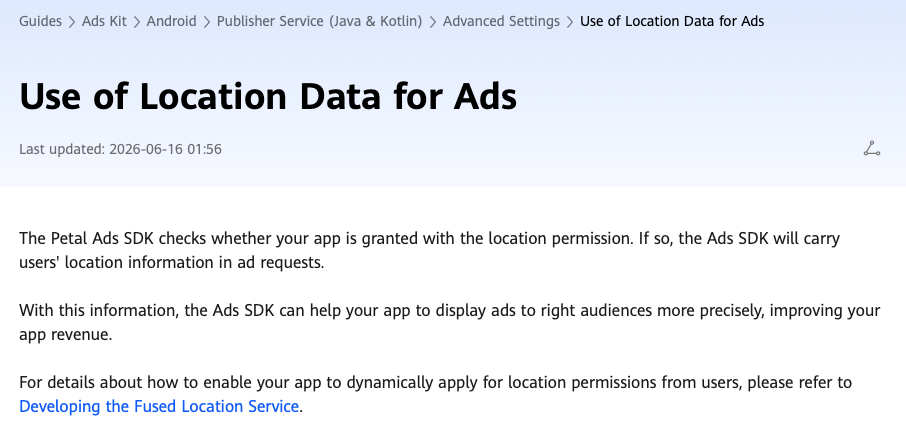
[Observed on “Use of Location Data for Ads,” 7/31/26]
Location Data Sharing Can Happen Without Users’ Knowledge or Meaningful Consent
In some cases, after an app itself obtains location permission, advertising SDKs can separately obtain and share users’ location information without their knowledge or meaningful consent. Neither app that EFF observed sharing precise location data with BidMachine (QR Scanner and GPS Speedometer) showed a notice or requested consent before doing so. Additionally, neither apps’ Google Play Store “Data safety” section includes location data under “This app may share these data types with third parties.” The lack of transparency and control that users have over their location on mobile apps is dangerous. QR Scanner and GPS Speedometer are just two examples of apps that quietly share users’ location data through advertising SDKs, but they have been downloaded more than 50 million and 10 million times, respectively.
App-level location permissions alone cannot signal meaningful consent to location collection and sharing by third-party advertising SDKs.
Even if users’ were to grant these apps permission to obtain their location data, they would likely not expect their location data to be shared with third parties. Many users don’t know that granting location permissions to an app grants the same permissions to third-party SDKs embedded in the app, or that an app they’re using contains code from outside companies. And many apps that request location permissions, like GPS Speedometer, require it for core functionality. App-level location permissions alone cannot signal meaningful consent to location collection and sharing by third-party advertising SDKs.
Location Privacy Issues Extend Beyond These Four SDKs
Our initial focus on four advertising SDKs does not mean that other SDKs adequately protect location data or that developers never choose to share location data when it’s not the default. Advertising SDKs not discussed in this report have been criticized and sued for allegations that they collect location data without valid user consent.
The issues we’ve highlighted around privacy-invasive defaults, financial incentives, and unclear documentation extend beyond the specific SDKs we analyzed. Multiple studies have found that advertising SDKs often steer developers toward increased data collection through their design and documentation. A 2021 study found that popular advertising SDKs used dark patterns to nudge developers towards sharing more sensitive data. A 2024 study identified discrepancies between several SDKs’ documentation and their actual data collection practices. And a 2025 study concluded that developers have minimal influence over SDKs’ data transmission, often leaving them with the choice of accepting SDKs’ invasive data collection or avoiding them entirely.
Fighting Back Against AdTech Companies That Enable and Encourage Location Data Sharing
EFF’s analysis shows that advertising SDKs don’t just allow developers to share location data–they often encourage it. Default settings, financial incentives, and unclear documentation can make sharing users’ location the easiest option for developers.
Users can take extra steps to defend their location privacy, but they shouldn’t have to. Developers, regulators, and legislators must act to stop apps from leaking users’ location to advertising companies and data brokers.
Developers
Developers should carefully evaluate all third-party SDKs they include in their apps and disable unnecessary data collection whenever possible. Regardless of advertising SDKs’ default settings, developers have a responsibility to protect their users’ location data. But protecting users’ privacy shouldn’t depend on developers reading the right piece of SDK documentation. Advertising SDKs should not make sharing personal data the default, especially for data as sensitive as a person’s location.
Regulators
Regulators should continue to hold app developers accountable when they unlawfully share personal data and include libraries which subject users to privacy harms, as they have in the past. But they should also scrutinize the companies whose SDKs encourage these practices at scale. Otherwise, companies can continue to design SDKs that make invasive data sharing the default while shifting the responsibility and consequences to developers who include their tools.
Legislators
The US is in dire need of a federal law to protect all Americans’ location privacy, one which doesn’t preempt stronger state privacy laws, and has a private right of action empowering individuals to sue those who violate their privacy. Countries across the globe should likewise enact legislation that protects their users’ location privacy. Everyone deserves privacy as a universal human right.
Legislators can address the root of the problem by banning online behavioral advertising. This would remove the primary incentive for companies to track and share your personal data. It would also prevent users’ precise locations from being broadcast to data brokers through RTB auctions.
Until then, developers should be wary of ad libraries that betray their users’ location privacy.
Notes on MethodologyWe were interested in looking at network traffic for various Android ads SDKs that send precise location by default when granted location permissions. We chose Android for this investigation because of the relative openness of and our familiarity with analysis on the platform. We’ve used publicly available resources like Exodus Privacy and AppBrain to identify popular ads SDKs and the apps which include them. In a lab setting, we set up a machine to view our own http(s) traffic using mitmproxy from our test device, and connect the test device to that machine in order to view our real-time traffic. Where needed, we use the dynamic instrumentation toolkit Frida to ensure the traffic we generate can be analyzed. We’ve included flows files in this post, which can be opened in mitmproxy to show the requests we’ve observed with location coordinates. |
Read the full article here
Fact Checker
Verify the accuracy of this article using AI-powered analysis and real-time sources.