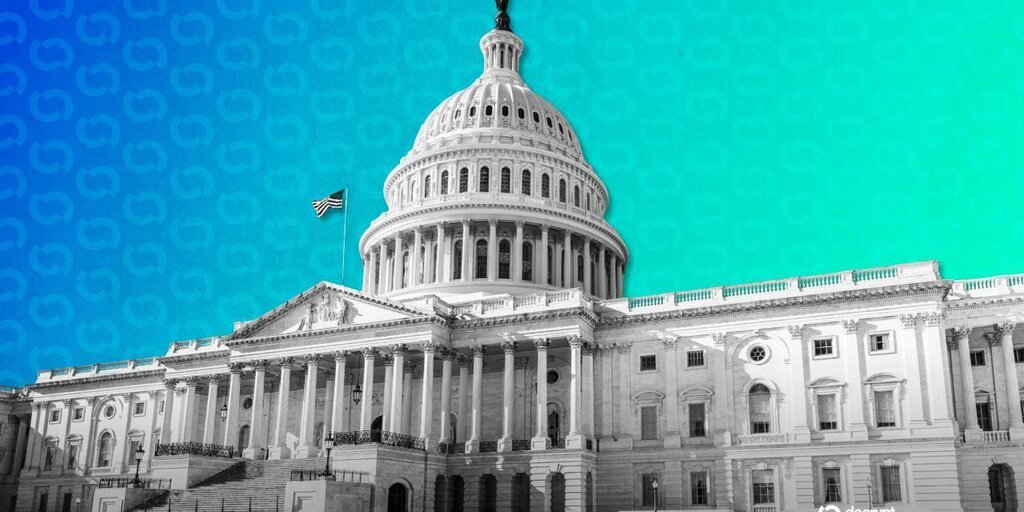
The House Ways and Means Committee approved the Digital Asset Tax Certainty Act.
The proposal covers transaction fees, stablecoins, mining, staking and lending.
The bill must still pass both chambers of Congress before reaching the president.
The House Ways and Means Committee approved the Digital Asset Tax Certainty Act Wednesday, sending a proposal to overhaul crypto taxation to the full House.
The committee announced the markup on Monday, scheduling the session for lawmakers to review H.R. 10357, consider amendments and vote on whether to send it to the full House.
Myriad: Will Democrats sweep midterm elections? Click to make your prediction.
“This wasn’t built overnight,” committee Chairman Rep. Jason Smith (R-Mo.) said in a statement, crediting more than a year of bipartisan work.
“The legislation before us today is the product of that work, bringing clarity, parity, and workability to digital asset taxation and helping keep the United States the crypto capital of the world, instead of pushing that innovation, and the jobs that come with it, offshore,” Smith said.
For crypto users, the proposal would remove gain-or-loss calculations on qualifying network or transaction fees of $10 or less. Paying those fees with tokens can trigger tax accounting because digital assets are treated as property. The relief would begin in 2028 and apply to eligible fee payments, not small crypto purchases generally.
The bill would simplify tax calculations for qualifying dollar stablecoins traded near their redemption value, classify mining and staking rewards as ordinary income, and allow certain investment trusts to stake assets without losing their tax status solely for doing so. It excludes an earlier proposal to let taxpayers defer recognition of some mining and staking rewards.
It would also extend wash-sale rules to traded digital assets, generally delaying loss deductions when investors acquire substantially identical assets within 30 days before or after selling. Qualifying crypto loans would not be treated as sales, and eligible taxpayers could correct past returns through a new disclosure program, according to the Joint Committee on Taxation.
The tax bill advanced a day after the Senate failed to move forward with the separate Clarity Act, which addresses crypto market oversight. The SEC and CFTC have since pledged to pursue crypto rules under their existing powers.
The tax proposal still requires approval from both chambers in identical form and the president’s signature before becoming law.
“I look forward to building on that work as we move these policies forward,” Smith said.
Daily Debrief Newsletter
Start every day with the top news stories right now, plus original features, a podcast, videos and more.
The FSNN News Room is the voice of our in-house journalists, editors, and researchers. We deliver timely, unbiased reporting at the crossroads of finance, cryptocurrency, and global politics, providing clear, fact-driven analysis free from agendas.
We and our selected partners wish to use cookies to collect information about you for functional purposes and statistical marketing. You may not give us your consent for certain purposes by selecting an option and you can withdraw your consent at any time via the cookie icon.
Cookies are small text that can be used by websites to make the user experience more efficient. The law states that we may store cookies on your device if they are strictly necessary for the operation of this site. For all other types of cookies, we need your permission. This site uses various types of cookies. Some cookies are placed by third party services that appear on our pages.
Your permission applies to the following domains:
https://fsnn.net
Necessary
Necessary cookies help make a website usable by enabling basic functions like page navigation and access to secure areas of the website. The website cannot function properly without these cookies.
Statistic
Statistic cookies help website owners to understand how visitors interact with websites by collecting and reporting information anonymously.
Preferences
Preference cookies enable a website to remember information that changes the way the website behaves or looks, like your preferred language or the region that you are in.
Marketing
Marketing cookies are used to track visitors across websites. The intention is to display ads that are relevant and engaging for the individual user and thereby more valuable for publishers and third party advertisers.


 Freedom Index