

 Freedom Index
Listen to the article
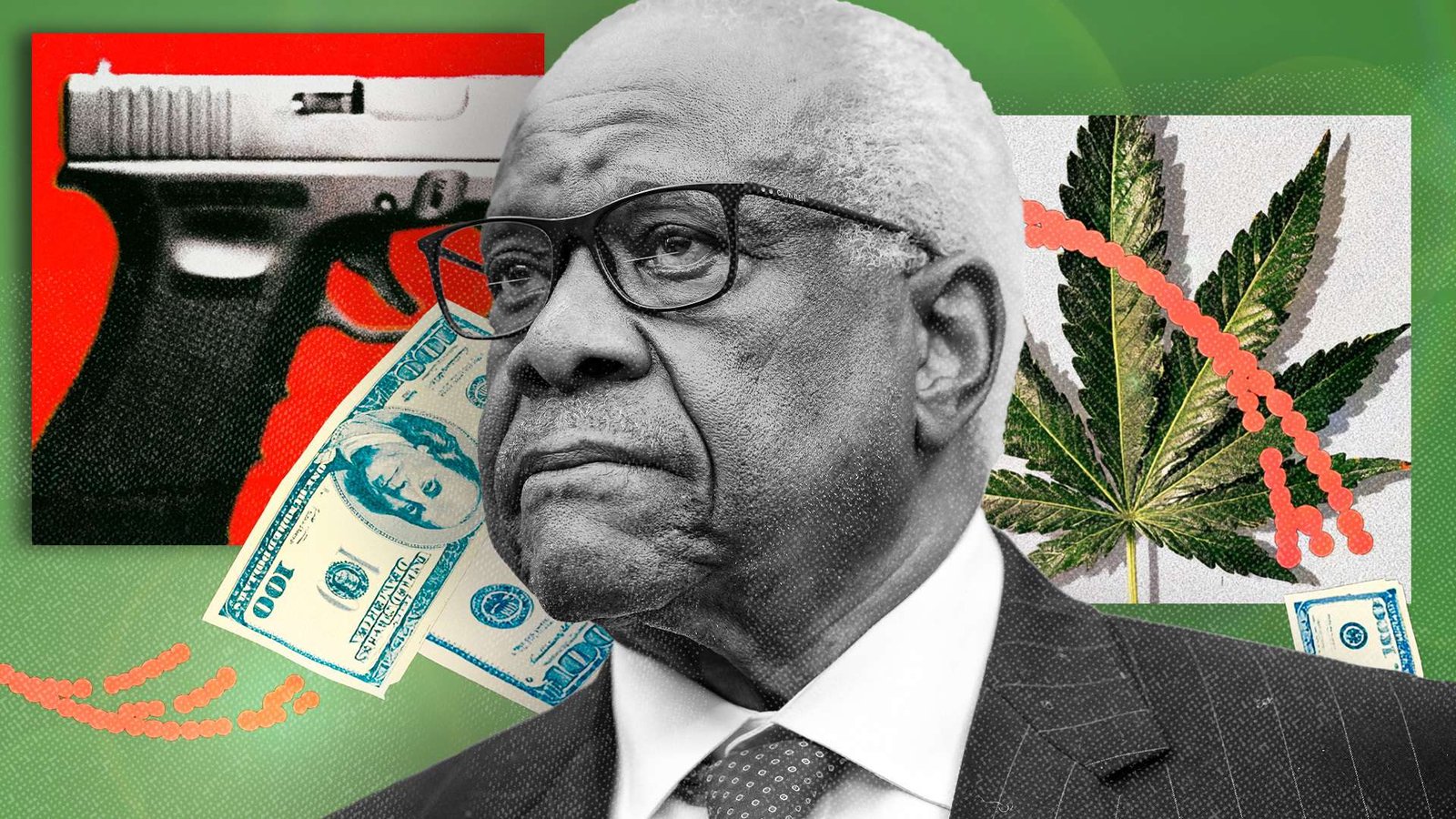
Last week in United States v. Hemani, the Supreme Court unanimously ruled that the government may not strip people of their Second Amendment rights or prosecute them for illegal gun possession simply because they are marijuana users. Justice Clarence Thomas, the longest-serving current member of the Court, joined his colleagues in upholding the Second Amendment rights of cannabis consumers threatened with prosecution under 18 USC 922(g)(3), which makes it a felony for an “unlawful user” of “any controlled substance” to possess a firearm. But Thomas perceived another constitutional problem with that law, arguing that it exceeds the federal government’s power to regulate interstate commerce.
As Reason‘s Damon Root notes, Thomas’ understanding of the Commerce Clause underlies a “lonely crusade” that he has been waging for decades. But the fact that Thomas has not mustered much support for his position from his colleagues does not mean he is wrong. To the contrary, it is hard to deny that laws like Section 922(g)(3), which applies to gun possession “in or affecting commerce,” rely on a highly elastic interpretation of the Commerce Clause that converts it into a license for nearly anything Congress wants to do.
Thomas’ objection to Section 922(g)(3) also applies to other provisions of the same law that categorically prohibit gun possession by broad classes of Americans. Those provisions include Section 922(g)(1), which permanently disarms people who have been convicted of crimes punishable by more than a year of incarceration, and Section 922(g)(4), which covers people who have been subjected to involuntary psychiatric treatment. In fact, all of the categorical bans in Section 922(g) rely on the same dubious justification, purporting to establish congressional authority by criminalizing gun possession “in or affecting commerce.”
In practice, that supposed qualification does not impose any limits at all. Thomas illustrates that point by noting what would have been required to convict the Texas cannabis consumer whose prosecution the Supreme Court barred in Hemani. In addition to establishing that Ali Hemani owned a pistol and used marijuana a few times a week (both of which he admitted), prosecutors would have had to prove that his gun “had previously traveled in interstate commerce.”
Since Hemani owned a Glock 19 pistol manufactured either in Austria or Georgia, that requirement would have been easily met. Prosecutors “alleged only that the firearm that he possessed had ‘been shipped and transported in interstate and foreign commerce’ in the past—even though Hemani was indicted for possessing it in his home in Texas,” Thomas notes in his concurring opinion. “The Government did not have to allege, nor would it have had to prove at trial, that Hemani bought the firearm from someone in another State or even carried it across state lines himself at any point.”
Section 922(g) “appears to exceed Congress’s powers under the Commerce Clause,” Thomas writes. “As a matter of both original meaning and this Court’s precedents, Congress lacks the power to regulate the possession of firearms solely on the ground
that they crossed state lines at some point in the past.”
As it was originally understood, Thomas says, the Commerce Clause “authorizes Congress only ‘to regulate the buying and selling of goods and services trafficked across state lines.'” Here he is quoting his own dissent in the 2005 case Gonzales v. Raich, which raised the question of whether the Commerce Clause authorized Congress to ban intrastate possession of medical marijuana. The majority held that it did, much to Thomas’ dismay.
“Diane Monson and Angel Raich use marijuana that has never been bought or sold, that has never crossed state lines, and that has had no demonstrable effect on the national market for marijuana,” Thomas wrote. “If Congress can regulate this under the Commerce Clause, then it can regulate virtually anything—and the Federal Government is no longer one of limited and enumerated powers.”
As that case illustrates, Thomas’ critique of federal gun laws also applies to federal drug laws to the extent that they criminalize intrastate conduct. Both types of laws were originally framed as revenue measures, a pretext that would have been unnecessary if legislators thought they could rely on the Commerce Clause. But after the Supreme Court stretched that grant of power to cover conduct that was neither commercial nor interstate, it became an all-purpose excuse for federal legislation.
Even under “this Court’s modern Commerce Clause doctrine,” Thomas argues, Section 922(g) is hard to justify. That doctrine, he notes, recognizes three justifications for congressional action: “It must either regulate ‘the use of the channels of interstate commerce,’ ‘regulate and protect the instrumentalities of interstate commerce, or persons or things in interstate commerce,’ or regulate ‘activities that substantially affect interstate commerce.'”
On its face, Section 922(g) does not “regulate the ‘use of the channels of interstate commerce’ because it criminalizes possession of a firearm within a State long after any use of those channels,” Thomas writes. “Nor does it ‘regulate and protect the instrumentalities of interstate commerce, or persons or things in interstate commerce’ because it requires no showing that the possession in question poses any risk to interstate buying, selling, shipping, or transportation.”
Thomas also doubts that Section 922(g)(3) and the other categorical gun bans are directed at “activities that substantially affect interstate commerce.” He notes that “the
mere possession of a firearm that long ago crossed state lines is not ‘economic activity’ in any sense, and the Court has never upheld regulation of intrastate activity that is not
‘economic in nature’ under this category.”
Three decades ago, the Supreme Court seemed to be taking such concerns seriously. In the 1995 case United States v. Lopez, the Court ruled that Congress had exceeded its Commerce Clause authority when it passed the Gun-Free School Zones Act of 1990, which made it a felony to possess a firearm within 1,000 feet of a school. Five years later in United States v. Morrison, the Court rejected “the argument that Congress may regulate noneconomic, violent criminal conduct based solely on that conduct’s aggregate effect on interstate commerce.”
Although those cases seemed to promise that the Court would start enforcing limits on the Commerce Clause, nothing much came of them. Consider what happened with the Gun-Free School Zones Act.
“The Act neither regulates a commercial activity nor contains a requirement that the possession be connected in any way to interstate commerce,” Chief Justice William Rehnquist wrote for the majority in Lopez. “If we were to accept the Government’s arguments, we are hard pressed to posit any activity by an individual that Congress is without power to regulate.” Rehnquist also noted that the law “contains no jurisdictional element which would ensure, through case-by-case inquiry, that the firearm possession in question affects interstate commerce.”
Concurring in Lopez, Thomas agreed that Congress had clearly overstepped its authority. “The power to regulate ‘commerce,'” he said, “can by no means encompass authority over mere gun possession, any more than it empowers the Federal Government to regulate marriage, littering, or cruelty to animals, throughout the 50 States.”
The following year, Congress responded to Lopez by amending the Gun-Free School Zones Act to specify that its restrictions applied only to “a firearm that has moved in or that otherwise affects interstate or foreign commerce.” As Congress saw it, however, even a gun that is made and sold in the same state where it is possessed “affects interstate or foreign commerce,” given the cumulative impact that bringing guns into school zones has on “a pervasive, nationwide problem.”
The U.S. Court of Appeals for the 8th Circuit thought Congress had cured the problem identified by Rehnquist. Because the law “contains language that ensures, on a case-by-case basis, that the firearm in question affects interstate commerce,” the appeals court ruled in 1999, it is “a constitutional exercise of Congress’s Commerce Clause power.” The U.S. Court of Appeals for the 9th Circuit concurred in 2005, noting that “incorporating a jurisdictional element into the offense has traditionally saved statutes from Commerce Clause challenges.”
Congress, in short, initially forgot that it was supposed to be regulating “interstate or foreign commerce.” But after the Supreme Court reminded it, the invocation of that phrase supposedly was enough to fix the law, even though nothing of substance had changed.
Unsurprisingly, Thomas disagrees with that understanding of what the Commerce Clause requires. He notes that some courts have upheld Section 922(g) based on Scarborough v. United States, a 1977 case in which the Supreme Court held that someone with a felony record could be convicted of illegal gun possession under federal law as long as the firearm “previously traveled in interstate commerce.” That reliance on Scarborough is mistaken, Thomas says, because the decision involved statutory interpretation rather than the Commerce Clause, and “the Court has never held that §922(g) is constitutional whenever the Scarborough test is satisfied.”
Other courts have held that Section 922(g)’s “jurisdictional hook” is enough for it to pass muster under the Commerce Clause. “This justification, too, appears to conflict with our precedents,” Thomas says. “Congress cannot regulate the possession of every thing that ever traveled across state lines. As a statutory matter, Congress required no more. But, treating Congress’s ‘jurisdictional element’ as dispositive ‘could very well remove any limit on the commerce power’ and ‘would trespass on traditional state police powers.’ It would also render meaningless this Court’s decisions requiring that exercises of the commerce power fit within defined categories.”
The Commerce Clause “does not authorize Congress to ‘regulate or ban possession of any item that has ever been offered for sale or crossed state lines,'” Thomas concludes. “Such an understanding would ‘convert congressional authority under the Commerce Clause to a general police power of the sort retained by the States.'”
The same concern animated Thomas’ vigorous dissent in Gonzales v. Raich. If merely alluding to interstate commerce is enough to justify national legislation, Congress “can regulate virtually anything,” and “the Federal Government is no longer one of limited and enumerated powers.”
Read the full article here
Fact Checker
Verify the accuracy of this article using AI-powered analysis and real-time sources.