Close Menu
FSNN | Free Speech News NetworkFSNN | Free Speech News Network
  • Home
  • News
    • Politics
    • Legal & Courts
    • Tech & Big Tech
    • Campus & Education
    • Media & Culture
    • Global Free Speech
  • Opinions
    • Debates
  • Video/Live
  • Community
  • Freedom Index
  • About
    • Mission
    • Contact
    • Support
Trending

The Trump Administration’s Secret YIMBY Grant Proposal

36 seconds ago

Brazil’s tokenization push draws in banking heavyweight Itaú

19 minutes ago

ARP Digital Wins VARA License for Dubai Crypto Services

24 minutes ago
Facebook X (Twitter) Instagram
Facebook X (Twitter) Discord Telegram
FSNN | Free Speech News NetworkFSNN | Free Speech News Network
Market Data Newsletter
Tuesday, August 11
  • Home
  • News
    • Politics
    • Legal & Courts
    • Tech & Big Tech
    • Campus & Education
    • Media & Culture
    • Global Free Speech
  • Opinions
    • Debates
  • Video/Live
  • Community
  • Freedom Index
  • About
    • Mission
    • Contact
    • Support
FSNN | Free Speech News NetworkFSNN | Free Speech News Network
Home»Opinions»Debates»China’s Ghost Cities Show Failed Tech Moonshot
Debates

China’s Ghost Cities Show Failed Tech Moonshot

News RoomBy News Room2 months agoNo Comments3 Mins Read2 Views
Share Facebook Twitter Pinterest Copy Link LinkedIn Tumblr Email VKontakte Telegram
China’s Ghost Cities Show Failed Tech Moonshot
Share
Facebook Twitter Pinterest Email Copy Link

Listen to the article

0:00
0:00

Key Takeaways

Playback Speed

Select a Voice

Our rockets can find Halley’s Comet and reach Venus.
But our fridges don’t work.

~Mikhail Gorbachev

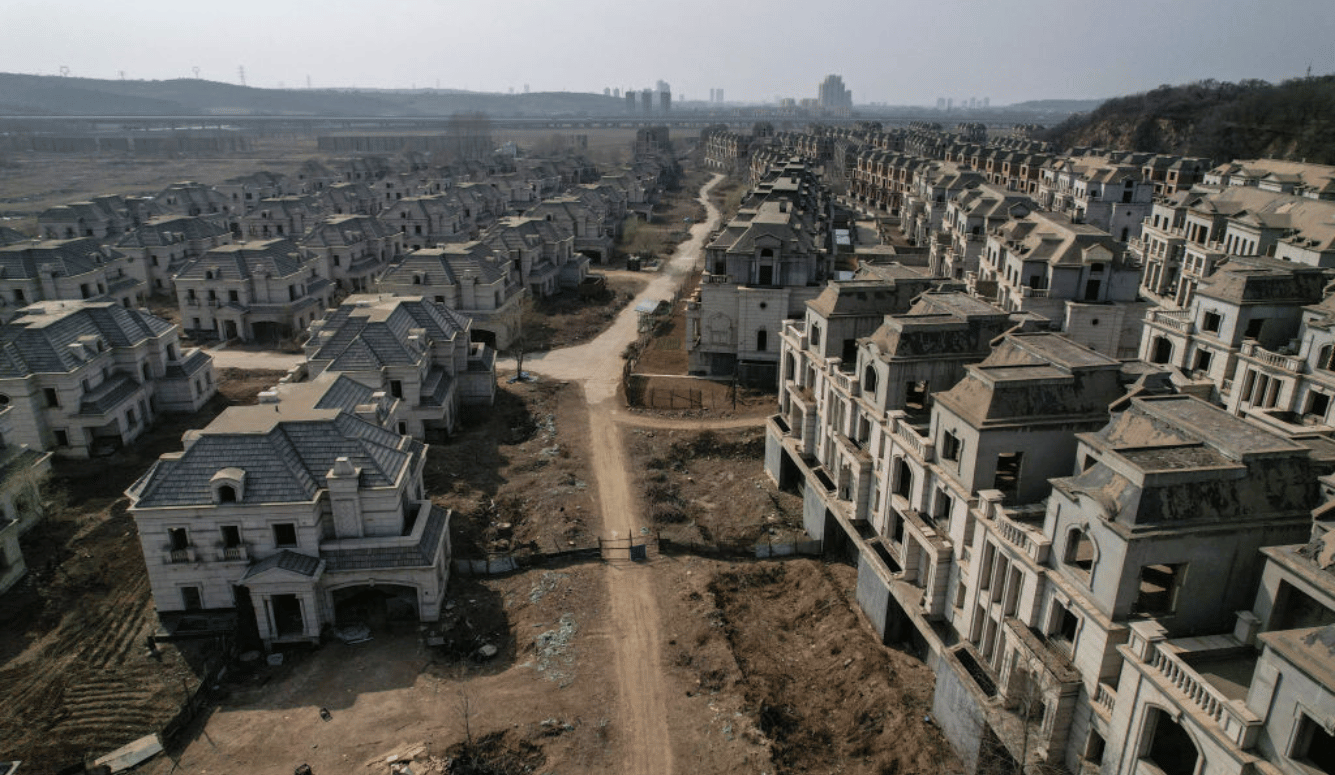
In the hills of northeast China, the “State Guest Mansions” sit empty and silent, like the well-preserved ruins of some lost civilisation. There are 260 of these mansions, huge but tediously uniform, each of them close to completion. The project was abandoned a couple of years after launch in 2010. Now local farmers plough the surrounding land. Cattle roam the villas, along with the occasional feral dog. Inside, urban explorers climb through the open jambs and fly their drones down marble hallways, creating creepy home movies.

Similar sights can be seen all over the country, of course, in China’s famed “ghost cities” (or sometimes “ghost districts”). The skyscrapers in Tianjin’s Binhai New Area may rise no higher than in any other major city, but the silence and emptiness of the surrounding neighbourhood makes the buildings feel truly enormous: looming, forbidding, watchful. In his 2024 book Vampire State, Ian Williams describes a “ghostly conurbation” on the other side of the country, near Dongguan, that boasts the world’s largest shopping mall:

Cavernous dusty halls, layer upon layer of meandering marble-lined walkways beside the shells of hundreds of shops, but not a soul to be seen. Wires hung from ceilings like an infestation of snakes. An artificial river wound through the complex, its water stagnant and dark green.

These vast monuments to state folly provide an apt picture of the Chinese economy: the speed and scale, the single-minded vigour, and then the waste left behind. The latter feature is partly due to China’s modern problem (communists with their central planning) and partly due to China’s ancient problem (a kowtowing mandarin culture that rewards impressive visible display over efficiency).

The rot spreads far beyond the ghost-city phenomenon. Georgetown professor Ning Leng carried out research in fifteen cities across China. She found that local governments had prioritised the building of expensive wastewater treatment plants over the construction of underground sewage pipes and drainage systems. They had focused on big treatment facilities because these looked more impressive to their bosses in Beijing. Without a vital subterranean root system of pipes and drainage, the treatment plants were operating far below capacity, and pollution was pumping into rivers and lakes.

And so on, and so on. China’s vaunted high-speed rail network piled up a trillion dollars in debt; most lines now run at a loss. In 2024, 90.6 percent of the country’s regional airports had fewer than one flight per day on average. Something similar is even happening in the wake of China’s protracted real-estate downturn, as the CCP tries to rescue the Chinese economy by pouring billions into a small handful of strategic industries—AI, robotics, chips, green energy.

This bold strategy is the Communist Party’s last great moonshot (itself actually the name of a major Chinese AI startup). The fear is that if Beijing can’t dominate in these industries then it will become technologically dependent on foreign powers. The hope is that high-tech sectors can replace the fallen giant of real estate and together constitute a new driver for the Chinese economy, while simultaneously enabling Beijing to “seize the commanding heights of technological competition and future development,” leapfrogging Washington into the position of global hegemon.


Read the full article here

Fact Checker

Verify the accuracy of this article using AI-powered analysis and real-time sources.

Get Your Fact Check Report

Enter your email to receive detailed fact-checking analysis

5 free reports remaining

Continue with Full Access

You've used your 5 free reports. Sign up for unlimited access!

Already have an account? Sign in here

Share. Facebook Twitter Pinterest LinkedIn Tumblr Email Telegram Copy Link
News Room
  • Website
  • Facebook
  • X (Twitter)
  • Instagram
  • LinkedIn

The FSNN News Room is the voice of our in-house journalists, editors, and researchers. We deliver timely, unbiased reporting at the crossroads of finance, cryptocurrency, and global politics, providing clear, fact-driven analysis free from agendas.

Related Articles

Media & Culture

The Trump Administration’s Secret YIMBY Grant Proposal

36 seconds ago
Cryptocurrency & Free Speech Finance

AI Agent Hacks a Gym—And the Tech World Wonders What’s Next

28 minutes ago
Media & Culture

The Censorship Industrial Complex Didn’t Exist Until The People Who Invented It Took It Over

1 hour ago
Media & Culture

Klein and Thompson’s Abudance Shows Abundant Lack of Introspection

1 hour ago
Cryptocurrency & Free Speech Finance

Russia Approves Trading of Bitcoin, Ethereum and USDT—But No XRP

1 hour ago
Media & Culture

Free Speech Unmuted: Can AI Libel You? The Robby Starbuck Case

2 hours ago
Add A Comment

Comments are closed.

Editors Picks

Brazil’s tokenization push draws in banking heavyweight Itaú

19 minutes ago

ARP Digital Wins VARA License for Dubai Crypto Services

24 minutes ago

AI Agent Hacks a Gym—And the Tech World Wonders What’s Next

28 minutes ago

The Censorship Industrial Complex Didn’t Exist Until The People Who Invented It Took It Over

1 hour ago
Latest Posts

Klein and Thompson’s Abudance Shows Abundant Lack of Introspection

1 hour ago

Ravencoin, a blockchain built from Bitcoin’s code, could roll back four days of transactions

1 hour ago

Strategy Remains Committed to Bitcoin Buys Despite Recent BTC Sales, CEO Says

1 hour ago

Subscribe to News

Get the latest news and updates directly to your inbox.

At FSNN – Free Speech News Network, we deliver unfiltered reporting and in-depth analysis on the stories that matter most. From breaking headlines to global perspectives, our mission is to keep you informed, empowered, and connected.

FSNN.net is owned and operated by GlobalBoost Media
, an independent media organization dedicated to advancing transparency, free expression, and factual journalism across the digital landscape.

Facebook X (Twitter) Discord Telegram
Latest News

The Trump Administration’s Secret YIMBY Grant Proposal

36 seconds ago

Brazil’s tokenization push draws in banking heavyweight Itaú

19 minutes ago

ARP Digital Wins VARA License for Dubai Crypto Services

24 minutes ago

Subscribe to Updates

Get the latest news and updates directly to your inbox.

© 2026 GlobalBoost Media. All Rights Reserved.
  • Privacy Policy
  • Terms of Service
  • Our Authors
  • Contact

Type above and press Enter to search. Press Esc to cancel.

🍪

Cookies

We and our selected partners wish to use cookies to collect information about you for functional purposes and statistical marketing. You may not give us your consent for certain purposes by selecting an option and you can withdraw your consent at any time via the cookie icon.

Cookie Preferences

Manage Cookies

Cookies are small text that can be used by websites to make the user experience more efficient. The law states that we may store cookies on your device if they are strictly necessary for the operation of this site. For all other types of cookies, we need your permission. This site uses various types of cookies. Some cookies are placed by third party services that appear on our pages.

Your permission applies to the following domains:

  • https://fsnn.net
Necessary
Necessary cookies help make a website usable by enabling basic functions like page navigation and access to secure areas of the website. The website cannot function properly without these cookies.
Statistic
Statistic cookies help website owners to understand how visitors interact with websites by collecting and reporting information anonymously.
Preferences
Preference cookies enable a website to remember information that changes the way the website behaves or looks, like your preferred language or the region that you are in.
Marketing
Marketing cookies are used to track visitors across websites. The intention is to display ads that are relevant and engaging for the individual user and thereby more valuable for publishers and third party advertisers.