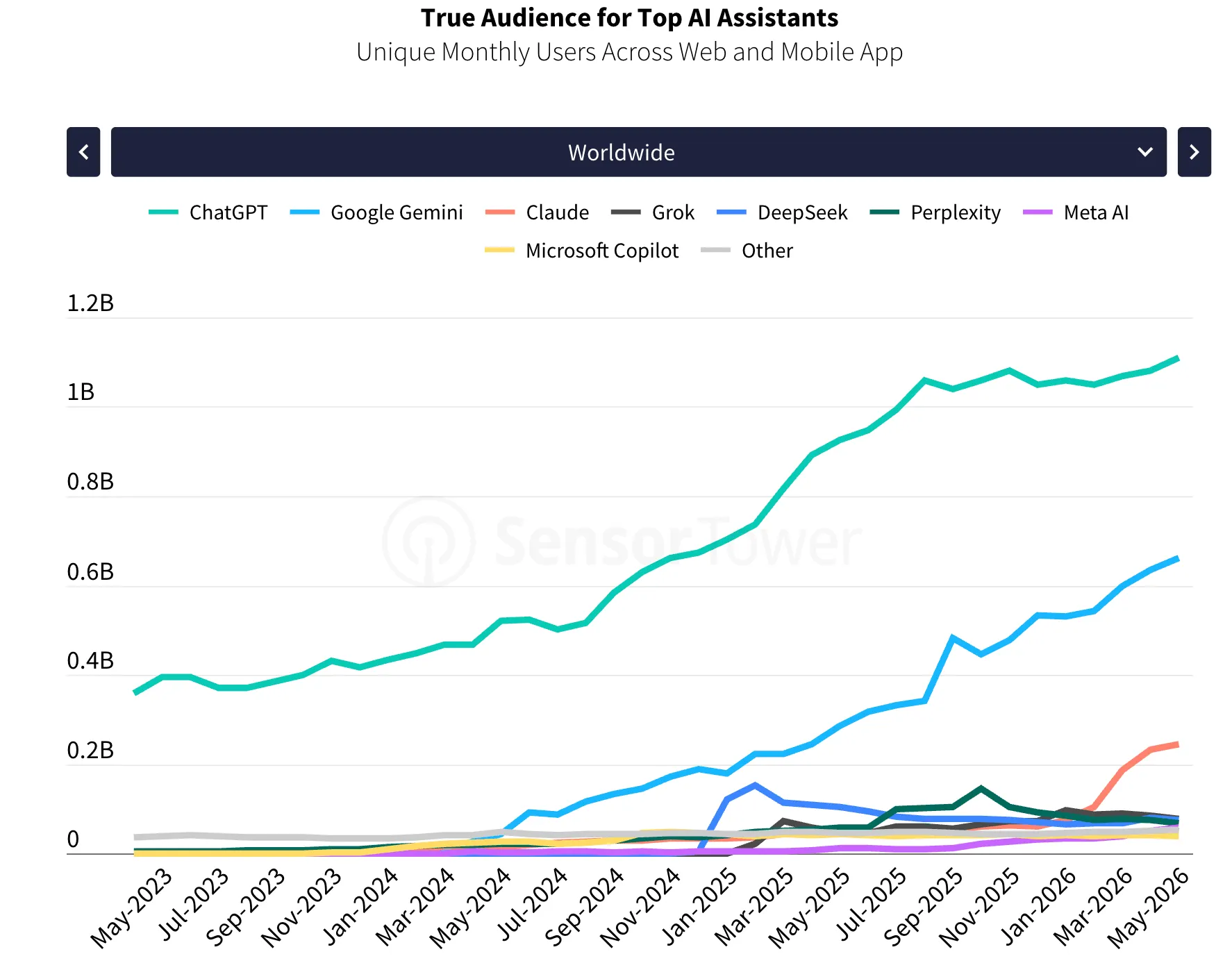
ChatGPT’s True Audience market share sat at 46% by the end of May, per Sensor Tower’s State of AI 2026 report.
Google Gemini climbed to 28% share and Claude to 10%.
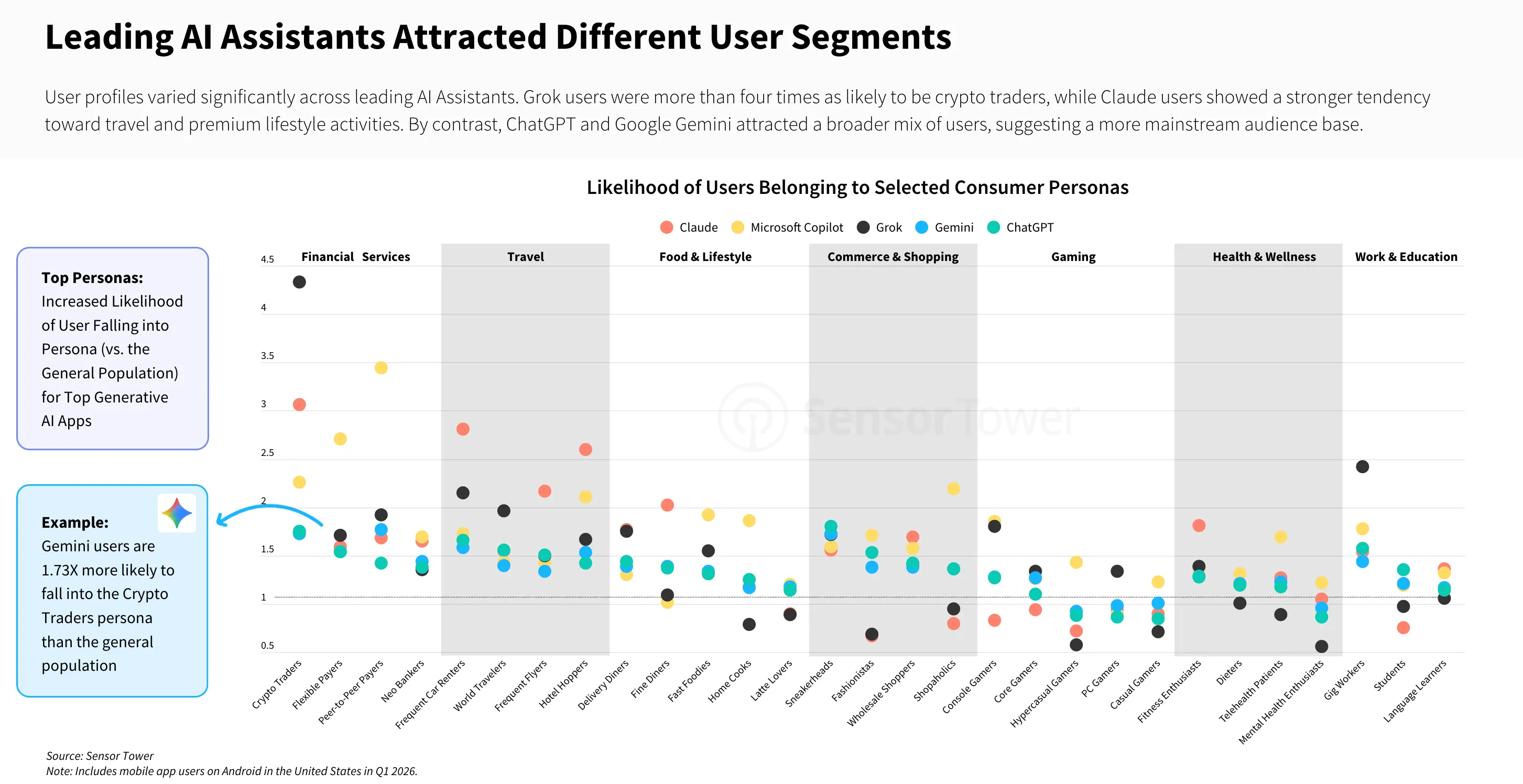
Grok users are about four times more likely than the general population to be crypto traders, the widest skew Sensor Tower measured for any assistant, ahead of Claude, Copilot, and ChatGPT in that order.
For three years, ChatGPT had the rarest advantage in tech: Its name was the category. Nobody said they were using generative AI. They said they were “using ChatGPT,” the way people once said they’d Google something.
But it’s possible ChatGPT’s glory days from 2023 are over.
ChatGPT’s share of the AI assistant market dropped below 50% for the first time in March 2026, then closed May at 46%, according to Sensor Tower’s new State of AI 2026 report. Google Gemini holds 28%. Claude has climbed to 10%.
None of that means ChatGPT is dying. The app crossed 1 billion monthly users in May, becoming the fastest app in history to hit that mark, ahead of TikTok, YouTube, and Instagram. OpenAI is now pushing ChatGPT toward a superapp bundling shopping and agents, timed to an IPO process it has already begun.
What’s ending is the monopoly on being the only AI app anyone’s normie cousin has heard of. Decrypt reported in May that ChatGPT’s web traffic share had already slid from 77.6% to 53.7% in a year. Sensor Tower’s numbers just confirm it crossed into minority territory.
The more alternatives in the market, the more brand-agnostic consumers are getting.
Gemini’s rise is mostly a distribution story, and the count depends on who’s doing it. Google told investors Gemini hit 750 million monthly users in February, then announced more than 900 million at its developer conference in May. Sensor Tower’s outside tracking, which measures only Gemini’s own app and site, puts that same month at 662 million.
Either number lands in the same place. ChatGPT’s dominance is fading not because it’s worse, but because distribution and defaults now matter more than raw capability—Gemini’s integration across Android, Search, Chrome, and Workspace gives it an advantage that benchmarks can’t capture.
Claude’s U.S. share nearly tripled, from 5% in December to 14% in May, and that spike has a name attached. In late February, Anthropic refused Pentagon demands to drop safeguards against mass surveillance and autonomous weapons, and the Department of Defense, renamed the Department of War, branded the company a supply chain risk. OpenAI signed its own deal with the same department days later.
ChatGPT uninstalls in the U.S. spiked roughly 200% above average the week of March 9, Sensor Tower found. Claude out-downloaded ChatGPT for five straight days that March, before ChatGPT’s lead snapped back. Brand trust turned out to be a feature too.
Crypto traders picked a favorite, and it’s not close
Buried in the user-persona data is the report’s best detail. Grok users are about four times more likely than the general population to be crypto traders, the widest skew of any assistant Sensor Tower measured.
For some reason, ChatGPT is ‘meh’ among degens. Claude is a distant second, ahead of Copilot, with ChatGPT users barely above the population baseline.
Grok’s edge traces back to X, where it ships free inside Premium and reads live posts the second a meme coin starts trending, an advantage no standalone chatbot has.
So the structural factors really reinforce each other here—Grok’s embedded in X’s ecosystem where crypto traders already congregate, it taps directly into real-time sentiment and meme coin chatter, Musk’s personal crypto enthusiasm shapes the platform’s culture, and the user base itself skews toward people already steeped in crypto Twitter dynamics. This creates a self-reinforcing loop that naturally pulls Grok toward crypto-focused output.
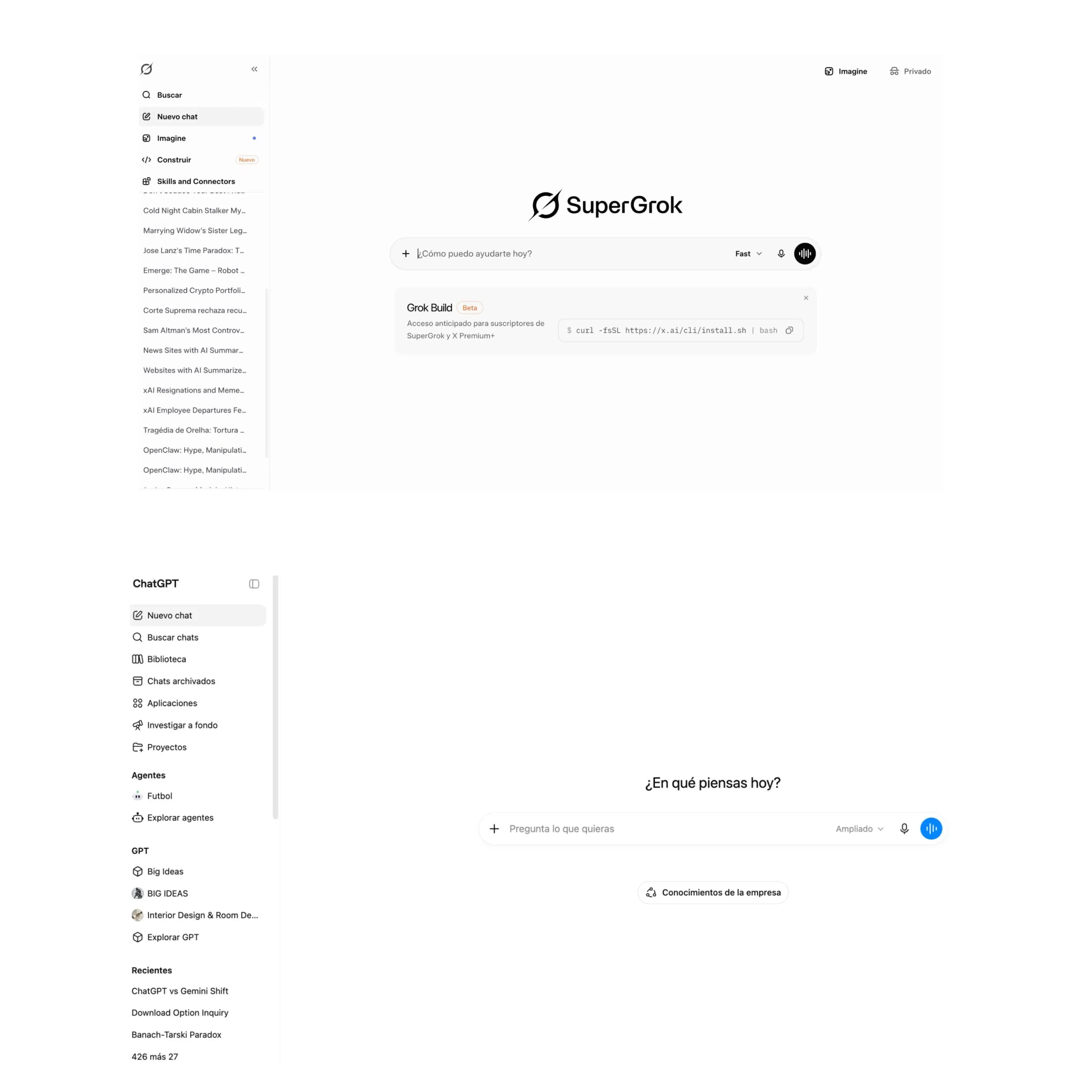
It also offers a similar experience to ChatGPT depending on the situation-a chat box, artifacts, coding capabilities, generative image, generative video which ChatGPT doesn’t offer, web searching, connectors, etc.
Claude’s runner-up spot tracks with last fall’s Alpha Arena contest, where Grok and Claude Sonnet posted real-money trading gains on the Hyperliquid exchange while GPT-5 and Gemini 2.5 Pro each lost more than a quarter of their stake. Crypto Twitter remembers who made it money, so they may not be too crazy judging by their chatbot preferences.
The revenue numbers back up the user numbers. Claude’s average revenue per U.S. mobile user jumped from under $0.50 last September to $2.76 in May, ahead of ChatGPT’s $1.74, and 13% of Claude’s users now pay for a subscription, the highest conversion rate in the report. OpenAI is heading toward an IPO with the biggest audience in AI history and a shrinking claim on what that audience actually prefers.
Daily Debrief Newsletter
Start every day with the top news stories right now, plus original features, a podcast, videos and more.
The FSNN News Room is the voice of our in-house journalists, editors, and researchers. We deliver timely, unbiased reporting at the crossroads of finance, cryptocurrency, and global politics, providing clear, fact-driven analysis free from agendas.
We and our selected partners wish to use cookies to collect information about you for functional purposes and statistical marketing. You may not give us your consent for certain purposes by selecting an option and you can withdraw your consent at any time via the cookie icon.
Cookies are small text that can be used by websites to make the user experience more efficient. The law states that we may store cookies on your device if they are strictly necessary for the operation of this site. For all other types of cookies, we need your permission. This site uses various types of cookies. Some cookies are placed by third party services that appear on our pages.
Your permission applies to the following domains:
https://fsnn.net
Necessary
Necessary cookies help make a website usable by enabling basic functions like page navigation and access to secure areas of the website. The website cannot function properly without these cookies.
Statistic
Statistic cookies help website owners to understand how visitors interact with websites by collecting and reporting information anonymously.
Preferences
Preference cookies enable a website to remember information that changes the way the website behaves or looks, like your preferred language or the region that you are in.
Marketing
Marketing cookies are used to track visitors across websites. The intention is to display ads that are relevant and engaging for the individual user and thereby more valuable for publishers and third party advertisers.


 Freedom Index