ChatGPT’s global web traffic share fell from 77.6% in May 2025 to 53.7% in April 2026, per SimilarWeb.
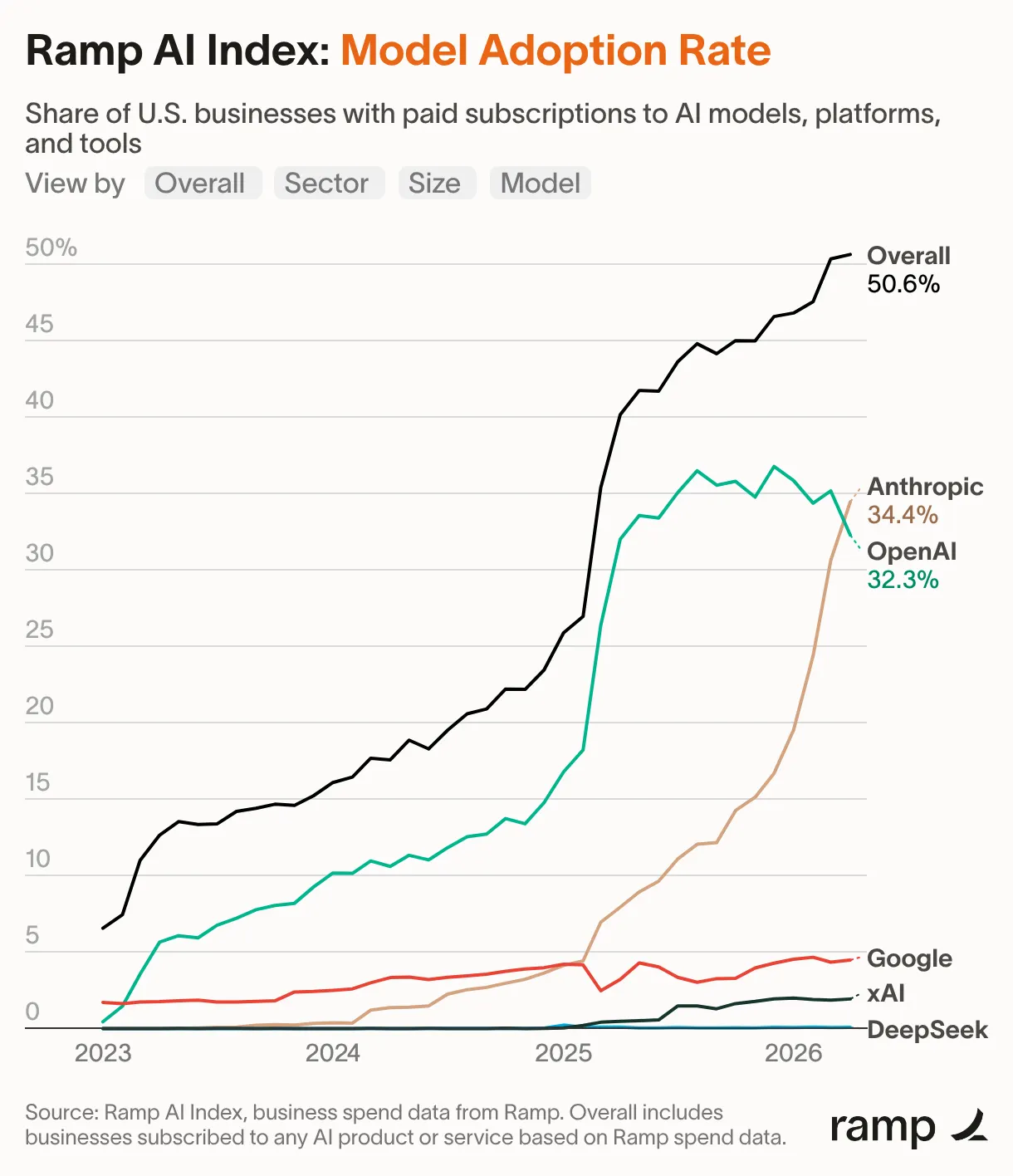
For the first time, Anthropic passed OpenAI in business adoption: 34.4% vs. 32.3% of companies tracked by the Ramp AI Index.
Secondary markets are pricing Anthropic at around $1 trillion—above OpenAI’s $880 billion on Forge Global.
For a long time, “ChatGPT” was almost synonymous with “AI.” That shorthand is getting harder to defend.
According to SimilarWeb’s latest web traffic data, ChatGPT commanded 77.6% of global generative AI website traffic in May 2025. By April 2026, that share had dropped to 53.7%. Still the leader—but it’s lost roughly 24% in 12 months.
The ground it’s ceding isn’t going to a single challenger. Google’s Gemini went from 7.27% to 26.7% in the same window—nearly quadrupling its share. Claude jumped from 1.37% to 7.95%, a near-sixfold increase.
Grok, Perplexity, and DeepSeek also grew, though less dramatically. The AI market is fragmenting, and OpenAI is carrying the cost of that fragmentation more than anyone else.
It’s worth being precise about what web traffic share actually measures. It counts visits to chatbot websites—not API calls, enterprise contracts, or the usage baked into third-party apps. Someone opening ChatGPT.com to write an email counts. A developer routing millions of API calls through Claude does not. So the web traffic numbers show consumer mindshare more than revenue or deployment at scale.
And that’s where the second data set comes in—and it tells a similar story. The Ramp AI Index, which tracks paid AI subscriptions across more than 50,000 U.S. businesses, published its May 2026 update this week. And, for the first time ever, more companies on Ramp’s platform are paying for Anthropic than for OpenAI.
Anthropic’s adoption rose 3.8% in April to 34.4% of businesses; OpenAI fell 2.9% to 32.3%.
Ramp lead economist Ara Kharazian called it “a stunning reversal.” A year ago, only 9% of businesses on the platform were paying for Anthropic at all. That number has now quadrupled. OpenAI, meanwhile, grew its business adoption by just 0.3% over the same 12 months.
The engine behind Anthropic’s business surge is largely Claude Code, the company’s agentic coding tool, which has been expanding rapidly in developer teams at firms of every size. Uber’s CTO publicly noted the company blew through its entire 2026 AI budget in four months—driven largely by Claude Code usage—with per-engineer monthly API costs running between $500 and $2,000.
One nuance the Ramp data can’t fully capture: OpenAI pushed back through a spokesperson, noting that its biggest enterprise deals don’t flow through corporate cards. “We are driving enterprise transformation at scale,” the company said, per Axios. “These are not engagements where customers pay with a credit card.” That’s a fair point—Ramp’s methodology captures a wide but imperfect slice of business spending.
Still, Ramp doesn’t think the lead will be easy to hold. The report flagged three specific risks: Anthropic’s token-based pricing model incentivizes pushing users toward more expensive models; Claude has experienced service outages and quality complaints in recent weeks; and newer, cheaper inference platforms are growing fast on Ramp’s own data. The index notes that OpenAI’s Codex does similar developer tasks at lower cost, with minimal friction to switch.
Traders and investors are paying attention to all of this. As Decrypt previously reported, Anthropic’s shares on secondary trading platform Forge Global were hovering around $1 trillion—above OpenAI’s $880 billion on the same platform. Three months ago, Anthropic’s secondary market valuation was $380 billion. That’s the market’s way of saying it believes the current trajectory is real, even if premature.
Both OpenAI and Anthropic pushed back against these markets, but still those statistics are a decent thermometer, if even on relatively illiquid markets, of what the global market is expecting and how people are seeing these companies.
Meanwhile, Google’s Gemini has been gaining ground since at least mid-2025, with its Android integration giving it structural distribution advantages that other challengers simply don’t have. ChatGPT was built on novelty and first-mover advantage. Both are fading assets. OpenAI’s next test is whether it can rebuild the lead on substance—Codex growth and enterprise contract wins are the two figures Ramp says it’ll be tracking next month.
Daily Debrief Newsletter
Start every day with the top news stories right now, plus original features, a podcast, videos and more.
The FSNN News Room is the voice of our in-house journalists, editors, and researchers. We deliver timely, unbiased reporting at the crossroads of finance, cryptocurrency, and global politics, providing clear, fact-driven analysis free from agendas.
We and our selected partners wish to use cookies to collect information about you for functional purposes and statistical marketing. You may not give us your consent for certain purposes by selecting an option and you can withdraw your consent at any time via the cookie icon.
Cookies are small text that can be used by websites to make the user experience more efficient. The law states that we may store cookies on your device if they are strictly necessary for the operation of this site. For all other types of cookies, we need your permission. This site uses various types of cookies. Some cookies are placed by third party services that appear on our pages.
Your permission applies to the following domains:
https://fsnn.net
Necessary
Necessary cookies help make a website usable by enabling basic functions like page navigation and access to secure areas of the website. The website cannot function properly without these cookies.
Statistic
Statistic cookies help website owners to understand how visitors interact with websites by collecting and reporting information anonymously.
Preferences
Preference cookies enable a website to remember information that changes the way the website behaves or looks, like your preferred language or the region that you are in.
Marketing
Marketing cookies are used to track visitors across websites. The intention is to display ads that are relevant and engaging for the individual user and thereby more valuable for publishers and third party advertisers.


 Freedom Index