

 Freedom Index
Listen to the article
“Hate speech” is notoriously hard to define and is usually a subjective characterization of harsh words. Though the term is thrown around by people describing comments they don’t like, it generally refers to expression that might not be nice but is protected by the First Amendment to the United States Constitution as well as state speech protections. But that’s not going to stop California lawmakers from trying to hector people into refraining from voicing nasty sentiments.
You are reading The Rattler from J.D. Tuccille and Reason. Get more of J.D.’s commentary on government overreach and threats to everyday liberty.
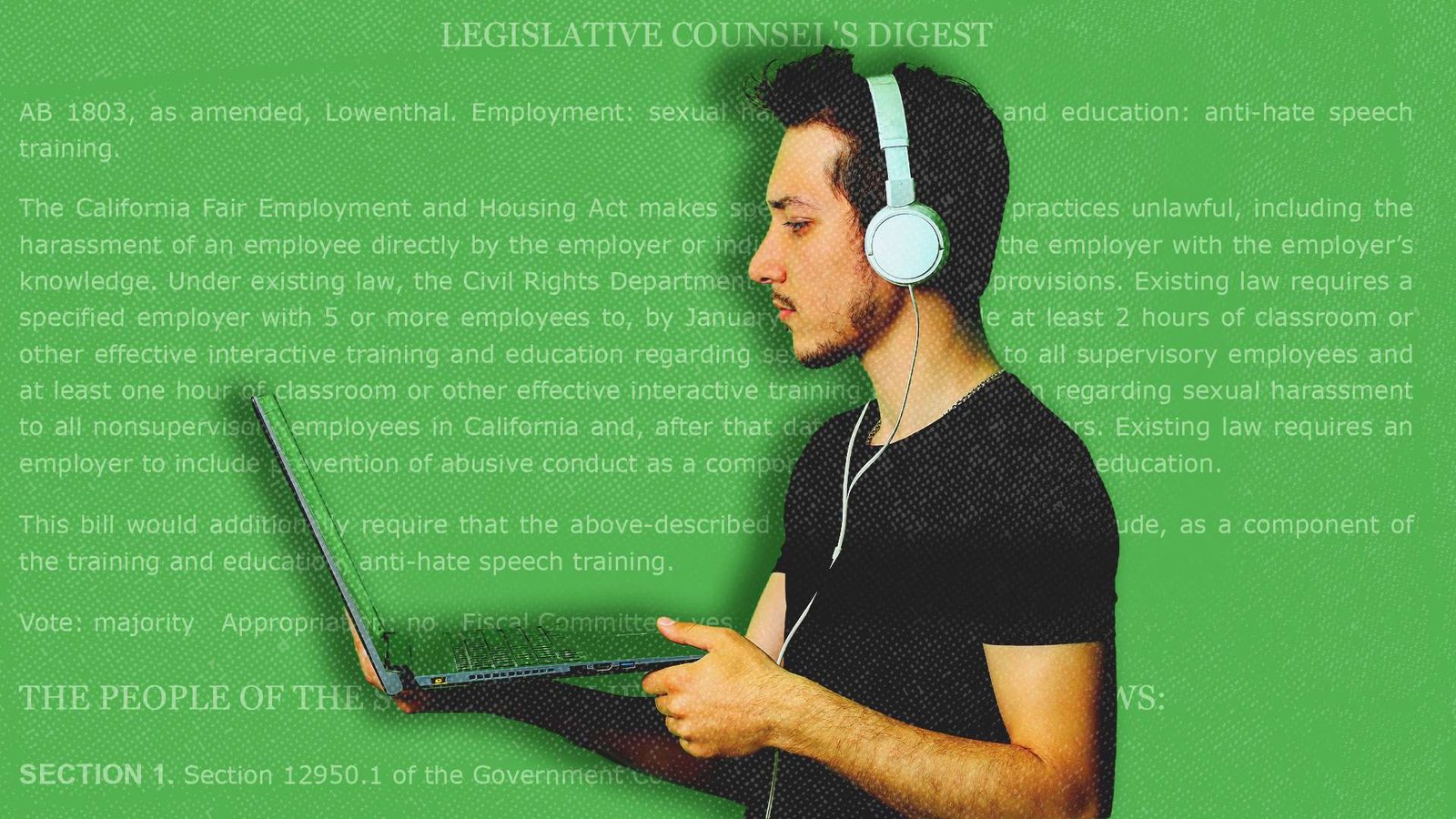
Existing California law requires employers with five or more employees to provide at least two hours of training regarding sexual harassment to all supervisors, and at least one hour of training to all other employees, repeated every two years. Assembly Bill 1803, introduced by Assemblymembers Josh Lowenthal (D–Long Beach) and Rick Chavez Zbur (D–Los Angeles) and co-authored by Assemblymember Corey Jackson (D–Moreno Valley), “would additionally require that the above-described training and education include, as a component of the training and education, anti-hate speech training.”
In a press release, Lowenthal claims that “AB 1803 is about making our workplaces safer, more respectful, and more inclusive for everyone. Hate speech has no place on the job, just as sexual harassment has no place on the job. By incorporating anti hate speech training into existing sexual harassment prevention programs, we are building on a proven framework to address harmful behavior before it escalates.”
What the world really doesn’t need, it should be noted, is more state-mandated nagging about the allegedly naughty activities we shouldn’t engage in. As PBS’s Rhana Natour reported in 2018, “there’s little evidence that sexual harassment training works.” A 2016 U.S. Equal Opportunity Employment Commission report concluded that “much of the training done over the last 30 years has not worked as a prevention tool—it’s been too focused on simply avoiding legal liability.” Research by Justine Tinkler, a sociologist at the University of Georgia, found that such training mostly reinforces traditional views of sex roles by portraying men as predators and women as victims. But training is an effective time suck.
Hate speech has the added burden of being primarily a political term used to describe expression that somebody doesn’t like. This makes it very difficult to describe in an actionable way in a country that has vigorous speech protections. California’s lawmakers have not risen to the challenge.
“As drafted, AB 1803 does not define hate speech,” observes the California Assembly Committee on Labor and Employment analysis of the bill. “Committee staff is not aware of a definition of hate speech in California law. Hate speech itself is not illegal but can violate employment law if it rises to an actionable level of workplace harassment or discrimination. Nevertheless, the author may wish to consider defining hate speech in the bill so as to give guidance to employers and the CRD [Civil Rights Department] since these entities will be developing the anti-hate speech training.”
So, the bill in its current reform would require employers to consume business resources and workers’ time with mandatory admonishments to not do something called “hate speech,” whatever that might be. Which is probably not illegal to begin with.
“‘Hate speech’ includes speech protected by the First Amendment — speech the government has no business trying to snuff out with legal mandates,” point out Adam Goldstein and Greg Gonzalez of the Foundation for Individual Rights and Expression (FIRE). “But also, it has no clear or consistent definition. Because of that vagueness, efforts to regulate ‘hate speech’ risk giving the government sweeping authority to suppress views it doesn’t like.”
That’s not a hypothetical possibility—it’s reality in countries that have adopted hate speech laws. Robert Habeck, an official in Germany’s last government, was infamous for wielding the country’s restrictive speech laws against his critics. “German Economy Minister Robert Habeck has filed complaints over 730 cases of criminal hate speech since April last year,” Politico‘s Nette Nöstlinger reported in 2024. A few of the cases involved actual threats, but many others were sparked by insults such as referring to Habeck as a “professional idiot.”
Current Chancellor Freidrich Merz continues that tradition; his government pressed charges against a man who called the politician “Pinocchio.” With around 300 such prosecutions underway, a German court recently ordered the government to disclose which prosecutors are handling the cases.
In the majority of these prosecutions, people face fines and prison time for saying unpleasant things that enjoy full legal protection under American law.
“In the United States, hate speech is protected by the First Amendment,” according to the American Library Association. “Courts extend this protection on the grounds that the First Amendment requires the government to strictly protect robust debate on matters of public concern even when such debate devolves into distasteful, offensive, or hateful speech that causes others to feel grief, anger, or fear.”
“Hate speech can only be criminalized when it directly incites imminent criminal activity or consists of specific threats of violence targeted against a person or group,” the group adds.
California lawmakers have tried to clarify their proposed legislation—mostly by adding scare words. That doesn’t make supposedly hateful speech itself illegal because it can’t.
“Recent amendments to AB 1803, citing speech that ‘vilifies, humiliates, or incites hatred’ based on protected characteristics, do little to resolve this problem,” comment FIRE’s Goldstein and Gonzalez. “Terms like ‘vilify,’ ‘humiliate,’ and ‘incite hatred’ lack clear legal meaning, so you end up with a vague mandate that fails to distinguish between protected speech and unprotected conduct.”
They warn that if forced to implement hate speech training, private employers will probably restrict perfectly lawful speech just to avoid hassles with state regulators.
A.B. 1803 was introduced as part of a package with A.B. 1578, which mandates hate speech training for state and local elected officials, and A.B. 2347, which mandates hate crime training for police officers.
It will be interesting to see if California lawmakers succeed more at consuming workplace time or at inviting First Amendment lawsuits.
Read the full article here
Fact Checker
Verify the accuracy of this article using AI-powered analysis and real-time sources.