

 Freedom Index
Listen to the article
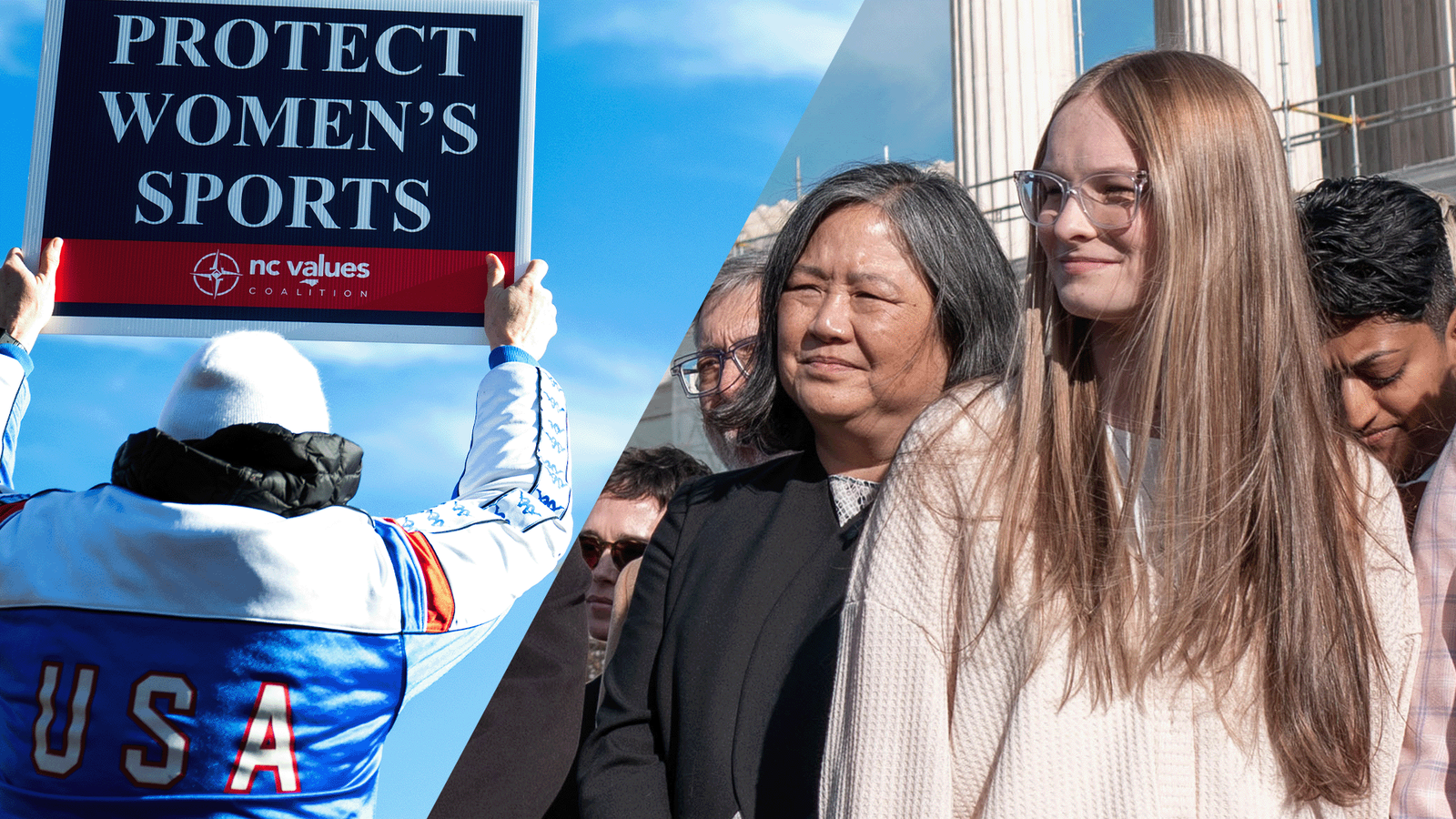
Becky Pepper-Jackson just wanted to be on the girls’ middle school cross country team. Now, five years later, she’s at the Supreme Court.
In 2021, West Virginia enacted a law banning transgender girls from playing on girls’ and women’s sports teams, from middle school through college, from the top levels of athletics down through intramural sports. But Pepper-Jackson didn’t just wake up one morning and decide to identify as a girl so that she could be on the middle school cross country team—she transitioned in third grade, never went through male puberty, and has been undergoing hormone therapy. Her lawyers argue that means she wouldn’t have an unfair athletic advantage against other girls—the science on that front is mixed.
Her story is one of many complex examples that show the legal and scientific questions around transgender athletes are far from the black-and-white issues that activists on both sides portray them as. Justice Brett Kavanaugh seemed to argue as much on Tuesday: “Given that half the states are allowing it, allowing transgender girls and women to participate, about half are not, why would we at this point…jump in and try to constitutionalize a rule for the whole country while there’s still…uncertainty and debate?” That argument came as the Supreme Court considered the constitutionality of an Idaho law that is similar, but a little more broad, than West Virginia’s. In theory, the same argument applies to laws like California’s, which is the polar opposite in that it says schools must allow transgender athletes to play on the team for whatever gender they identify with. Blanket policies that either allow or disallow all transgender athletes from participating in girls’ and women’s sports are not the way—they are better handled on a case-by-case basis closer to the ground, at the level of the individual school, league, or governing body for each sport that can look at the nuances of each athlete.
Including Idaho and West Virginia, 27 states have laws restricting transgender participation in female athletics. Each one raises difficult questions about who they apply to, where they apply, and what to do about unexpected edge cases—like, perhaps, Pepper-Jackson’s argument that she has no athletic advantage due to her prepubescent
transition.
In West Virginia, for example, athletic eligibility is determined by whatever sex was on the person’s birth certificate. That’s simple in most cases, but what about cases where a birth certificate is lost and can’t be verified, or where the government is at fault for putting the wrong information down?
In Idaho, the verification process is much more invasive. If an athlete’s gender is disputed, they would have to have a doctor establish their sex “based solely on: (a) The student’s internal and external reproductive anatomy; (b) The student’s normal endogenously produced levels of testosterone; and (c) An analysis of the student’s genetic makeup.” (“Normal” levels are not defined in the four-page law.)
All that can be triggered by anyone who raises a dispute—even by someone who just wants to abuse the process and subject a rival to embarrassment and invasive medical testing. It could also mean that a girl or woman who was born female, has always been biologically female, and happens to have higher than normal natural testosterone levels could get caught up in the ban even though she’s not transgender.
(Some might argue those higher than normal testosterone levels are easily dealt with by hormone suppression. South African Olympic runner Caster Semenya described her experience on such medications: “It makes you feel sick, nauseous. You have panic attacks. It starts creating a little bit of blood clots in your system. Your stomach is burning. You eat a lot. You can’t sleep.”)
The complexities of these laws aren’t just biological, but geographical. How are private schools implicated? In West Virginia, they still fall under the law’s restrictions if they want to participate in the West Virginia Secondary School Activities Commission, the state’s main governing body for high school sports. What about private youth leagues, and does it matter if they are playing at public or private facilities? At least in Idaho and West Virginia, they seem to be allowed to set their own rules and are allowed to include transgender athletes in competition at public facilities if they so choose, as long as they are not school-affiliated teams.
The complexities are constitutional in nature, too. Kavanaugh and Justice Elena Kagan wondered aloud if, perhaps, all states should be forced to exclude transgender athletes from women’s sports. Multiple justices discussed whether Bostock v. Clayton County (2020) comes into play, a ruling that banned employer discrimination on the basis of sexual orientation or gender identity. Justice Neil Gorsuch wrote in that decision that “an employer who fires an individual for being homosexual or transgender fires that person for traits or actions it would not have questioned in members of a different sex.” Does that call into question the constitutionality of separate boys and girls sports leagues at public schools? The justices didn’t seem to want to get into that.
Opponents of these laws do not seem optimistic about getting them overturned. Pepper-Jackson’s lawyer is hoping the Supreme Court will send the case back to lower courts—presumably, he is either not confident considering the Supreme Court’s current makeup or trying to buy time. Plus, “the court’s three Democratic appointees appeared to recognize that the challengers faced an uphill battle,” as Amy Howe wrote on SCOTUSblog. “They seemed to devote much of their efforts to mitigating their losses—either by getting one case thrown out or by limiting the court’s decision to a narrow one.”
When Kavanaugh mentioned the “uncertainty and debate” in this issue, he seemed to be arguing against the judiciary striking down the state bans on transgender athletes in women’s sports. Legislators should take that argument further and realize the complexities of this issue do not lend themselves well to heavy-handed regulation. Transgender people are a fraction of the population, transgender athletes an even smaller one, but each one deserves a flexible law that takes into account nuance and changes in science. It does not seem like the politicians in Idaho and West Virginia have taken many of these unique edge cases into account—and on the opposite side in California, it does not seem like politicians have taken the competitive implications of their law into account.
Perhaps a better standard would be one based on harm. Allowing an 11-year-old Becky Pepper-Jackson to be on her middle school cross country team doesn’t really harm anyone. The stakes are low or nil. Letting her and other transgender athletes participate in varsity sports at the high school and collegiate level—where there are scholarships and name, image, and likeness money on the line—is a whole different question, and one that is better handled on by sporting administrators close to the situation than politicians who think everything is simpler than it really is.
Read the full article here
Fact Checker
Verify the accuracy of this article using AI-powered analysis and real-time sources.