

Close Menu
FSNN | Free Speech News NetworkFSNN | Free Speech News Network
  • Home
  • News
    • Politics
    • Legal & Courts
    • Tech & Big Tech
    • Campus & Education
    • Media & Culture
    • Global Free Speech
  • Opinions
    • Debates
  • Video/Live
  • Community
  • Freedom Index
  • About
    • Mission
    • Contact
    • Support
Trending

ICE Officers Break Cameras. Cops Steal Them. Welcome To New Jersey.

26 minutes ago

ACLU Sues After Facial Recognition Falsely Identifies Florida Man as a Child Abductor

27 minutes ago

U.S. House bill would erect crypto-theft task force across law enforcement agencies

46 minutes ago
Facebook X (Twitter) Instagram
Facebook X (Twitter) Discord Telegram
FSNN | Free Speech News NetworkFSNN | Free Speech News Network
Market Data Newsletter
Thursday, June 11
  • Home
  • News
    • Politics
    • Legal & Courts
    • Tech & Big Tech
    • Campus & Education
    • Media & Culture
    • Global Free Speech
  • Opinions
    • Debates
  • Video/Live
  • Community
  • Freedom Index
  • About
    • Mission
    • Contact
    • Support
FSNN | Free Speech News NetworkFSNN | Free Speech News Network
Home»News»Media & Culture»Bondi Bragged About Forcing Facebook To Censor Speech. Now FIRE Is Suing.
Media & Culture

Bondi Bragged About Forcing Facebook To Censor Speech. Now FIRE Is Suing.

News RoomBy News Room4 months agoNo Comments13 Mins Read621 Views
Share Facebook Twitter Pinterest Copy Link LinkedIn Tumblr Email VKontakte Telegram
Share
Facebook Twitter Pinterest Email Copy Link

Listen to the article

0:00
0:00

Key Takeaways

Playback Speed

Select a Voice

from the every-accusation-is-a-confession-tweeted-out dept

I seem to recall a years-long freakout among MAGA folks about the Biden administration pressuring social media companies to remove content. You may have heard about it.

Anyway. In unrelated news FIRE (the Foundation for Individual Rights and Expression), has filed suit against Attorney General Pam Bondi and DHS Secretary Kristi Noem on behalf of Kassandra Rosado, who ran a 100,000-member Facebook group called “ICE Sightings – Chicagoland,” and Mark Hodges, who created the Eyes Up app for documenting and archiving videos of ICE enforcement activity.

The suit alleges that Bondi and Noem coerced Facebook into disabling the group and coerced Apple into pulling the app from its App Store, in direct violation of the First Amendment. Because, you know, government officials calling social media companies and demanding they remove content is… bad.

The legal theory is straightforward, the evidence is overwhelming, and perhaps most remarkably, the government handed FIRE much of its case on a silver platter. In other words, for all the talk of “censorship” during the Biden admin, which went nowhere due to the lack of any actual evidence, here there not only is evidence, it was eagerly and readily provided by Pam Bondi and Kristi Noem themselves. In public. Repeatedly. Proudly.

Let’s start with the basics of what actually happened, because the facts here are almost embarrassingly damning. Kassandra Rosado created her Facebook group in January 2025, initially as a small community resource for Chicago-area small business owners trying to understand how ICE raids were affecting foot traffic and community events. The group grew to nearly 100,000 members by October as ICE enforcement escalated under what the agency publicly branded “Operation Midway Blitz.” According to the complaint, Facebook’s own moderators reviewed thousands of posts and found exactly five that violated its guidelines. Just five. Which Facebook removed, telling Rosado that participants acting badly don’t impact the group themselves (a good policy!).

Out of thousands of posts and tens of thousands of comments that members of the Chicagoland group created through October 2025, Facebook’s own moderators found and removed only five purportedly violating its guidelines.

Even as to these five posts, Facebook advised Rosado that they were “participant violations” that “don’t hurt your group.” Facebook further explained: “Groups aren’t penalized when members or visitors break the rules without admin approval.”

Then, on October 12, 2025, Laura Loomer tagged Noem and Bondi in a social media post flagging the group. Loomer’s role here deserves a moment of appreciation. This is a person who sued Facebook, claiming it was literally RICO to moderate her posts. Who sued all the major tech companies, arguing that content moderation violated her First Amendment rights. Her entire public identity has been built on the premise that private platforms moderating her speech is unconstitutional censorship.

And here she is, tagging federal officials to demand they force Facebook to suppress other people’s speech. The First Amendment, which constrains government action, apparently only matters when Loomer is the one being moderated. When she wants someone else silenced, she calls in the actual state.
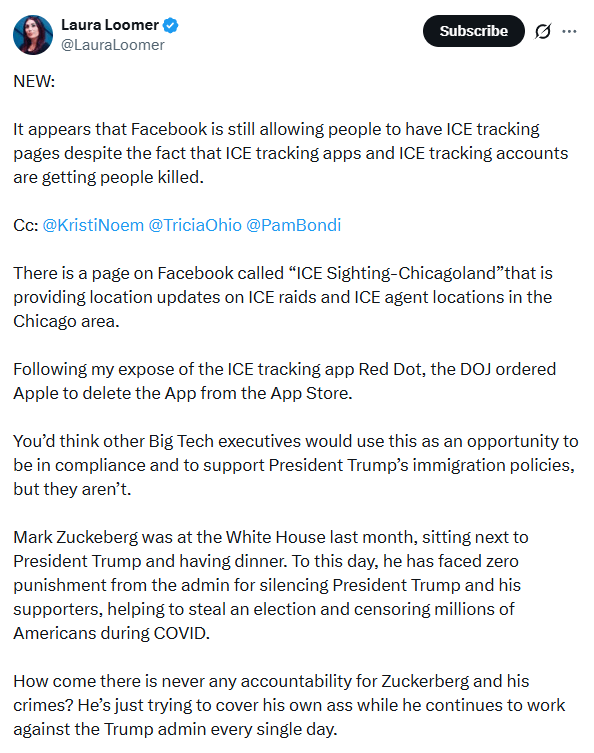
The next day, a DOJ source confirmed to Loomer that DOJ had contacted Facebook to demand removal.
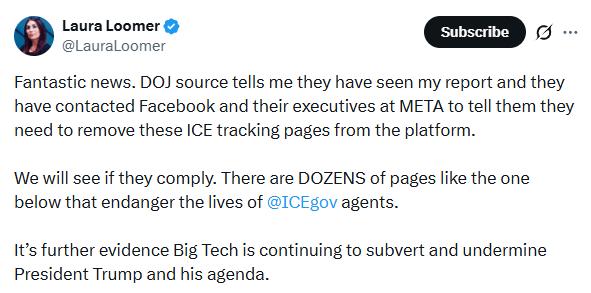
That same day, Facebook disabled the entire group. Then Bondi posted on social media claiming credit:
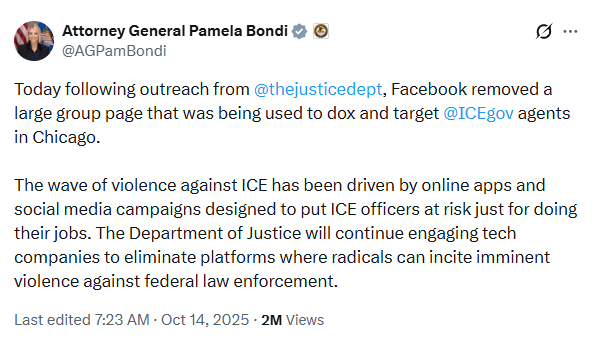
That’s the AG admitting to a pretty clear First Amendment violation. Not in a leaked email discovered through litigation. Not in a deposition. On X, taking credit. Proudly.

Today following outreach from @thejusticedept, Facebook removed a large group page that was being used to dox and target @ICEgov agents in Chicago.

…. The Department of Justice will continue engaging tech companies to eliminate platforms where radicals can incite imminent violence against federal law enforcement.

Noem piled on with her own post, crediting the DOJ for the takedown.

That’s the Secretary of Homeland Security saying:

Anti-ICE radicals are using social media apps to dox, threaten, and terrorize the brave men and women of ICE and their families.

Today, thanks to @POTUS Trump’s @TheJusticeDept under the leadership of @AGPamBondi, Facebook removed a large page being used to dox and threaten our ICE agents in Chicago.

These officers risk their lives every day arresting murderers, rapists, and gang members to protect our homeland. Platforms like Facebook must be PROACTIVE in stopping the doxxing of our @ICEgov law enforcement.

We will prosecute those who dox our agents to the fullest extent of the law.

The Eyes Up situation is even more instructive. Mark Hodges built Eyes Up specifically as a documentation and archiving tool for videos of ICE enforcement activity. The app uses manual moderation—meaning Hodges or other moderators personally review every video before it becomes publicly accessible.

The complaint specifically notes that:

Eyes Up is not useful for tracking ICE location or movement in real time. Because Hodges or other moderators manually review each video before it becomes publicly available, any ICE officers would be long gone by the time a video is posted.

Apple had independently reviewed and approved Eyes Up for the App Store in August 2025, raising no concerns about the content. On October 3, Apple removed it anyway—citing “information provided by law enforcement” that the app violated its guidelines on “Defamatory, discriminatory, or mean-spirited content.”

Bondi again made no effort to be subtle about DOJ’s role, gleefully telling Fox News:

“We reached out to Apple today demanding they remove the ICEBlock app from their App Store—and Apple did so.”

She later boasted at a roundtable that:

“We had Apple and Google take down the ICEBlock apps.”

For years, MAGA world has treated Murthy v. Missouri as a foundational text of government overreach—proof that the Biden administration ran a sophisticated censorship operation by pressuring social media companies to remove content. Jim Jordan convened hearings. The case went all the way to the Supreme Court, though MAGA folks love to ignore or downplay what the Supreme Court decision actually said about the case. The argument, reduced to its essence, was that White House officials sending emails asking platforms to review posts against their existing policies constituted unconstitutional “jawboning.”

The Supreme Court threw the case out because the plaintiffs couldn’t prove that the government’s communications actually caused the platforms to take action. The majority opinion by Justice Amy Coney Barrett found that the platforms were making their own independent decisions, often rejecting the government’s requests, and that the plaintiffs couldn’t trace any specific content removal directly to government coercion. The evidence, the Court concluded, just wasn’t there. Barrett’s opinion uses the phrase “no evidence” five times. And the little evidence plaintiffs did offer? She called it out as “unfortunately appear[ing] to be clearly erroneous.”

Bondi and Noem have now done something remarkable: they have provided, entirely on their own initiative and through public statements made to friendly media outlets, every single piece of evidence that was missing in Murthy.

Traceability? Bondi literally said “We reached out to Apple today demanding they remove the ICEBlock app—and Apple did so.” Coercion versus mere persuasion? The complaint details how Noem announced she was “working with the Department of Justice to see if we can prosecute” app developers, how Bondi told Fox News that ICEBlock’s creator “better watch out” because the speech was “not protected,” and how these explicit criminal threats preceded the removals.

The NRA v. Vullo standard, which the Supreme Court articulated just before the Murthy ruling (on a case they heard the same day as Murthy), holds clearly that a government official cannot use “the power of the State to punish or suppress disfavored expression” through third-party intermediaries. The complaint quotes this directly. There is no ambiguity here about what happened or who caused it.

In Murthy, investigators spent years poring over internal communications trying to find proof that the government’s requests had actually caused the platforms to act. And found nothing concrete. Here, the government’s own press releases and Fox News appearances serve that function. You don’t need subpoenas or discovery depositions when the Attorney General is posting on X to take credit.

The complaint captures the legal significance:

Attorney General Pamela Bondi and Homeland Security Secretary Kristi Noem want to control what the public can see, hear, or say about ICE operations. Wielding the power of federal criminal law, they coerced Facebook to disable Rosado’s Facebook group and coerced Apple to remove Kreisau Group’s Eyes Up app from its App Store. That’s unconstitutional. The First Amendment prohibits the government from coercing companies to censor protected speech. NRA v. Vullo, 602 U.S. 175, 190–91 (2024) (“[A] government official cannot do indirectly what she is barred from doing directly.”). Without this Court’s intervention, this unconstitutional coercion will continue.

That last line is important as well, because a key piece of Murthy was that to get an injunction, the plaintiffs had to show that these suppression efforts were likely to continue. That wasn’t there in Murthy. But here, we (again) have Noem and Bondi screaming to the heavens that they’re going to keep doing this.

The “officer safety” justification doesn’t survive contact with the actual facts. An app that archives manually reviewed videos of past ICE activity cannot be used to track officers in real time. The complaint notes that Apple had previously approved the app with full knowledge of what it did, then reversed course only after receiving “information from law enforcement”—which appears to mean a phone call from Bondi’s DOJ:

Apple cited its app review guideline 1.1.1, which prohibits “Defamatory, discriminatory, or mean-spirited content, including references or commentary about religion, race, sexual orientation, gender, national/ethnic origin, or other targeted groups.”

Apple had never previously stated that Eyes Up purportedly violated guideline 1.1.1 or included “Defamatory, discriminatory, or mean-spirited content.”

In fact, when Apple had independently reviewed Kreisau Group’s application to include Eyes Up in the App Store in August 2025, Apple did not conclude that Eyes Up violated guideline 1.1.1. During that review, Eyes Up was already available on its website, and Apple had full knowledge of the purpose of Eyes Up, of actual videos available on it, and of how it worked (including its location features). Apple flagged some unrelated issues, which Kreisau Group resolved before Apple approved the app. Apple raised no concern that Eyes Up contained “Defamatory, discriminatory, or mean-spirited” content in violation of guideline 1.1.1.

This appears to be the exact opposite of the situation in Murthy, where tech companies frequently rejected government requests if they didn’t violate policies. Here, it appears that, under pressure from Bondi, Apple changed its interpretation of the policies in a weak pretext to justify the government-led censorship.

And it was so clearly pretext:

Apple’s transparency reports show that from 2022 to 2024, it almost never removed apps for “Defamatory, discriminatory, or mean-spirited” content under guideline 1.1.1. Apple removed only three apps by US-based creators under guideline 1.1.1 in 2022, four apps in 2023, and none in 2024.

Eyes Up was not tracking anyone. It was creating an archive of documented government behavior in public spaces, exactly the kind of activity the First Amendment—and the Seventh Circuit’s precedent in ACLU v. Alvarez—exists to protect.

The viewpoint discrimination point in the complaint is also notable. The government targeted speech that was critical of ICE operations, while ICE itself actively posts on social media about its own enforcement activities, including specific locations and neighborhoods:

Bondi and Noem are not suppressing laudatory speech about ICE’s operations. ICE’s own social media accounts, for example, frequently share videos and photos of ICE arrests and other information indicating where enforcement operations occurred. Bondi and Noem only target such speech, like with Rosado’s Facebook group, that shares information about ICE operations in ways that are critical of those operations or that defendants perceive as such.

The same footage, in the government’s hands, becomes a success story, which make it textbook viewpoint discrimination.

Which brings us back to the political context that makes this so extraordinary to watch.

The people who spent years insisting that Biden’s White House committed the gravest sin against free speech in living memory by asking Twitter to look at some posts about COVID vaccines are, by and large, completely untroubled by Pam Bondi going on Fox News to brag about forcing Apple to remove an app.

The people who elevated Murthy v. Missouri into a constitutional crisis, who convened hearings and issued subpoenas and demanded that the “censorship industrial complex” be dismantled, have found absolutely nothing to say about a case where the Attorney General of the United States explicitly announced that she demanded a tech company remove an application and the company complied within hours.

Their position was, of course, never really about the principle. It was always about which direction the government’s thumb was pressing. When the Biden administration asked platforms to review COVID misinformation posts against their own existing policies—and platforms rejected the vast majority of those requests—that was tyranny.

When Bondi demands Apple remove an app and Apple does it the same day, that’s apparently just law enforcement doing its job.

The lawsuit asks for declaratory relief and injunctions preventing Bondi and Noem from continuing to coerce Apple and Facebook into suppressing this speech.

These irreparable harms will continue absent declaratory and prospective injunctive relief.

At no point have Bondi or Noem backtracked from their position that any involvement in ICE-tracking speech exposes an individual or business to criminal prosecution, nor from their demands that Apple and Facebook suppress such speech.

Accordingly, Bondi and Noem’s threats continue to hang over Apple and Facebook, who would risk adverse government action were they to reinstate Kreisau Group’s app or Rosado’s Facebook group

FIRE’s complaint frames the stakes with appropriate directness:

Our First Amendment right to speak “to oppose or challenge police action without thereby risking arrest is one of the principal characteristics by which we distinguish a free nation from a police state.” City of Houston v. Hill, 482 U.S. 451, 462–63 (1987). Plaintiffs bring this case to preserve our country’s fundamental character as a free nation, asking this Court to protect the basic First Amendment right to share information about our government and its activities.

The MAGA world spent four years constructing an elaborate theory of shadow-government censorship—one that required stretching reality to its breaking point, cherry-picked emails, and ultimately couldn’t survive Supreme Court scrutiny—when the actual government censorship they always claimed to fear was apparently just one phone call from the AG’s office away. They finally got the “coercive jawboning” they warned everyone about. Bondi and Noem are doing it out in the open, on television, and bragging about it in official social media posts.

And the free speech warriors have nothing to say.

Which tells you everything you need to know about what they actually believed all along. The principle was never “the government shouldn’t pressure platforms to remove speech.” The principle was “the government shouldn’t pressure platforms to remove our speech.” Now that the thumb is pressing in the direction they like, the constitutional crisis has mysteriously resolved itself.

Filed Under: 1st amendment, censorship, eyes up, free speech, ice sightings, iceblock, jawboning, kasandra rosado, kristi noem, laura loomer, mark hodges, pam bondi

Companies: apple, facebook, fire, meta

Read the full article here

Fact Checker

Verify the accuracy of this article using AI-powered analysis and real-time sources.

Get Your Fact Check Report

Enter your email to receive detailed fact-checking analysis

5 free reports remaining

Continue with Full Access

You've used your 5 free reports. Sign up for unlimited access!

Already have an account? Sign in here

#IndependentMedia #NewMedia #OpenInternet #TechIndustry #TechNews #Technology
Share. Facebook Twitter Pinterest LinkedIn Tumblr Email Telegram Copy Link
News Room
  • Website
  • Facebook
  • X (Twitter)
  • Instagram
  • LinkedIn

The FSNN News Room is the voice of our in-house journalists, editors, and researchers. We deliver timely, unbiased reporting at the crossroads of finance, cryptocurrency, and global politics, providing clear, fact-driven analysis free from agendas.

Related Articles

Media & Culture

ICE Officers Break Cameras. Cops Steal Them. Welcome To New Jersey.

26 minutes ago
Media & Culture

ACLU Sues After Facial Recognition Falsely Identifies Florida Man as a Child Abductor

27 minutes ago
Cryptocurrency & Free Speech Finance

Banks Say Stablecoin Rules Should Cover Secondary Markets

54 minutes ago
Media & Culture

The Economist Who Wants To Make the World Poorer

1 hour ago
Cryptocurrency & Free Speech Finance

Wall Street Giants, Sovereign Wealth Fund Back Canton Network Creator in $355M Round

2 hours ago
Media & Culture

Blockbuster NYT Reveal About Judge Ross Scandal

2 hours ago
Add A Comment

Comments are closed.

Editors Picks

ACLU Sues After Facial Recognition Falsely Identifies Florida Man as a Child Abductor

27 minutes ago

U.S. House bill would erect crypto-theft task force across law enforcement agencies

46 minutes ago

MassPay Taps Coinbase to Expand Stablecoin Payouts

48 minutes ago

Banks Say Stablecoin Rules Should Cover Secondary Markets

54 minutes ago
Latest Posts

The Economist Who Wants To Make the World Poorer

1 hour ago

An Afghan teacher. Photo: Yunus Tuğ/Unsplash+ I was sitting in the staffroom of the school where I teach. It was a hot afternoon, and the weather made everything feel heavier. The room was small and crowded, with furniture pushed tightly against the walls as if it had been forced into place years ago and never moved again. Beside me stood an old grey metal cupboard where we kept our daily lesson plans. Its doors were stiff and heavy, and sometimes we had to push hard just to open it properly. The room had only one window. Because the building was above the second floor, the window had been built high into the wall according to local customs, so people could not easily look into their neighbours’ homes. From where I sat beside the cupboard, I could glimpse the sky. It was pale blue mixed with grey, but the sunlight spread across it so harshly that it almost looked white. The brightness felt distant, as if it belonged to another world outside the room. Beside me sat Basira, one of my colleagues who had studied architectural engineering at university. Sometimes she looked at that window and spoke about the years she had spent drawing designs and construction plans, believing she was building a future for herself. She once told me that architecture had taught her to think about light, openness and possibility. Now she sat in a room where even the architecture carried silence and limitation. It was a private school, because that was the only place I could find work. In Afghanistan, private schools are usually attended by the children of businessmen, powerful families and those who can afford better educational opportunities. I studied in a public school myself and I have always believed that education does not depend entirely on the type of school someone attends, but on the determination and enthusiasm of the student. But when I went looking for a job, my opportunities were restricted. After the Taliban came to power in Afghanistan, women were stopped from teaching boys over the age of seven, and girls over the age of 11. Many high school teachers lost their jobs, their profession, their source of independence, stability and participation in society. Some of them moved down to teach at primary school. At the same time, women from other professions, like Basira, went into teaching because it was the only job open to them. The result is that a private school in Kabul or Mazar has an infinite supply of highly qualified women teachers and can treat them as badly as they like. We live under threat. As one of my colleagues said to me once: “Bring a knife and kill us instead. How can we live after being fired with no future and no place in society?” A simple example: laptops. I was expected to bring my own – but I did not have one. This article is typed on a phone. I use my phone for my lesson plans and everything else. But even our phones had to stay hidden most of the time because teachers were not supposed to use them openly during school hours. The administration believed phones distracted teachers from teaching and worried they would spend time scrolling through social media instead of focusing on students. Cameras were installed in every classroom and hallway, and teachers were constantly watched by the school administration. At break, 17 teachers shared the staffroom. Now, four were outside supervising students during the break, while the rest of us squeezed together wherever we could find space. Sometimes we sat so close it felt as if we were sitting in each other’s laps. Beside me sat Freshta, who had studied English literature and spent two years studying nursing before her education was interrupted. She had dreamed of becoming a doctor, but now she taught Oxford Science to young children in a private school. I was studying medicine myself, carrying my own unfinished hopes quietly beside me each day. Across the room sat Yalda, who had studied law and imagined a future in the courts, before the Taliban returned. Teaching was never supposed to be her life. Susan was one of the few who truly loved teaching. She studied mathematics and taught the Afghan curriculum, while I taught Oxford mathematics, which was slightly more advanced. But even Susan was easily replaceable. Our headteacher often spoke of our students studying for their future, but all the time his teachers were learning how temporary they were. Sometimes the worry of losing this last remaining job reminded me of The Metamorphosis, where Gregor worries about work even after turning into an insect. When it comes down to it, people care less about who leaves than about who can still be useful. Across the room one of our middle-aged teachers, Ustad Ziba, was struggling. She suffers from heart problems and finds it difficult to breathe while teaching in a mask. One of her hands constantly pulls the mask down and pushes it back up again as she gasps for air. We thought we were lucky to be in a school where, after much discussion, women teachers were not required to wear the full burqa inside. Instead, we wear a hijab, a headscarf that covers a woman’s hair, neck, shoulders and sometimes the chest, so that not even a single strand of hair is visible. It is worn with a long, loose dress that covers the entire body. In addition, all teachers wear a medical face mask, which covers the nose and mouth. On hot days though, even this lighter face covering is restrictive. Before these rules, long dresses were my favourite clothes. But after they became mandatory, my feelings changed. Whenever I wear them now, I feel as if I am tied with ropes. As I walk, I am constantly afraid of slipping because the long skirt sometimes gets stuck under my feet. When I move around the classroom while teaching, I often think, “What if I suddenly fall in front of my students?” Even simple movements no longer feel natural or comfortable. I was eating a biscuit with a glass of green tea when our male headteacher, a man around 37 years old, came in. In school, he wears local Afghan clothes because in formal workplaces it has become compulsory for men as well as women. Today, he was wearing a long tunic (perahan), loose trousers (tunban) and a long outer coat. No face mask for him though. I could see his kind, anxious face. Our headteacher is an educated man and has two daughters. From the time he started at our school he has always spoken to us in a calm and respectful way. Unlike many others, he did not seem happy about the restrictions placed on women. I felt that he understood our struggles, even if he could not openly speak against the rules. He was part of the school administration, but always afraid that Taliban officials might suddenly arrive without warning to inspect the building. It was always a shocking event: dusty white pick-up trucks would roll up,  armed men sitting in the front. The back opened onto a space for carrying groups of fighters. Truckloads of dust and fear. They would enter our school without even asking permission from the administration, park their vehicles outside the gates and step out with guns hanging from their shoulders. They’d walk through the corridors as if they were searching for a fugitive or someone who had committed a terrible crime. Their radios crackled in their hands while teachers and children lowered their eyes and became silent. Even before they spoke, terror spread through the building. That day, the headteacher told us about something he had heard the day before. A woman walking beside her husband in the market had been stopped because her mask was not covering her face properly. As he spoke, I imagined the scene clearly in my mind. In many provinces, women are beaten with whips by the morality police. This time though he said there were also female workers with the Taliban patrol. They surrounded the woman in the crowded market while male officers stood nearby watching. The woman resisted, perhaps only by trying to protect herself or pull her veil closer around her face, and then the female officers were ordered to beat her. Afterward, they grabbed her by the arms and pulled her toward the waiting vehicle to take her away. All the people watched silently, as if a film scene were unfolding in front of them, yet no one dared to speak. Fear held every voice down. I imagined the dirt roads of the market, the carriages and carts parked around the crowded streets, and the salesmen with tired faces standing helplessly behind their vegetables and goods. Dust hung in the hot air while the woman was dragged away, and everyone pretended not to see because in that moment even looking too long could be dangerous. He lowered his gaze and looked down. There was a kind of silent shame on his face, a silence that many men in Afghanistan seem to carry when they witness these restrictions, but cannot openly oppose them.  The weight of it all bore down on the room. We teachers looked at each other. Yalda pressed her mask tighter against her face, as if trying to disappear into it. Freshta looked down, as if she was searching on the floor for the lost sparkles in her eyes. I stopped eating my biscuit. For a few seconds, no one spoke. The silence was so deep that it felt like even breathing had become louder than usual. The headteacher said: “Dear teachers, your dignity is more important than anything to us. We don’t want any of you to be beaten or arrested on the excuse that you are wearing makeup, using nail polish or not properly covering your face and body.” After that, he left the room. But the heaviness of his words, and the heaviness of these rules, stayed in the room. At that moment something inside me tightened. The room felt even smaller. I looked away and stayed silent. I thought about all the years I had spent studying and working for a future I believed in. I had worked so hard to become someone. Yet now, even the smallest choices, how I dressed, whether I covered my face with a mask on a hot afternoon, no longer belonged to me. I realised that I wanted to scream. Not just a sound, something deeper. I wanted to scream that I exist. That I am a human being. That I have thoughts and a heart and a voice. But the scream did not come out. It stayed inside my throat like a stone that I could not swallow or remove. I wiped my tears before anyone could notice. Outside, life continued as normal. Inside us, something had already changed, even if nothing around us did. I can still feel that scream now. I’m putting it here. Rahmati is a 24-year-old and lives in Kabul, Afghanistan. She had been studying at Kabul University for two years, but her education was stopped. She currently works in education and writes under a pen name for her safety. Some personal details have been adjusted to protect her identity and her family. This story is very personal to her. It reflects the emotional reality of living under restrictions and the silence experienced by many Afghan women. Writing has become her only way to express what cannot be safely spoken in daily life. She hopes that, through publication, these experiences will be seen and understood by a wider audience. READ MORE

2 hours ago

May Breakdown and What’s Next

2 hours ago

Subscribe to News

Get the latest news and updates directly to your inbox.

At FSNN – Free Speech News Network, we deliver unfiltered reporting and in-depth analysis on the stories that matter most. From breaking headlines to global perspectives, our mission is to keep you informed, empowered, and connected.

FSNN.net is owned and operated by GlobalBoost Media
, an independent media organization dedicated to advancing transparency, free expression, and factual journalism across the digital landscape.

Facebook X (Twitter) Discord Telegram
Latest News

ICE Officers Break Cameras. Cops Steal Them. Welcome To New Jersey.

26 minutes ago

ACLU Sues After Facial Recognition Falsely Identifies Florida Man as a Child Abductor

27 minutes ago

U.S. House bill would erect crypto-theft task force across law enforcement agencies

46 minutes ago

Subscribe to Updates

Get the latest news and updates directly to your inbox.

© 2026 GlobalBoost Media. All Rights Reserved.
  • Privacy Policy
  • Terms of Service
  • Our Authors
  • Contact

Type above and press Enter to search. Press Esc to cancel.

🍪

Cookies

We and our selected partners wish to use cookies to collect information about you for functional purposes and statistical marketing. You may not give us your consent for certain purposes by selecting an option and you can withdraw your consent at any time via the cookie icon.

Cookie Preferences

Manage Cookies

Cookies are small text that can be used by websites to make the user experience more efficient. The law states that we may store cookies on your device if they are strictly necessary for the operation of this site. For all other types of cookies, we need your permission. This site uses various types of cookies. Some cookies are placed by third party services that appear on our pages.

Your permission applies to the following domains:

  • https://fsnn.net
Necessary
Necessary cookies help make a website usable by enabling basic functions like page navigation and access to secure areas of the website. The website cannot function properly without these cookies.
Statistic
Statistic cookies help website owners to understand how visitors interact with websites by collecting and reporting information anonymously.
Preferences
Preference cookies enable a website to remember information that changes the way the website behaves or looks, like your preferred language or the region that you are in.
Marketing
Marketing cookies are used to track visitors across websites. The intention is to display ads that are relevant and engaging for the individual user and thereby more valuable for publishers and third party advertisers.