Close Menu
FSNN | Free Speech News NetworkFSNN | Free Speech News Network
  • Home
  • News
    • Politics
    • Legal & Courts
    • Tech & Big Tech
    • Campus & Education
    • Media & Culture
    • Global Free Speech
  • Opinions
    • Debates
  • Video/Live
  • Community
  • Freedom Index
  • About
    • Mission
    • Contact
    • Support
Trending

Dogecoin slides 4%, bitcoin rally pauses as Iran ceasefire optimism lifts equities

11 minutes ago

Samsung SDS To Build KSD Tokenized Securities Platform

12 minutes ago

Apple Agrees to $250 Million Settlement Over AI Claims—Here’s Who Can Get Paid

15 minutes ago
Facebook X (Twitter) Instagram
Facebook X (Twitter) Discord Telegram
FSNN | Free Speech News NetworkFSNN | Free Speech News Network
Market Data Newsletter
Thursday, May 7
  • Home
  • News
    • Politics
    • Legal & Courts
    • Tech & Big Tech
    • Campus & Education
    • Media & Culture
    • Global Free Speech
  • Opinions
    • Debates
  • Video/Live
  • Community
  • Freedom Index
  • About
    • Mission
    • Contact
    • Support
FSNN | Free Speech News NetworkFSNN | Free Speech News Network
Home»Cryptocurrency & Free Speech Finance»Bitcoin’s post-quantum migration will be harder than Taproot and needs to start now, Project Eleven CEO says
Cryptocurrency & Free Speech Finance

Bitcoin’s post-quantum migration will be harder than Taproot and needs to start now, Project Eleven CEO says

News RoomBy News Room1 hour agoNo Comments4 Mins Read1,111 Views
Share Facebook Twitter Pinterest Copy Link LinkedIn Tumblr Email VKontakte Telegram
Bitcoin’s post-quantum migration will be harder than Taproot and needs to start now, Project Eleven CEO says
Share
Facebook Twitter Pinterest Email Copy Link

Listen to the article

0:00
0:00

Key Takeaways

Playback Speed

Select a Voice

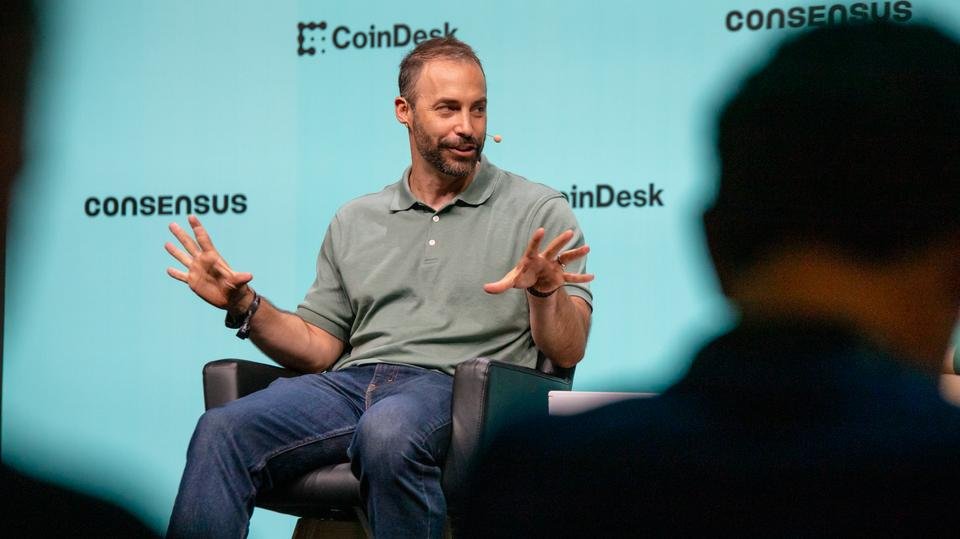
Bitcoin’s developer community should stop waiting for certainty about quantum-computing timelines and focus on getting a post-quantum signature scheme into production, Alex Pruden, CEO of Project Eleven, told CoinDesk’s Consensus Miami conference on Wednesday.

Pruden said the asymmetry between acting now and waiting favors action.

“We added some new cryptography, we kind of built in this optionality, it turns out we didn’t need quite yet, but at least we have it,” he said, describing the worst case of moving early.

The worst case of moving late is far worse: a sufficiently capable quantum computer could derive private keys from any exposed public key using Shor’s algorithm, the 1994 algorithm that remains the canonical example of what a quantum machine can do that a classical one cannot.

Pruden valued the asset at stake at roughly $2.3 trillion.

“In a very real sense, someone with a sufficiently large and capable quantum computer kind of owns everyone’s digital assets or bitcoin for the public key that they can see,” Pruden said.

The path forward, Pruden said, is to introduce a new signature scheme into Bitcoin that does not rely on the classical math underlying the elliptic-curve digital signature algorithm, or ECDSA, it uses today.

The National Institute of Standards and Technology has standardized post-quantum schemes based on hash functions and lattices, he said, and Bitcoin community discussion has trended toward the hash-based option. BIP-360, proposed last year, laid groundwork for adding a quantum-resistant Taproot output type, and Blockstream has deployed a hash-based signature scheme on its Liquid Network.

“Moving stuff out of just research into production is, I think, actually what we need to focus on,” Pruden said. “Let’s focus on the D of R&D.”

The migration will be substantially harder than the Taproot upgrade, Pruden warned.

“Taproot took five years, but that’s not even really the entire challenge that this will take.” Where Taproot was opt-in and most users never bothered migrating, every bitcoin holder and every wallet, exchange and institution that touches the asset will need to participate in a post-quantum migration.

Pruden said the timing risk is severe: if a quantum computer arrives before users have migrated, an attacker could front-run pending transactions within a single block time, paying a higher fee to capture funds whose private keys it has just derived.

Pressed on the unresolved debate over what to do with bitcoin sitting in dormant, quantum-vulnerable addresses, Pruden urged the community to defer that fight and focus on the migration itself. Harper framed that debate as involving upward of 5 million dormant coins, including coins attributed to Satoshi Nakamoto via the so-called “Patoshi” pattern of early miner blocks.

“The question of the Satoshi coins in particular is a hard one,” Pruden said, because it puts two philosophical commitments in tension: Bitcoin’s fixed-supply ethos and its commitment to digital property rights. Asked for his personal lean, Pruden said the dormant coins could potentially be “recycle[d] back into the end of the supply curve” to extend Bitcoin’s mining-incentive runway after the block subsidy runs out.

“If you put me on the hot seat, that’s probably what I would say,” Pruden said. “So I guess overall would be the confiscation side. But again, I think ultimately, the community is going to decide. The institutions and the market are going to decide.”

On whether Bitcoin Core developers are taking the threat seriously, Pruden said the answer is mixed. “Core is not a monolithic entity. So I think there are definitely [some] in Core that are taking it seriously. I think there are some people that have the opinion” that quantum computers will never arrive. He pointed to the broader scientific community as a counterweight: “The majority of physicists out there, if you ask them this, they’ll say, yes, it will be a thing. And by the way, many of them believe that the timelines are accelerating.”

The same physics that makes quantum computers a threat to existing cryptography may also seed the next generation of cryptographic primitives, he said, citing key-exchange protocols based on quantum entanglement and certified-randomness work that won the Turing Award last year.

Read the full article here

Fact Checker

Verify the accuracy of this article using AI-powered analysis and real-time sources.

Get Your Fact Check Report

Enter your email to receive detailed fact-checking analysis

5 free reports remaining

Continue with Full Access

You've used your 5 free reports. Sign up for unlimited access!

Already have an account? Sign in here

Share. Facebook Twitter Pinterest LinkedIn Tumblr Email Telegram Copy Link
News Room
  • Website
  • Facebook
  • X (Twitter)
  • Instagram
  • LinkedIn

The FSNN News Room is the voice of our in-house journalists, editors, and researchers. We deliver timely, unbiased reporting at the crossroads of finance, cryptocurrency, and global politics, providing clear, fact-driven analysis free from agendas.

Related Articles

Cryptocurrency & Free Speech Finance

Dogecoin slides 4%, bitcoin rally pauses as Iran ceasefire optimism lifts equities

11 minutes ago
Cryptocurrency & Free Speech Finance

Samsung SDS To Build KSD Tokenized Securities Platform

12 minutes ago
Cryptocurrency & Free Speech Finance

Apple Agrees to $250 Million Settlement Over AI Claims—Here’s Who Can Get Paid

15 minutes ago
Cryptocurrency & Free Speech Finance

Why Stablecoins and SWIFT May Have to Coexist

1 hour ago
Cryptocurrency & Free Speech Finance

Anthropic Deploys AI Agents to Tackle Wall Street’s Most Tedious Work

1 hour ago
Cryptocurrency & Free Speech Finance

Crypto’s mainstream moment has arrived, industry leaders say

2 hours ago
Add A Comment
Leave A Reply Cancel Reply

Editors Picks

Samsung SDS To Build KSD Tokenized Securities Platform

12 minutes ago

Apple Agrees to $250 Million Settlement Over AI Claims—Here’s Who Can Get Paid

15 minutes ago

Members of the European Parliament urge EU to push for foreign journalist Gaza access 

1 hour ago

Bitcoin’s post-quantum migration will be harder than Taproot and needs to start now, Project Eleven CEO says

1 hour ago
Latest Posts

Why Stablecoins and SWIFT May Have to Coexist

1 hour ago

Anthropic Deploys AI Agents to Tackle Wall Street’s Most Tedious Work

1 hour ago

Nintendo Shuts Down Fun Faux ‘Pokemon Documentary’ YouTuber Via Copyright Strikes

2 hours ago

Subscribe to News

Get the latest news and updates directly to your inbox.

At FSNN – Free Speech News Network, we deliver unfiltered reporting and in-depth analysis on the stories that matter most. From breaking headlines to global perspectives, our mission is to keep you informed, empowered, and connected.

FSNN.net is owned and operated by GlobalBoost Media
, an independent media organization dedicated to advancing transparency, free expression, and factual journalism across the digital landscape.

Facebook X (Twitter) Discord Telegram
Latest News

Dogecoin slides 4%, bitcoin rally pauses as Iran ceasefire optimism lifts equities

11 minutes ago

Samsung SDS To Build KSD Tokenized Securities Platform

12 minutes ago

Apple Agrees to $250 Million Settlement Over AI Claims—Here’s Who Can Get Paid

15 minutes ago

Subscribe to Updates

Get the latest news and updates directly to your inbox.

© 2026 GlobalBoost Media. All Rights Reserved.
  • Privacy Policy
  • Terms of Service
  • Our Authors
  • Contact

Type above and press Enter to search. Press Esc to cancel.

🍪

Cookies

We and our selected partners wish to use cookies to collect information about you for functional purposes and statistical marketing. You may not give us your consent for certain purposes by selecting an option and you can withdraw your consent at any time via the cookie icon.

Cookie Preferences

Manage Cookies

Cookies are small text that can be used by websites to make the user experience more efficient. The law states that we may store cookies on your device if they are strictly necessary for the operation of this site. For all other types of cookies, we need your permission. This site uses various types of cookies. Some cookies are placed by third party services that appear on our pages.

Your permission applies to the following domains:

  • https://fsnn.net
Necessary
Necessary cookies help make a website usable by enabling basic functions like page navigation and access to secure areas of the website. The website cannot function properly without these cookies.
Statistic
Statistic cookies help website owners to understand how visitors interact with websites by collecting and reporting information anonymously.
Preferences
Preference cookies enable a website to remember information that changes the way the website behaves or looks, like your preferred language or the region that you are in.
Marketing
Marketing cookies are used to track visitors across websites. The intention is to display ads that are relevant and engaging for the individual user and thereby more valuable for publishers and third party advertisers.