Bitcoin is trading around $76,000 in the wake of the Clarity Act’s failure to pass the Senate.
Analysts say Wednesday’s Federal Reserve decision matters more to prices than the vote did.
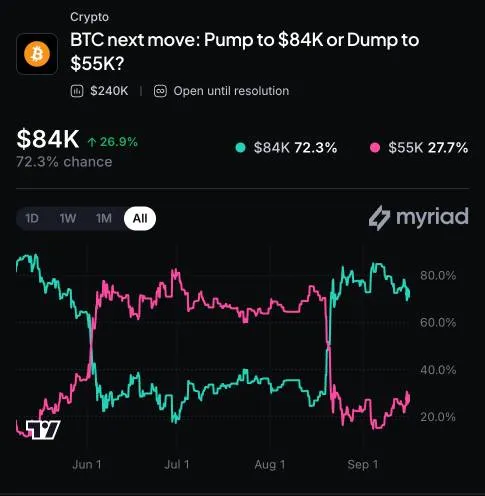
Myriad users put a 72% chance on Bitcoin’s next move being up to $84,000.
Bitcoin traded around $76,140 Wednesday morning, down 0.9% on the day and 4% for the week, a day after senators blocked the Digital Asset Market Clarity Act. Analysts argued that the legislation’s failure, while “disappointing,” is less consequential for Bitcoin’s price than today’s Fed decision.
Stephen Wundke, strategy and revenue director at Algoz, put the odds of a quarter-point increase at 93%, in line with CME FedWatch, so the decision “appears to be a given,” putting the focus on the language. Those odds were 33.1% a month ago.
“Dovish signals about this being a protective move” could give crypto a strong last quarter of the year, Wundke said, noting that October and November are historically Bitcoin’s best-performing months. Hawkish remarks from Fed Chair Kevin Warsh could see Bitcoin retest its $63,000 low, he cautioned.
Trading data suggest investors have already stepped back, with Talos seeing a 28% net buying tilt toward stablecoins ahead of the decision, against an average 8% selling tilt around previous FOMC meetings. Buying conviction in Bitcoin has fallen from 10% to 3% and in Ethereum from 23% to 9%, said research analyst Cooper Duschang in a note shared with Decrypt.
The two ends of the market are moving in opposite directions: hedge funds remain net buyers at a 25% tilt, while systematic and quantitative strategies have swung heavily toward selling. Investors are “reducing risk and holding greater liquidity ahead of the Fed,” Duschang said, potentially leaving capital “available to deploy once the decision removes some of the uncertainty.”
He pointed to the last time the Fed raised rates, in July 2023, when Bitcoin barely moved because the increase had been priced in beforehand. Order-book depth has stayed broadly stable this week, he added, and the signal to watch afterwards is “whether stablecoin capital moves back onto exchanges.”
BitcoinBTC · USD
$75,770−4.05%
Sep 9Sep 11Sep 13Sep 14Sep 16
$79.2k$78.0k$76.7k$75.5k
24h HighHigh$77,146
24h LowLow$75,038
VolVol$1.4B
Market projectionsOdds by Myriad
Tim Sun, senior researcher at HashKey, argued that while the Clarity Act’s failure to pass may extend the market bottom, the “true pricing mechanism” for this downturn remains “U.S. dollar liquidity, rather than congressional legislation.”
“Even if this bill had passed, it would not have directly triggered a new major bull market rally,” Sun argued, pointing to “tighter financial conditions alongside uncertainty regarding Federal Reserve policy” as U.S. Treasury yields move back toward 5% alongside increasing energy prices and inflationary pressures. “What the market truly needs to wait for may not be a policy bottom, but a liquidity bottom,” he argued.
On prediction market Myriad, owned by Decrypt’s parent company Dastan, users remain bullish on Bitcoin’s outlook, placing a 72% chance on its next move taking it to $84,000.
Myriad: Where does Bitcoin go next? Click to make your prediction.
The limits of regulatory authority
“The failure of the Clarity Act, whilst disappointing, is not a dagger to the heart of crypto,” Wundke said, and indeed regulators have already stated their intention to write crypto rules in order to bridge the gap.
CFTC Chair Michael Selig directed staff in August to draft a crypto market structure regime using existing authority, and SEC Chair Paul Atkins has said his agency is ready to do likewise. Agencies “can interpret the powers they already possess, but they cannot write a new rule to invent power that Congress never granted them,” Sun said. The CFTC’s spot-market authority over Bitcoin and Ethereum runs only to fraud and manipulation.
Institutions wanting certainty that outlasts a presidency will slow, Sun said, because the next administration or agency leadership “could still alter rules, revoke exemptions, or reinterpret regulatory boundaries.” The cost falls unevenly, he added: established platforms can work case by case, while DeFi and smaller projects must buy certainty through legal opinions and litigation, which “will dramatically drive up project costs.”
Hong Yea, co-founder of onchain venue Grvt, argued demand reroutes to venues that “don’t require that legal certainty to offer credible custody protection in the first place.” Watch funding rates and open interest, he argued, noting that, “That pattern, not the headline dip, is what tells us whether this is sentiment, or a real shift in the thesis.”
Daily Debrief Newsletter
Start every day with the top news stories right now, plus original features, a podcast, videos and more.
The FSNN News Room is the voice of our in-house journalists, editors, and researchers. We deliver timely, unbiased reporting at the crossroads of finance, cryptocurrency, and global politics, providing clear, fact-driven analysis free from agendas.
We and our selected partners wish to use cookies to collect information about you for functional purposes and statistical marketing. You may not give us your consent for certain purposes by selecting an option and you can withdraw your consent at any time via the cookie icon.
Cookies are small text that can be used by websites to make the user experience more efficient. The law states that we may store cookies on your device if they are strictly necessary for the operation of this site. For all other types of cookies, we need your permission. This site uses various types of cookies. Some cookies are placed by third party services that appear on our pages.
Your permission applies to the following domains:
https://fsnn.net
Necessary
Necessary cookies help make a website usable by enabling basic functions like page navigation and access to secure areas of the website. The website cannot function properly without these cookies.
Statistic
Statistic cookies help website owners to understand how visitors interact with websites by collecting and reporting information anonymously.
Preferences
Preference cookies enable a website to remember information that changes the way the website behaves or looks, like your preferred language or the region that you are in.
Marketing
Marketing cookies are used to track visitors across websites. The intention is to display ads that are relevant and engaging for the individual user and thereby more valuable for publishers and third party advertisers.


 Freedom Index