Close Menu
FSNN | Free Speech News NetworkFSNN | Free Speech News Network
  • Home
  • News
    • Politics
    • Legal & Courts
    • Tech & Big Tech
    • Campus & Education
    • Media & Culture
    • Global Free Speech
  • Opinions
    • Debates
  • Video/Live
  • Community
  • Freedom Index
  • About
    • Mission
    • Contact
    • Support
Trending

AI Solutions in Search of Problems

38 minutes ago

Europol urges phased shift to post-quantum security to protect exposed crypto wallets

51 minutes ago

Wall Street Wealth Creation Model Unsustainable for Most Participants: Hyperliquid CEO

55 minutes ago
Facebook X (Twitter) Instagram
Facebook X (Twitter) Discord Telegram
FSNN | Free Speech News NetworkFSNN | Free Speech News Network
Market Data Newsletter
Wednesday, October 7
  • Home
  • News
    • Politics
    • Legal & Courts
    • Tech & Big Tech
    • Campus & Education
    • Media & Culture
    • Global Free Speech
  • Opinions
    • Debates
  • Video/Live
  • Community
  • Freedom Index
  • About
    • Mission
    • Contact
    • Support
FSNN | Free Speech News NetworkFSNN | Free Speech News Network
Home»Cryptocurrency & Free Speech Finance»Bitcoin ETFs Just Had Their Biggest Day Since May—BlackRock Took 83% of It
Cryptocurrency & Free Speech Finance

Bitcoin ETFs Just Had Their Biggest Day Since May—BlackRock Took 83% of It

News RoomBy News Room2 months agoNo Comments5 Mins Read10 Views
Share Facebook Twitter Pinterest Copy Link LinkedIn Tumblr Email VKontakte Telegram
Bitcoin ETFs Just Had Their Biggest Day Since May—BlackRock Took 83% of It
Share
Facebook Twitter Pinterest Email Copy Link

Listen to the article

0:00
0:00

Key Takeaways

Playback Speed

Select a Voice

In brief

  • U.S. spot Bitcoin ETFs took in $606.29 million on August 20, their largest single-day haul since May 1 and a fourth straight day of inflows.
  • BlackRock’s IBIT accounted for $502.99 million of that—about 83%, up from 55% the day before, while VanEck’s HODL posted an outflow.
  • Ethereum funds added $221 million, XRP $13 million, and Solana $15 million, with every listed asset drawing money.

U.S. spot Bitcoin ETFs pulled in $606.29 million on Thursday, their biggest single-day haul since May 1, according to SoSoValue. That beats Wednesday’s $517.19 million and extends the inflow streak to four sessions.

The four-day run—$297.56 million Monday, $189.30 million Tuesday, then Wednesday and Thursday—comes to roughly $1.61 billion in all. August now stands at $2.07 billion, the best month of 2026, beating April’s $$1.97 billion, with seven trading sessions left to close the gap.

One fund took almost all of it

Bitcoin ETFs are financial instruments that give investors exposure to an asset without directly owning it. In the case of Bitcoin ETFs, the issuer of the fund holds the coin, and the investor owns a 1:1 equivalent, gaining exposure to the price of Bitcoin in real time.

Myriad: Bitcoin price next move? Click to make your prediction.

These funds have been extremely popular among investors since they launched in early 2024, with the biggest fund issuer of them all—the $15 trillion asset manager BlackRock—as the primary beneficiary.

Adding to its already monster total, BlackRock’s IBIT collected $502.99 million on Thursday, roughly 83 cents of every dollar that entered the category. Fidelity’s FBTC took $64.74 million, Bitwise’s BITB $26.4 million and Ark and 21Shares’ ARKB $12.2 million. VanEck’s HODL went the other way, shedding $3.59 million.

Compare that to Wednesday, when IBIT’s share was 55% and eight of 12 funds finished positive with none in the red. A day later the total was bigger and the distribution was narrower.

Across the four sessions, IBIT alone accounted for about $1.09 billion of the $1.61 billion. That is closer to the pattern from earlier this month, when the funds drew $853.5 million over five days and roughly 80% arrived through IBIT.

The altcoin funds finally turned up

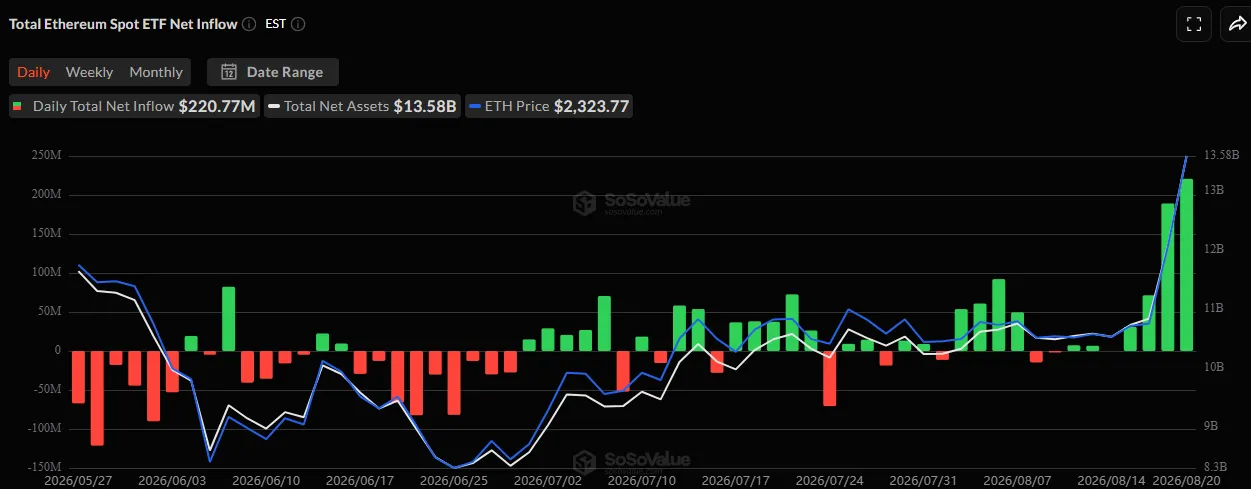
Ethereum ETFs added almost $221 million, their largest single-day intake since October 2025. That is also a fourth consecutive positive session.

Ethereum ETF data. Image: SoSoValue

The smaller products moved hardest in percentage terms. XRP funds took $13 million against $2.35 million on Wednesday. Solana funds took $15 million against $2.10 million. Every listed asset drew inflows, including Hyperliquid’s product, which had been the lone outflow a day earlier.

On Wednesday, Bitcoin funds collected one dollar for every $220 that reached XRP funds. On Thursday that gap closed to about 47 to one.

So the money broadened across assets and narrowed within Bitcoin at the same time. That squeeze is not abstract, and it claimed a fund this month.

Hashdex shut its DEFI Bitcoin ETF, the first US spot Bitcoin fund ever liquidated, with a final trading day of August 17. It charged the same 0.25% as IBIT but held $14.7 million against IBIT’s $47 billion, throwing off roughly $26,000 a year in fees—not enough to run a fund.

Anyone who held past the 17th lost their exchange exit. They are owed a cash payment at net asset value instead, dated either August 24 or August 28 depending on which Hashdex filing you read, minus closing costs and adjusted for whatever Bitcoin does while the fund sells its remaining 225 coins. That sale is happening during Bitcoin’s best week since 2023.

Price ran ahead of the flows

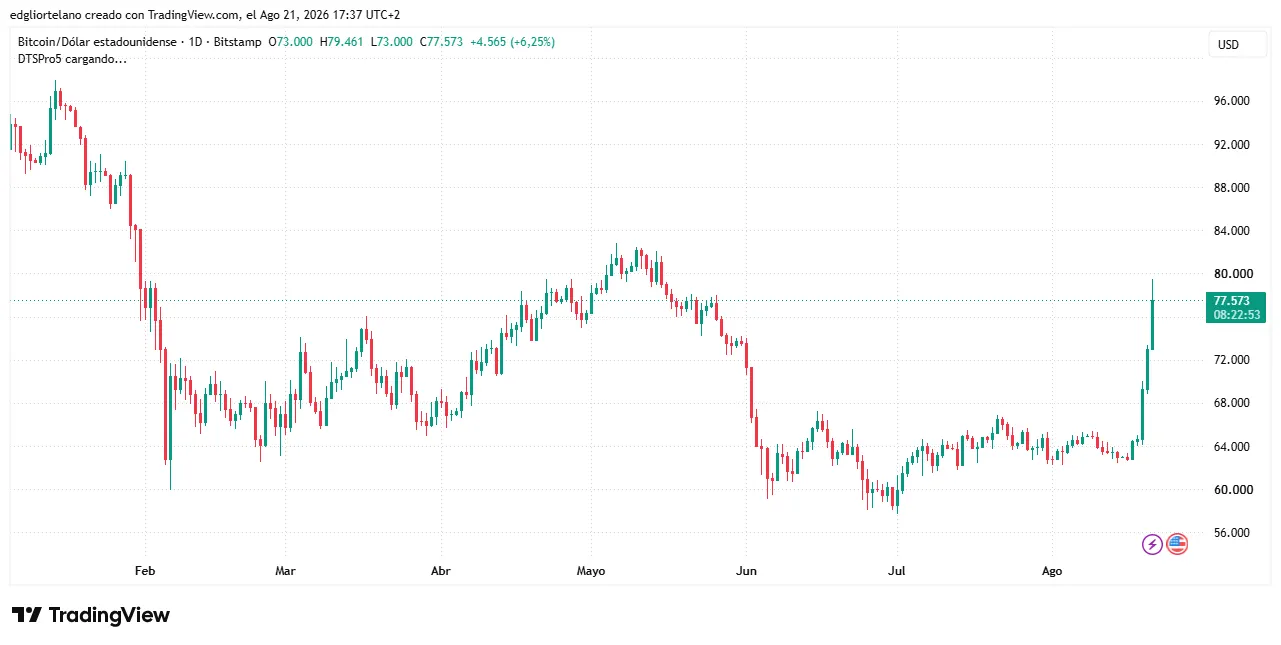
Bitcoin traded around $77,000 Friday after challenging $80,000 overnight and touching roughly $79,400. It cleared $69,000 Wednesday and $72,000 Thursday, and is up about 24% since Monday—its best week since 2023—while still sitting some 38% below the record above $126,000 set in October 2025.

Bitcoin price data. Image: Tradingview

The run has not yet flipped the chart. Bitcoin’s death cross has held since November 16, 2025, and while price has climbed back above the 200-day simple moving average at $69,005, the 50-day sits at $63,976. It needs to cover roughly $5,000 more before a golden cross, the inverse of the bearish death cross, completes.

Ethereum changed hands near $2,357 and XRP around $1.38, extending what was already its best week for the Ripple-linked token since the 2024 election pump to a roughly 38% gain. The move began with the Treasury’s decision to at least double long-end bond buybacks, then accelerated through a squeeze that liquidated $3 billion in short positions in 24 hours, with another $1 billion wiped out Friday.

Bitcoin ETF net assets closed Thursday at $90.16 billion, equal to 6.18% of Bitcoin’s market capitalization at that point, with cumulative net inflows of $53.40 billion since the funds began trading on January 11, 2024, per SoSoValue. Value traded across the sector reached $5.41 billion on the day. The expanded buyback program takes effect September 9 and runs through November 4, when Treasury sets sizes for the following quarter at its next quarterly refunding.

Daily Debrief Newsletter

Start every day with the top news stories right now, plus original features, a podcast, videos and more.

Read the full article here

Fact Checker

Verify the accuracy of this article using AI-powered analysis and real-time sources.

Get Your Fact Check Report

Enter your email to receive detailed fact-checking analysis

5 free reports remaining

Continue with Full Access

You've used your 5 free reports. Sign up for unlimited access!

Already have an account? Sign in here

Share. Facebook Twitter Pinterest LinkedIn Tumblr Email Telegram Copy Link
News Room
  • Website
  • Facebook
  • X (Twitter)
  • Instagram
  • LinkedIn

The FSNN News Room is the voice of our in-house journalists, editors, and researchers. We deliver timely, unbiased reporting at the crossroads of finance, cryptocurrency, and global politics, providing clear, fact-driven analysis free from agendas.

Related Articles

Media & Culture

AI Solutions in Search of Problems

38 minutes ago
Cryptocurrency & Free Speech Finance

Europol urges phased shift to post-quantum security to protect exposed crypto wallets

51 minutes ago
Cryptocurrency & Free Speech Finance

Wall Street Wealth Creation Model Unsustainable for Most Participants: Hyperliquid CEO

55 minutes ago
Cryptocurrency & Free Speech Finance

Morning Minute: OKX Raises at $25B From Circle, Ripple, and StanChart

56 minutes ago
Media & Culture

Federal Court Slaps Down Utah’s VPN Restrictions

2 hours ago
Cryptocurrency & Free Speech Finance

Ethereum news: Tom Lee says Bitmine to soon stop buying ETH

2 hours ago
Add A Comment

Comments are closed.

Editors Picks

Europol urges phased shift to post-quantum security to protect exposed crypto wallets

51 minutes ago

Wall Street Wealth Creation Model Unsustainable for Most Participants: Hyperliquid CEO

55 minutes ago

Morning Minute: OKX Raises at $25B From Circle, Ripple, and StanChart

56 minutes ago

Venezuela is a cautionary tale w/ Jim Epstein and Germania Rodriguez Poleo

2 hours ago
Latest Posts

Federal Court Slaps Down Utah’s VPN Restrictions

2 hours ago

Matsada2sh, Arabic for “don’t believe it”, was founded in 2018 to check the facts in a country where the official narrative goes largely unchallenged. President Abdel Fattah El-Sisi has repeatedly told his people to only believe what he says. What started as a fact-checking platform has since expanded into investigative reporting covering Egypt and other Arab countries, digging into everything from discrepancies in official figures to hidden cracks within state institutions. Its Facebook page, the primary channel through which it reached readers inside a country that has reportedly blocked its website, accumulated more than 1.3 million followers. On the nights of 28 and 29 September 2026, Egyptian security forces arrested all six members of its editorial team in a coordinated operation spanning multiple governorates. After days of forced disappearance, they emerged before the public prosecutor, facing charges of being members of the banned Muslim Brotherhood and spreading fabricated news in exchange for foreign funding. The detained journalists denied these charges, accusing state security of torturing them, which the Ministry of Interior denied in a statement. It was the first time an entire newsroom team had been arrested in Egypt. “Even when state forces stormed Mada Masr several years back, they only detained several journalists at the time, and these were quickly released,” Mohamed Lotfy, co-founder and executive director of Egyptian Centre for Rights and Freedoms (ECRF), a homegrown organisation defending rights in Egypt, told Index on Censorship. “This is an alarming precedent.” President Abdel Fattah El-Sisi has repeatedly told his people to only believe what he says The arrests brought the number of journalists behind bars in Egypt to at least 26, according to the Egyptian Initiative for Personal Rights — all facing security and political charges, including belonging to the banned Muslim Brotherhood and spreading false news. What Matsada2sh actually did “Did the state want journalism from abroad? We chose to do journalism from Egypt. Why are we paying the price?” With these lines, a post published on Matsada2sh’s Facebook page on 3 October began defending its editorial team against the Ministry of Interior’s accusations – accusations replayed across countless talk shows and headlines run by state-aligned media. What distinguished Matsada2sh was its method. “It used open-source tools to overcome the limited access to information in the country, investigate and report stories other media platforms haven’t covered, and challenge the official narrative on many issues,” said Mina Thabet, head of the Middle East and North Africa at PEN International. Over the years, Matsada2sh dug into official narratives, challenging officials’ statements inflating immigrants’ numbers as another justification for economic hardships; exposing otherwise overlooked decline in spending on the education system; breaking down legal and economic expressions for a general audience. It also revealed concealed disagreements within institutions long considered opaque. “Recent reports about discontent among judges and public prosecutors over new hirings revealed the scale of favouritism and patronage, but also brought before the public disagreements within the judiciary that are meant to remain hidden,” said Lotfy. “Matsada2sh relied in its reports on official and verified sources, precisely the kind of fact-based journalism that made it dangerous to the system. Its reporting revealed information about those in power and undermined the trust of citizens in official narratives, which the authorities characterised as destabilising public security.” “We chose to do journalism from Egypt. Why are we paying the price?” In 2023, the platform published reporting on the identities of Egyptian nationals, including security officials, on board a private plane seized in Zambia carrying cash and weapons. A journalist was arrested within hours and later released. Matsada2sh invoked the incident directly: “If we are Brotherhood [members] and funded [from abroad], why did [the] security apparatus clear us in 2023?” The exact trigger for the September 2026 arrests remains unclear. Co-founder Abdelrahman Mansour, who lives abroad and has denied all accusations of ties to the Brotherhood, had played a pivotal role in the 2011 uprising through a Facebook page he co-founded, which helped mobilise mass protests that ultimately toppled President Hosni Mubarak and threatened the military’s grip on the country. Since seizing power in 2014 following a coup against Mohamed Morsi – the country’s only freely elected president and a senior Brotherhood figure – El-Sisi has taken systematic measures to prevent any recurrence. A media landscape hollowed out from within Egypt’s media consolidation happened through both censorship and ownership. In 2017, the General Intelligence Service established Eagle Capital, which acquired controlling shares in the Egyptian Media Group, a nominally private conglomerate that now controls major television channels and newspapers. The State Media Monitor identifies three structures through which the government has consolidated control of the media sector: the constitutional bodies of the National Media Authority and the National Press Authority, as well as the Egyptian Media Group. Three media laws passed in 2018 – Laws 178, 179, and 180 – together with a cybercrime law the same year, gave the Supreme Council for Media Regulation (SCMR) sweeping powers to block websites, revoke licences, and refer journalists to prosecutors. By the 2024 World Press Freedom Index, Egypt ranked 170th out of 180 countries. “Since President El-Sisi seized power in 2014, spaces for independent and free media have shrunk significantly,” said Thabet. “These practices and policies have created a fragile press and a new breed of journalism that does what the security apparatus tells it and never questions the authorities’ narrative – with many even turning to propaganda platforms for the regime.” This left Matsada2sh, “along with a handful of other online platforms – which continue to operate without mandated licence from the SCMR –  the only independent, professional and serious journalism in a country with a dying media landscape,” said Lotfy. “With little to no challenge to official narratives, policies, and decisions,” Thabet said. “The regime lost its tolerance for criticism and, within a few years, grew sensitive and insecure about even the simplest questions.” Noting that the exact reason for the attack on the platform is unclear, he added that “it is clearly part of El-Sisi’s crackdown on press freedom and a manifestation of his zero-tolerance policy toward criticism.” In its 3 October post, which garnered nearly 30,000 reactions, Matsada2sh wrote: “We belong to neither side. We didn’t want a press that parroted a ready-made narrative simply because it originated domestically, nor did we want a press that acted according to a political discourse imposed from abroad. It was a difficult gamble. We chose ourselves. We chose Egypt, and the press we dream of. A press that is impartial and unbiased, where ideology doesn’t trump professionalism, where agendas aren’t imposed on truth, and where there is no place for political affiliations.” *Journalist used a pseudonym for security concerns. READ MORE

2 hours ago

Ethereum news: Tom Lee says Bitmine to soon stop buying ETH

2 hours ago

Subscribe to News

Get the latest news and updates directly to your inbox.

At FSNN – Free Speech News Network, we deliver unfiltered reporting and in-depth analysis on the stories that matter most. From breaking headlines to global perspectives, our mission is to keep you informed, empowered, and connected.

FSNN.net is owned and operated by GlobalBoost Media
, an independent media organization dedicated to advancing transparency, free expression, and factual journalism across the digital landscape.

Facebook X (Twitter) Discord Telegram
Latest News

AI Solutions in Search of Problems

38 minutes ago

Europol urges phased shift to post-quantum security to protect exposed crypto wallets

51 minutes ago

Wall Street Wealth Creation Model Unsustainable for Most Participants: Hyperliquid CEO

55 minutes ago

Subscribe to Updates

Get the latest news and updates directly to your inbox.

© 2026 GlobalBoost Media. All Rights Reserved.
  • Privacy Policy
  • Terms of Service
  • Our Authors
  • Contact

Type above and press Enter to search. Press Esc to cancel.

🍪

Cookies

We and our selected partners wish to use cookies to collect information about you for functional purposes and statistical marketing. You may not give us your consent for certain purposes by selecting an option and you can withdraw your consent at any time via the cookie icon.

Cookie Preferences

Manage Cookies

Cookies are small text that can be used by websites to make the user experience more efficient. The law states that we may store cookies on your device if they are strictly necessary for the operation of this site. For all other types of cookies, we need your permission. This site uses various types of cookies. Some cookies are placed by third party services that appear on our pages.

Your permission applies to the following domains:

  • https://fsnn.net
Necessary
Necessary cookies help make a website usable by enabling basic functions like page navigation and access to secure areas of the website. The website cannot function properly without these cookies.
Statistic
Statistic cookies help website owners to understand how visitors interact with websites by collecting and reporting information anonymously.
Preferences
Preference cookies enable a website to remember information that changes the way the website behaves or looks, like your preferred language or the region that you are in.
Marketing
Marketing cookies are used to track visitors across websites. The intention is to display ads that are relevant and engaging for the individual user and thereby more valuable for publishers and third party advertisers.