

 Freedom Index
Listen to the article
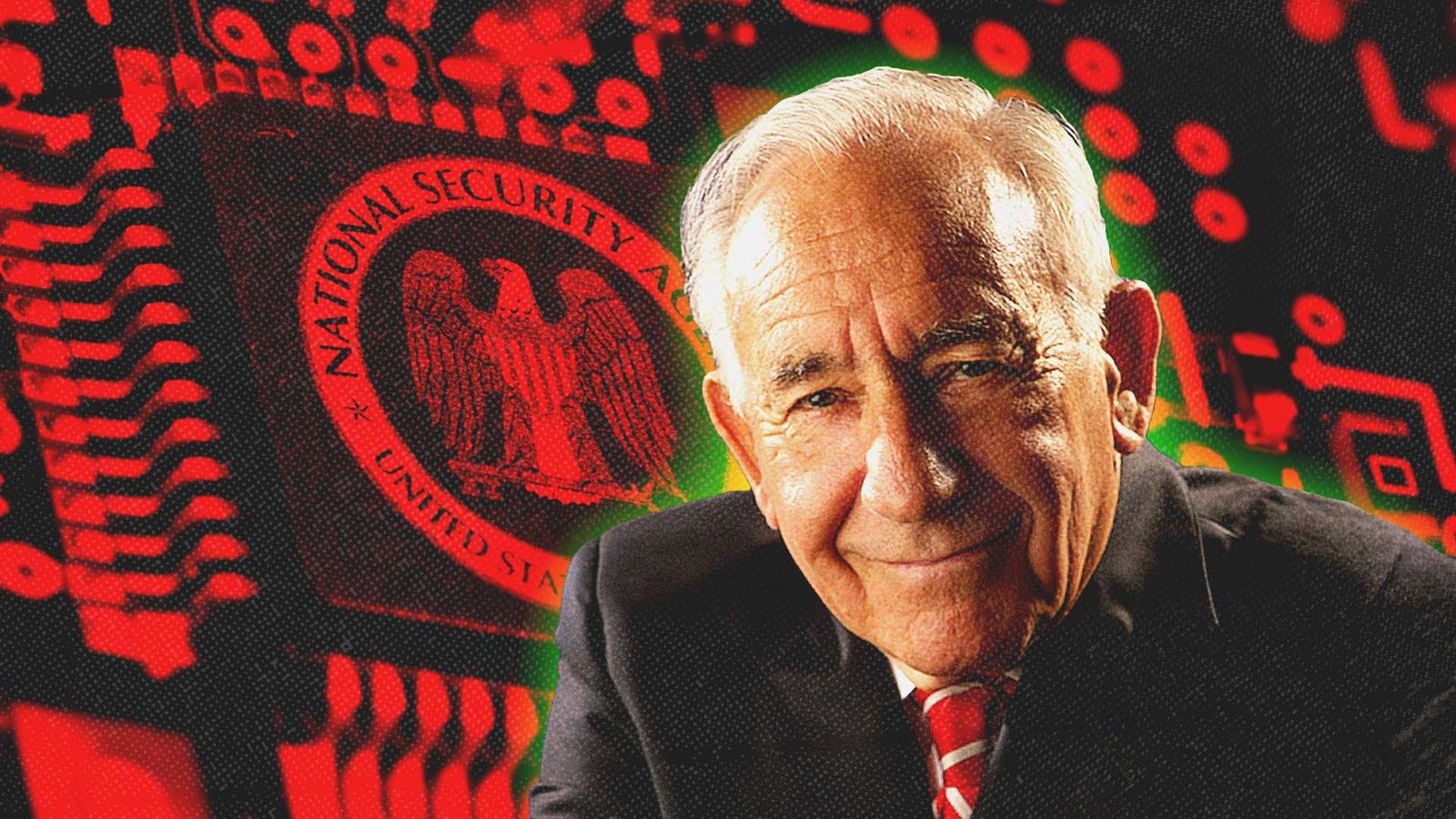
The U.S. government came to like the work of historian David Kahn, who passed away in 2024. The National Security Agency (NSA) honored him three times for his research on cryptography and espionage: with a “scholar-in-residence” title in 1993, a ceremony making his personal library part of the National Cryptological Museum in 2010, and a hall of fame induction in 2020.
But decades before, the U.S. government considered that personal library an alarming security threat. The FBI has declassified its files on Kahn, which Reason obtained under the Freedom of Information Act. Although it is publicly known that the NSA tried to stop Kahn from publishing his 1967 magnum opus, The Codebreakers, the new files show that Kahn had caught the feds’ attention a decade before, with the case making its way up to FBI Director J. Edgar Hoover himself.
Kahn’s FBI file is one of those rare government documents with a personality. His curiosity, equal parts cheeky and naive, shines through the FBI agents’ dry recap of events. The file is also a time capsule from the early Cold War, an age when cryptography—now the infrastructure that makes the modern internet possible—was still an obscure dark art for math nerds.
In 1953, the U.S. Army Counterintelligence Corps caught wind that Kahn, then a 23-year-old enlisted reservist and part-time ice cream truck driver, was mailing “restricted Army documents” to another man named Frederic C. Flindt. The corps alerted the FBI, which set up a stakeout on August 6 at the post office in Flindt’s hometown of Woodbury, New Jersey.
As expected, Flindt picked up a certified mail package from Kahn with a collection of government cryptography manuals inside. The FBI agents pounced, but Flindt was totally cooperative, even showing the agents his other letters with Kahn.
Alongside his Army reservist training, Kahn was taking correspondence courses on how to use the Army’s cipher machines and forwarding the materials for Flindt to copy and return. He wrote to Flindt that the course material would “be a valuable permanent addition to both our libraries. But I do not have the time nor the money either to copy it myself or to get it copied.”
Kahn also warned Flindt “to take the greatest precautions” lest they be “chucked into the calaboose.” Flindt agreed to keep it “confidential,” and offered to show Kahn his own collection of translated European cryptography guides. In other words, they were building an unauthorized archive of cryptographic history.
“It was my intention to use the material obtained from David Kahn for reference material to write a history of cryptology after it had been declassified,” Flindt told the FBI agents.
Flindt and Kahn had met through a civilian club called the American Cryptogram Association. A few years later, The New York Times covered a meeting of the association as a nerdy curiosity. Kahn excitedly spoke to a reporter about his hobby under the pseudonym “Ishcabibel,” the same pen name he signed his letters to Flindt (“Nip N. Bud”) with.
After interrogating Flindt, the FBI moved on to Kahn, who told his interrogators that he sent Flindt that particular manual because “he considered it to be a collector’s item and to be well-written.” Both Flindt and Kahn come off as painfully naive; Kahn admitted that he “realized that classified material should not be passed on to unauthorized individuals but from his review of the material he saw no reason for its being restricted as there was nothing in this material which was not known to cryptographists,” according to the FBI agents’ paraphrase of the interview.
A point in Kahn’s favor: All of the material he sent to Flindt was about to be declassified in a few months anyway. The documents were marked “Restricted,” a security classification that President Dwight D. Eisenhower abolished in November 1953, automatically declassifying the materials in that category. Indeed, Kahn pointed out to the agents that he was able to buy a cipher machine and its “Restricted” manual from military surplus vendors “before I ever had access to any restricted Army cryptographic material.”
But betting on the forgiveness and graciousness of government agents is a very bad wager, especially from behind an interrogation table. The FBI confiscated both the papers and the cipher machine. On September 17, a little over a month after the post office sting operation, the agents’ report landed on the desk of Hoover. He wrote to the Department of the Army asking “whether your Department would interpose any objection to the introduction of the material not legally in subject’s possession in evidence in the event of prosecution.” It was not looking good for Ishcabibel and Nip N. Bud.
A few days later, Kahn’s father called the FBI. By coincidence, Kahn had just returned home to his parents in Great Neck, New York. His father, a lawyer, was no doubt horrified that his son had been blabbering about potential crimes to government agents. In November, the younger Kahn was kicked out of the Army, and the elder Kahn called the FBI again to say “that his son was immature in many respects and was definitely not a person who should be given the label ‘a security risk’ for the rest of his life,” according to a Department of Justice memo.
The momentum within the FBI to prosecute Kahn and Flindt seems to have died out soon after. In February 1954, Kahn actually called the FBI asking to get back the papers and cipher machine from before his Army service because he “wished to continue code studies.” A few weeks later, FBI agents knocked on Flindt’s door—this time, to return his belongings.
That close brush with the law didn’t deter Kahn. In fact, he started actively reaching out to the FBI. In March 1955, he asked the local FBI field office whether anyone would be interested in giving a speech to the New York Cipher Society, another cryptographic club. The assistant special agent in charge noted in the margins of the letter that “even though Dept. of Justice declined prosecution,” Kahn was obviously unworthy of having his request considered.
The feds eventually started warming up to Kahn. In 1961, while Kahn was working at the newspaper Newsday, the FBI gave him information about Soviet spy Rudolf Abel and other espionage cases. (Kahn had excitedly raved about the Abel case in the Times story about the American Cryptogram Association.) In April 1964, Kahn asked the FBI for another photo of Abel’s codebook and an explanation of its color scheme for a new book he was writing.
“Despite Kahn’s background,” an FBI official wrote in a memo, “there appears to be no reason why we should not make a copy available to Kahn.”
However, the same memo warned that Kahn was interviewing retired military officers and the book “likely falls within the scope of national policy against release of information related to communications intelligence.” It noted that the U.S. Intelligence Board, a council of spy agency leaders, recommended “further low-key action short of legal action to discourage Mr. Kahn or his publishers from providing possible available security information to foreign governments.”
According to Kahn’s New York Times obituary, the NSA actually considered breaking into Kahn’s house. Instead, the agency contacted Kahn’s publisher, asking for the book to be censored. Kahn agreed to take out only a few paragraphs about World War II-era codebreaking efforts that were still classified.
The new files show that the FBI, too, opened an investigation into him while he was working on the book. Although most of the details are redacted, the file shows that FBI agents contacted no less than 11 informants in April 1964 to ask about Kahn, to no avail. They closed the case “in view of the fact that subject is currently self-employed as a writer, and an interview of him might cause possible embarrassment to the Bureau, and he has used extremely poor judgement in the past, and he is believed too unreliable for the informant program.”
Decades later, the feds would have a very different view of Kahn. The NSA website states that “hundreds [of NSA staff] told him they had first gotten into cryptology because of his writings” and that Kahn “has done more than any single individual to educate the public, around the world, about the importance of cryptology to international peace and security.” His ultimate legacy in the government’s eyes is a far cry from the security threat that the FBI saw in the 1950s or the unstable but harmless crank that the bureau saw in the 1960s.
Still, the same doggedness and sense of whimsy that got a young Kahn in trouble also enabled his later success. When the photo of Abel’s codebook turned out to be too small for print, Kahn appealed to Hoover himself to send a bigger copy. “I am reluctant to trouble you again, but, following the principles of persistence I learned from the FBI…feel that it is necessary,” he wrote.
Read the full article here
Fact Checker
Verify the accuracy of this article using AI-powered analysis and real-time sources.