Yale and Brookings researchers found no evidence of mass AI-driven unemployment 33 months after ChatGPT’s release.
Occupational shifts rose about one percentage point above early 2000s levels, but matched typical tech transitions.
High AI-exposure jobs—law, finance, customer service—showed no displacement in federal data.
Three years after ChatGPT burst onto the scene, American workers are still showing up to their jobs. A new study from Yale University’s Budget Lab and the Brookings Institution examined federal employment data through July, and found that AI has yet to trigger the mass unemployment that technology executives have been predicting.
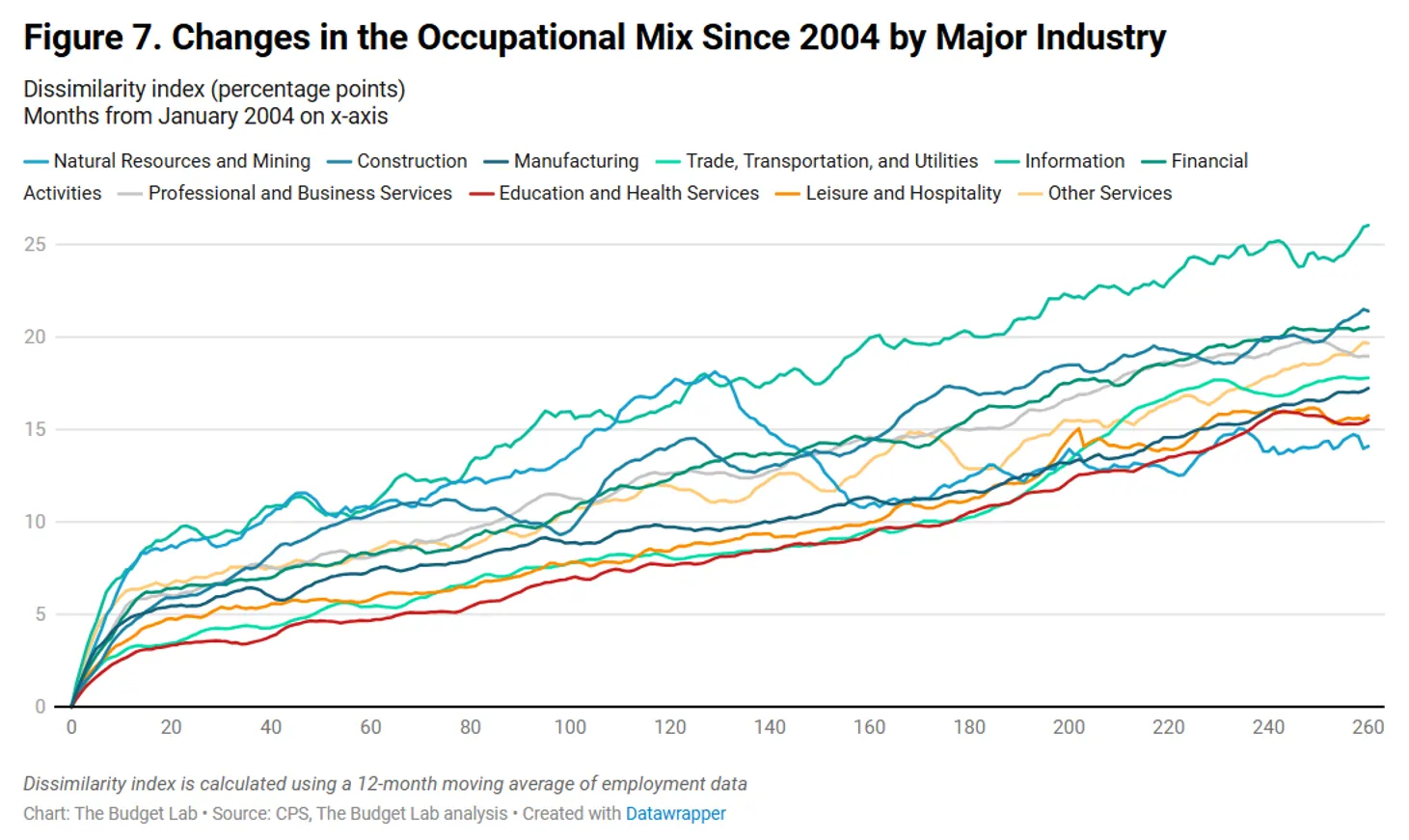
The researchers tracked how quickly the mix of occupations has changed since November 2022, when OpenAI released ChatGPT to the public. While jobs are shifting slightly faster than in recent years—about one percentage point higher than during the early 2000s internet boom—the changes appear to be pretty typical for technological transitions rather than the economic upheaval many feared.
Winter may still be coming—just not right now.
“We are not in an economy-wide jobs apocalypse right now; it’s mostly stable,” Molly Kinder, a senior fellow at Brookings and co-author of the paper, told The Financial Times. “That should be a reassuring message to an anxious public.”
The gap between Silicon Valley rhetoric and workplace reality has grown stark. As reported by Decrypt, Anthropic CEO Dario Amode said that up to 50% of entry-level white-collar roles could disappear within five years, while Geoffrey Hinton—known as the “Godfather of AI”—estimated that AI could dramatically worsen the financial gap if things keep going the way they are.
“What’s actually going to happen is rich people are going to use AI to replace workers,” he told the Financial Times. “It’s going to create massive unemployment and a huge rise in profits. It will make a few people much richer and most people poorer. That’s not AI’s fault, that is the capitalist system.”
OpenAI’s Sam Altman has repeatedly singled out customer service jobs as particularly vulnerable, with a recent study arguing that AI matched skilled human workers in at least 44 business areas.
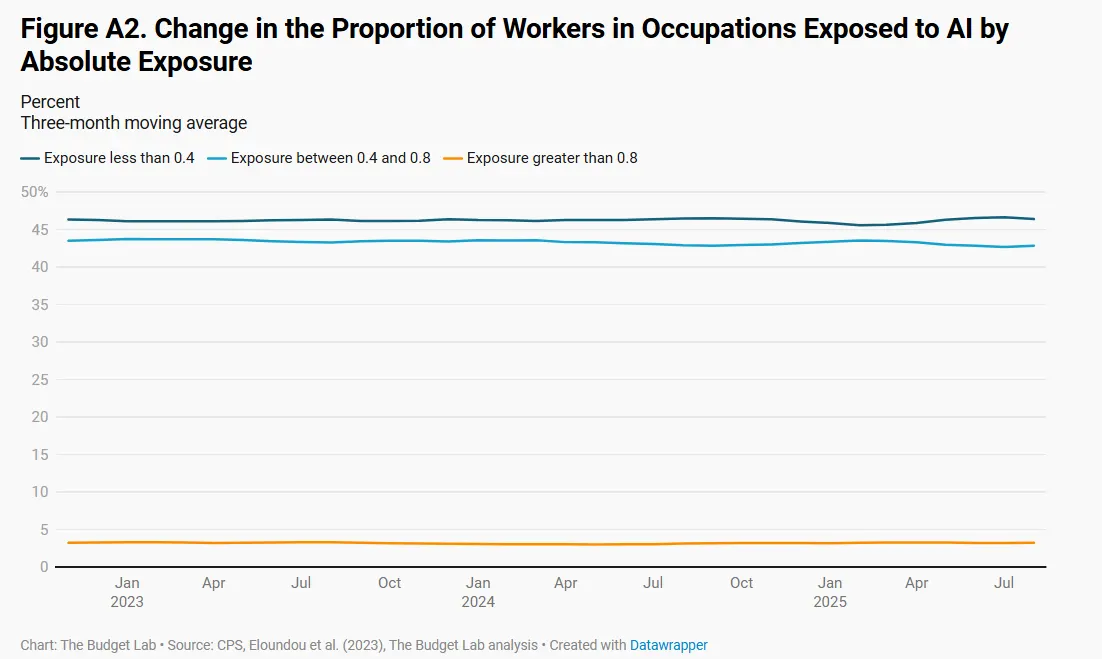
But data tells a different story. Yale researchers examined multiple metrics, including occupational mix changes, industry-specific shifts, and AI exposure levels across different job categories. Workers in occupations theoretically most exposed to AI automation, based on OpenAI’s own metrics, showed no signs of displacement. About 18% of workers hold jobs in the highest AI-exposure category, a proportion that has remained flat since January 2023.
The information sector, which includes newspapers, movies, and data processing, showed the largest occupational shifts. But these changes began before ChatGPT’s release, suggesting industry-specific factors rather than AI disruption. Finance and professional services displayed similar patterns—movements that predated the supposed AI revolution.
Young college graduates have struggled, with unemployment among 20- to 24-year-olds with bachelor’s degrees rising to 9.3% in August from 4.4% in April. But the research team found the pattern matched that of older degree holders aged 25 to 29, indicating a broader labor market slowdown rather than AI replacement. The dissimilarity between these age groups has fluctuated within a narrow 30-33 percent range since 2021, showing no acceleration after ChatGPT’s arrival.
Historical precedent supports the researchers’ skepticism about immediate disruption. Computers didn’t become standard office equipment until nearly a decade after their public release. The internet’s workplace transformation stretched out even longer. The study notes that occupational change peaked during the 1940s and 1950s—periods of massive industrial shifts—at rates of 20-21%. Current changes hover around 10%.
“Historically, widespread technological disruption in workplaces tends to occur over decades, rather than months or years,” the researchers wrote.
The researchers acknowledged significant data limitations. OpenAI’s “exposure” metrics measure theoretical vulnerability rather than actual AI usage. Anthropic’s usage data from its Claude chatbot shows heavy concentration among coders and writers—not representative of broader workforce patterns. The team called for comprehensive usage data from all major AI companies to properly assess workplace impacts.
The research team plans monthly updates to track any emerging patterns. For now, nearly three years into the AI revolution, the most dramatic workplace change appears to be how much executives talk about AI rather than what it’s actually doing to employment on a broad scale.
Generally Intelligent Newsletter
A weekly AI journey narrated by Gen, a generative AI model.
The FSNN News Room is the voice of our in-house journalists, editors, and researchers. We deliver timely, unbiased reporting at the crossroads of finance, cryptocurrency, and global politics, providing clear, fact-driven analysis free from agendas.
We and our selected partners wish to use cookies to collect information about you for functional purposes and statistical marketing. You may not give us your consent for certain purposes by selecting an option and you can withdraw your consent at any time via the cookie icon.
Cookies are small text that can be used by websites to make the user experience more efficient. The law states that we may store cookies on your device if they are strictly necessary for the operation of this site. For all other types of cookies, we need your permission. This site uses various types of cookies. Some cookies are placed by third party services that appear on our pages.
Your permission applies to the following domains:
https://fsnn.net
Necessary
Necessary cookies help make a website usable by enabling basic functions like page navigation and access to secure areas of the website. The website cannot function properly without these cookies.
Statistic
Statistic cookies help website owners to understand how visitors interact with websites by collecting and reporting information anonymously.
Preferences
Preference cookies enable a website to remember information that changes the way the website behaves or looks, like your preferred language or the region that you are in.
Marketing
Marketing cookies are used to track visitors across websites. The intention is to display ads that are relevant and engaging for the individual user and thereby more valuable for publishers and third party advertisers.


 Freedom Index