

 Freedom Index

Listen to the article
Several publicly traded Bitcoin miners have enjoyed sharp stock re-ratings after pivoting toward AI infrastructure, but investors are increasingly questioning whether insiders and major shareholders capitalized on the rally before the sector cooled, raising fresh governance concerns, according to Blocksbridge Consulting.
In its latest Miner Weekly newsletter, Blocksbridge said the AI narrative helped lift valuations for several Bitcoin mining companies as they repositioned operations around data centers, power infrastructure and hyperscaler partnerships. However, sentiment has since weakened, with AI and chip stocks pulling back. The TEM AI Infrastructure Growth Index, which tracks Bitcoin miners, artificial intelligence cloud providers, power suppliers and other AI infrastructure companies, has decline 16% over the past month.
That shift has brought insider transactions into sharper focus. Executives at TeraWulf, Cipher Digital, Riot Platforms and Core Scientific have disclosed stock sales, many of them executed under prearranged Rule 10b5-1 trading plans. While such plans are common and designed to avoid conflicts around nonpublic information, the sales have attracted greater scrutiny as AI-related stocks have retreated, Blocksbridge said.
The trend extends beyond company executives. Strategic investors have also reduced their exposure, including stablecoin issuer Tether, which trimmed its stake in Bitdeer after the company’s AI-driven rebound.
According to Blocksbridge, investors are increasingly shifting their attention from the AI growth narrative to questions around governance and whether the benefits of the tech transition will ultimately accrue to public shareholders.
Most stocks in the TEM AI Infrastructure Growth Index have declined sharply over the past month. Source: Miner Weekly
Blocksbridge said TeraWulf offers the clearest example because the company remains one of the biggest beneficiaries of the AI infrastructure transition. CEO Paul Prager and Beowulf E&D Holdings, an entity he manages, sold roughly 1.59 million WULF shares before the company on Monday announced a 20-year AI infrastructure lease with AI developer Anthropic, a deal widely viewed as a major validation of its AI strategy.
Related: SBI Crypto shuts Bitcoin mining pool after 5-year run
AI spending raises questions about long-term returns
Many Bitcoin miners have pivoted toward AI data centers as mining economics have become increasingly challenging, particularly after Bitcoin’s 2024 halving squeezed industry margins. However, the artificial intelligence trade has also become more crowded, with companies facing growing pressure from investors to justify heavy infrastructure spending amid uncertain returns.
A report published by Deloitte in October described AI as a “paradox of rising investment and elusive returns,” noting that many organizations expect AI investments to take longer than anticipated to generate meaningful value.
Separate research by Teneo, based on a survey of more than 350 public company CEOs, found that fewer than half of artificial intelligence initiatives have delivered returns exceeding their costs.
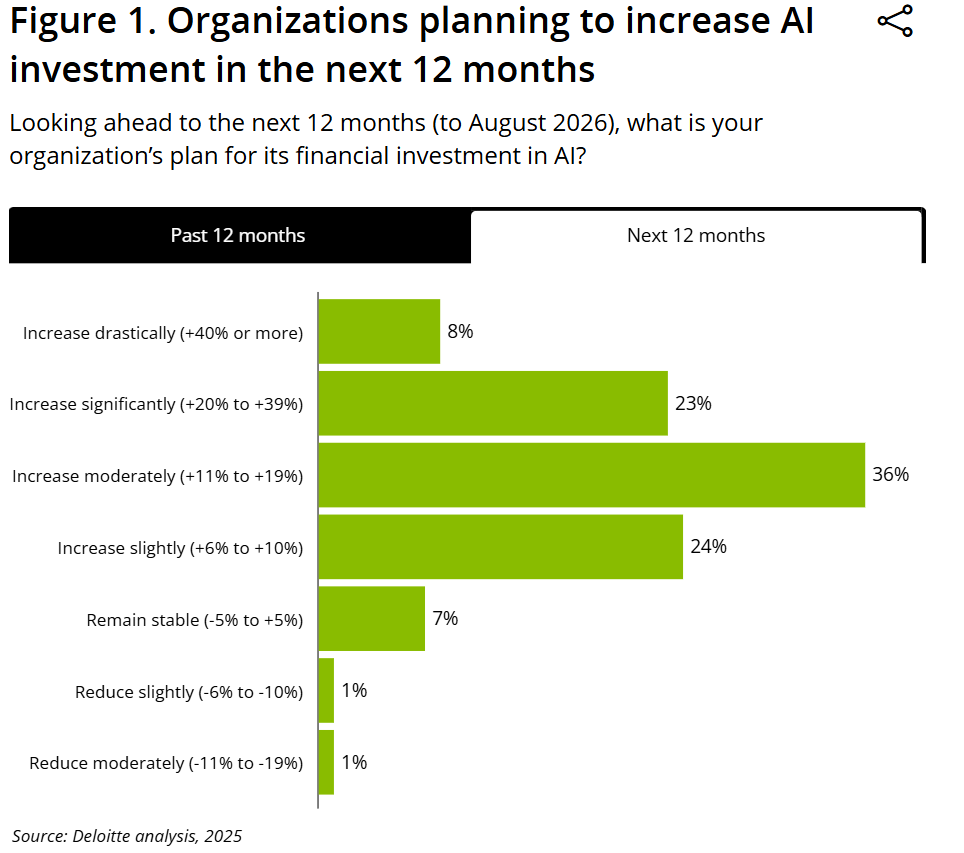
Corporate AI spending is expected to increase significantly despite modest returns on investment. Source: Deloitte
Despite those challenges, companies continue to invest aggressively in AI infrastructure, betting that long-term demand for compute capacity will outweigh near-term concerns over profitability.
Bitcoin miners, with access to large-scale power and existing data center infrastructure, are positioning themselves to capture that opportunity.
Related: Trumps’ American Bitcoin sinks 8.4% ahead of reverse stock split to stay listed
Read the full article here
Fact Checker
Verify the accuracy of this article using AI-powered analysis and real-time sources.