

 Freedom Index
Listen to the article
On Tuesday, a federal judge in Georgia quashed a grand jury subpoena aimed at validating President Donald Trump’s counterfactual claim that massive fraud deprived him of his rightful victory in the 2020 election. U.S. District Judge William M. Ray II, a Trump appointee, noted that the breadth of the subpoena, which sought “private and sensitive” information about thousands of Fulton County employees and volunteers who were involved in collecting, processing, counting, or recounting ballots that year, was “staggering.” That demand, he ruled, could not be justified by “any valid prosecutorial need,” since the statutory deadline for criminal charges related to the 2020 election came and went at least six months ago.
Ray’s decision is striking for several reasons. First, it was necessary only because Trump remains fully invested in a stolen-election fantasy that the courts rejected nearly six years ago. Second, although the Department of Justice (DOJ) seems eager to pursue the president’s personal vendettas, it frequently falls down on the job, as illustrated by its disregard for the statute of limitations in this case. Third, federal judges almost never quash grand jury subpoenas, so this rebuke by a Trump nominee speaks volumes about the incompetence of the president’s hatchet men.
“The Court agrees with Fulton County that, in pursuing the Subpoena, the DOJ is engaged in an ‘arbitrary fishing expedition,’ such that the Subpoena is unreasonable and must be quashed,” Ray writes. “The statute of limitations for any possible crime arising from the 2020 Election has long expired.” Although grand juries work with federal prosecutors to “investigate alleged criminal actions,” he says, “that does not give the DOJ the right to use the Grand Jury to do whatever the DOJ wants.”
The subpoena, which Fulton County received on April 20, demanded the names, positions, residential and email addresses, and personal phone numbers of people who directly or tangentially helped Fulton County with the 2020 election. The list included individuals “assigned to review Mail-In Ballots,” “assigned to the Voter Review Panel/Board,” “assigned to Mobile Voting Locations,” or “assigned to transfer results to or from media or to transport ballots, ballot stock, or media.” It also included people “employed or contracted by the Fulton County Board of Registration and Elections,” people “who worked or volunteered on Election Day who were assigned to review or tabulate ballots,” people “who worked or volunteered for the Risk Limiting Audit,” people “who worked or volunteered for the Recount,” and people “who served as precinct managers and assistant managers.”
Why did the DOJ want that information? “It argues that it is engaged in legitimate law enforcement activities,” notes Ray, who disagrees. “Against that claim is the fact that it has long been the view of the current President of the United States, both before and after he was elected in the 2024 General Election, that he was denied re-election to a second consecutive term in 2020 due to election fraud.”
In particular, Trump “has alleged fraud in states that he won during the 2016 Election, but lost in 2020, which includes Georgia,” Ray writes. “It was alleged, both then and now, that the genesis of his defeat in Georgia came from supposed fraud at the hands of election officials and others in Fulton County, which provided the final margin of votes in Georgia that decided the 2020 Election. Thus, perhaps it makes sense that the DOJ, now unquestionably under the current President’s control, is seeking to identify individuals who might possess information or opinions in support of his claim that the 2020 Election was not legitimate.”
Ray does not weigh in on the validity of that claim. But he notes that the DOJ faces an insuperable obstacle in trying to prosecute anyone allegedly involved in the plot that Trump imagines.
“The 2020 Election occurred on November 3, 2020,” Ray writes. “Audits and recounts
occurred in the 2–3 weeks immediately thereafter. The electors of each state (making
up the Electoral College) met to cast their vote for President on December 14, 2020.
And, the Congress of the United States met to count the certified votes of the Electoral College on January 6, 2021.” He notes that the congressional count “was not completed until January 7, 2021, due to well-chronicled events”—a not-so-subtle reference to the Capitol riot by Trump supporters who took his phony grievance to heart.
Why does all of that matter? Because, Ray explains, “the five-year statute of limitations on any purported crime related to the 2020 Election ran, at the latest, on Wednesday, January 7, 2026, which was six months ago.” In other words, “an investigation of alleged criminal conduct of anyone that may have led to the certification of the 2020 Election in Georgia would not be a legitimate use of the Grand Jury and its subpoena power, in that no valid indictment could issue from said Grand Jury due to the expiration of the applicable statutes of limitations.”
If the DOJ had “moved expeditiously to seek this information after the current President returned to office on January 20, 2024, and within the applicable period of limitations,” Ray adds in a footnote, “this Court’s analysis [might] well have been different.” To compensate for its lassitude, the DOJ argued that its subpoena might help discover evidence that anti-Trump conspirators sought to cover up their nefarious 2020 scheme within the last five years, in which case they could still be charged with obstruction.
Ray was not impressed by that argument. “In the DOJ’s view, the possibility of
criminal obstruction creates a timely offense,” he notes. But that claim, he explains, is foreclosed by the Supreme Court’s 1957 ruling in Grunewald v. United States, which held that “acts of concealment undertaken after the central objectives of [a] conspiracy [have] been achieved do not, by themselves, extend the duration of the conspiracy for statute-of-limitations purposes.”
The DOJ sought “essentially a limitless extension of the statute of limitations, such that a court is powerless to quash a subpoena despite the existence of Grunewald if the DOJ theorizes possible evidence supporting obstruction,” Ray writes. “Such a position is unreasonable. The DOJ cannot evade the statute of limitations based merely on a theory that someone, somewhere, somehow did something that was illegal….The DOJ essentially asks the Court to turn a blind eye to the DOJ’s investigation of nonspecific allegations and/or crimes which have no possibility of a conviction.”
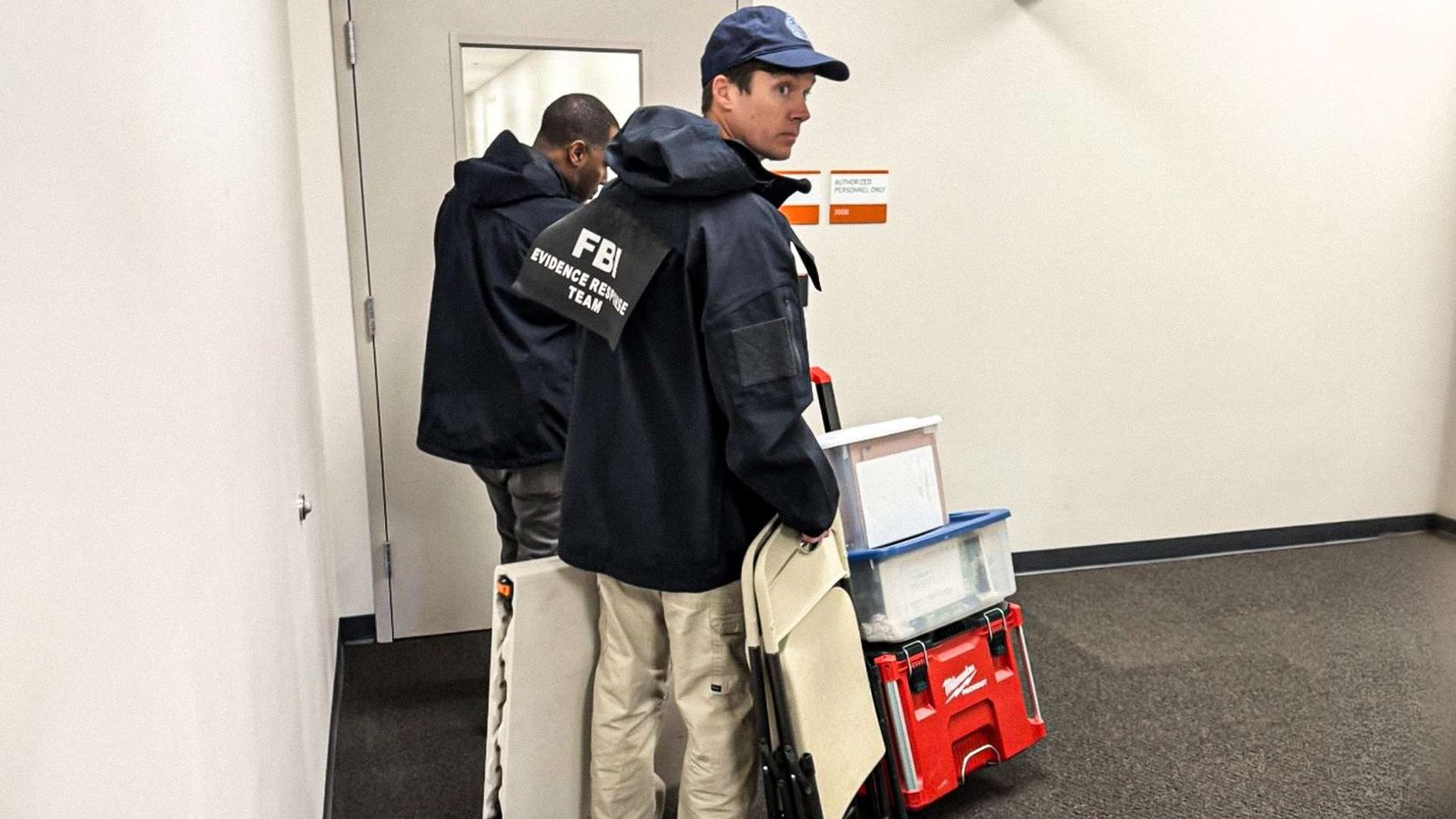
The DOJ also tried to shore up its case by citing a January 28 warrant, approved by a federal magistrate judge, that authorized the FBI to seize more than 600 boxes of Fulton County election records, which likewise was part of Trump’s efforts to salve his ego by proving that voters did not actually reject him in 2020. When Fulton County sought the return of those records, U.S. District Judge J.P. Boulee noted that the FBI raid was “unprecedented,” that the warrant affidavit “was defective in some respects,” that its inclusion of some statements was “troubling,” and that Fulton County had identified “features” that were “problematic.”
Boulee nevertheless ruled that Fulton County had not proven that the government “callously disregarded” its rights, which the DOJ thought was good enough to justify its subpoena. Ray disagrees, saying “nothing within Judge Boulee’s order convinces this Court that the DOJ has a high need for the election workers’ personal, private information, which is something altogether different [from] the ballots” seized by the FBI.
Ray understands that his ruling won’t be popular with the president’s supporters. “In these hyper-political times in which we currently live,” he says, “there are sure to be some who disagree with this decision because they believe the allegations of fraud in the 2020 Election and believe that ‘light’ should be brought to those claims.”
Ray notes that “nothing prevents a continued inquiry into those allegations by those who believe such claims, such as Congress and perhaps even by the DOJ.” But he adds that “the power of the Grand Jury, which exists to investigate potential crimes and to bring viable indictments thereof, cannot be used as [a] tool” to conduct such an inquiry.
Otherwise, Ray warns, “anyone in power (perhaps the next administration of a different party) could use the Grand Jury process similarly to subpoena personal information of citizens (perhaps that of their political opponents) with no legitimate law enforcement purpose.” He notes that “the information sought herein (names, addresses, phone
numbers, emails) is private and sensitive, so much so that should a private company
fail to protect such information from electronic thieves, such company would most
likely be sued in a data breach class action lawsuit.”
In other words, even MAGA enthusiasts might have a stake in making sure that grand juries do not engage in politically motivated fishing expeditions untethered to prosecutable crimes. “Whether you support the President or you do not, or whether you believe the 2020 Election was fair or believe that it was not,” Ray says, you “should be concerned about the DOJ’s ability to utilize the power of the Grand Jury to appropriate your private information without a legitimate purpose.”
Read the full article here
Fact Checker
Verify the accuracy of this article using AI-powered analysis and real-time sources.