

 Freedom Index
Listen to the article
Last April, Missouri’s Kearney School District (KSD) announced that it had hired a new principal to run Southview Elementary School: Ali Stewart, who had been the district’s director of curriculum and instruction since 2023. Annie Palmer, a KSD parent and former KSD teacher who had worked with Stewart, did not think she was a good choice for that job. When Palmer saw the announcement on the school district’s Facebook page, she expressed her displeasure with a thumbs-down emoji.
Or maybe it was a “sad-face” emoji, as Ray Weikal, the school district’s director of communications and community relations, later described it in an email to KSD Superintendent Emily Miller. We can’t say for sure, because Weikal deleted Palmer’s response. He also banned her from the KSD Facebook page, seemingly oblivious to the First Amendment implications of that decision.
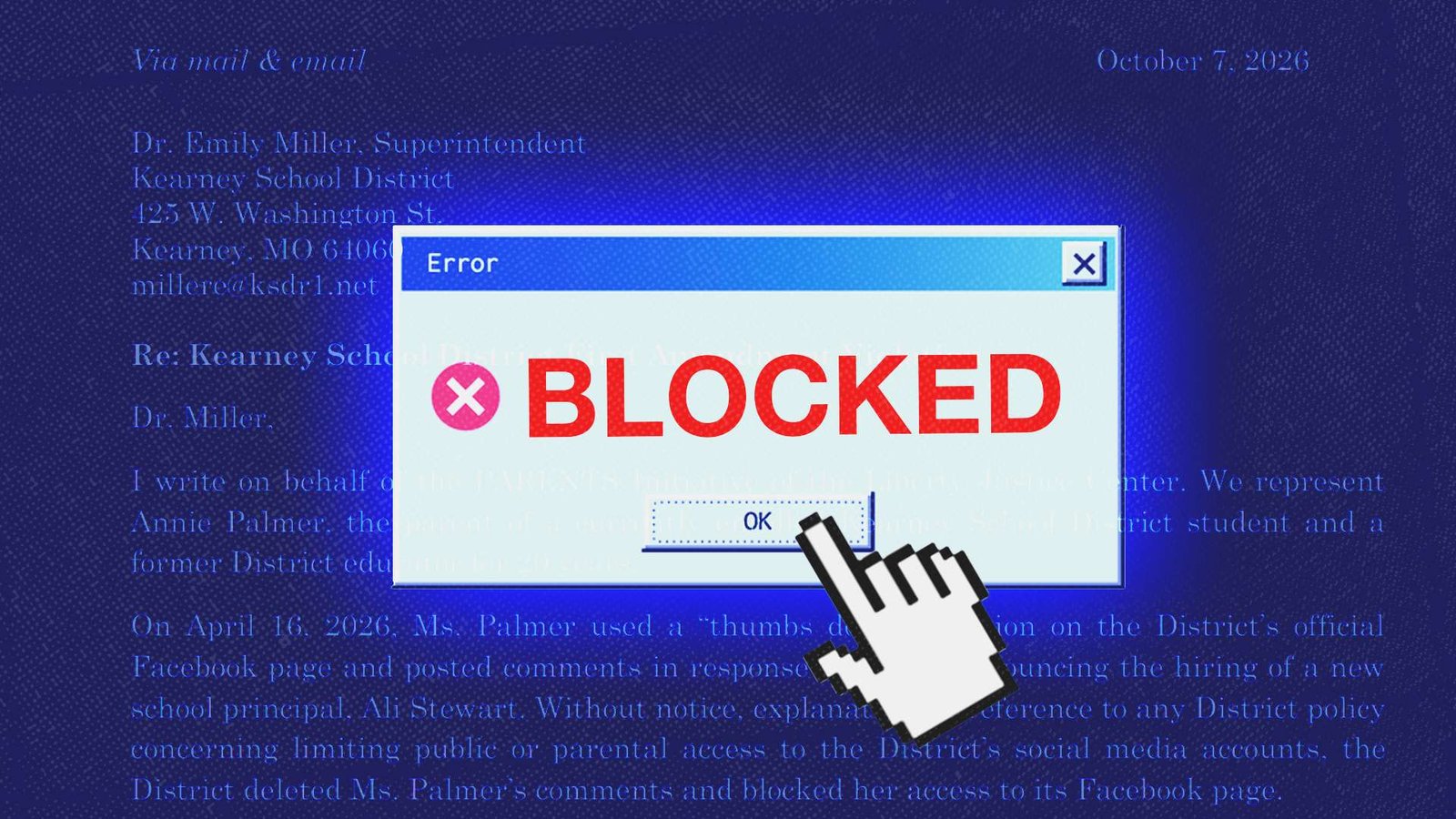
Timothy Snowball, senior counsel at the Liberty Justice Center’s PARENTS Intitiative, highlights those implications in a letter he sent Miller on Wednesday. “Government officials violate the First Amendment when they restrict constituents’ access to official social media accounts” in response to opinions that offend them, he writes. He adds that the U.S. Court of Appeals for the 8th Circuit, which includes Missouri, “has also acknowledged that blocking a constituent from a government-operated social media page based on the viewpoint of their expression is unconstitutional.”
That apparently was news to Weikal, who did not hesitate to censor Palmer and punish her for expressing a dissenting view. “I was with Ali,” KSD Data Coordinator Tami Thomas told Weikal in an April 16 text message that Palmer obtained via a public records request, “and she mentioned that Annie Palmer put a sad face on the Facebook announcement. It was upsetting! Any way you can delete that???”
Weikal was happy to help. “Of course!” he replied. “That pisses me off. I’ll probably ban her from the page for a while.” Later he gave Thomas an update: “I had to delete the post and then block her. Now I will reshare it.”
Thomas was grateful. “Good job by you Ray Weikal!!!” she said. “I appreciate you!!!”
Palmer had a different reaction. Palmer “contacted me because she was unable to access the district Facebook page,” Weikal reported in an August 18 email to Miller that Palmer obtained through the same public records request. “When I looked into it, I realized that I had previously blocked her account following a sad-face reaction she placed on our April 16 post announcing Ali Stewart as the new principal at Southview Elementary.”
In response to Palmer’s inquiry, Weikal said, he had “removed the restriction.” When Palmer “initially asked what had happened,” he explained, “I told her that her account had been restricted following a reaction to a district post” and “that I had reviewed the situation and determined the restriction was not warranted.” He conceded that “blocking her over that reaction was a judgment call I made at the time, and in retrospect it was the wrong call.”
As Weikal saw it, he had “already corrected” his “mistake” by “restoring her access.” But now Palmer wanted to know “which post and reaction resulted in the restriction, approximately when the restriction was placed, what district social media policy or moderation guideline was used in making the decision, and whether restricting someone based solely on a reaction to a district post is or was standard district practice.”
Snowball has similar questions. “By restricting Ms. Palmer’s access to an officially operated social media page because a District employee took offense at a thumbs-down emoji—an obvious and quintessential expression of opinion on a matter of public concern—the District violated the First Amendment,” he says in his letter to Miller. “This conclusion is reinforced by the District’s own written policies—or lack thereof—which contain no specific provision concerning the First Amendment right of parents to access the District’s social media accounts.”
Snowball cites Lindke v. Freed, a 2024 decision in which the Supreme Court unanimously held that a government official who has “actual authority to speak on the State’s behalf” and “purported to exercise that authority when he spoke on social media” is subject to First Amendment claims under 42 USC 1983 when he decides to block a critic. That case, which the Court remanded for further consideration, involved a Facebook page that a city manager used for both personal and official purposes, which made application of the Court’s test for “state action” tricky. But since Palmer was blocked from a school district’s official Facebook page, it seems clear that censoring her qualified as state action.
Snowball also cites the 8th Circuit’s 2024 decision in Felts v. Green, which involved First Amendment claims by a critic who was blocked on Twitter by the president of the St. Louis Board of Aldermen. The appeals court upheld a federal judge’s decision granting “declaratory relief, nominal damages, costs, and attorney’s fees.”
In light of those precedents, Snowball says in his letter, the school district needs to go beyond restoring Palmer’s access to its Facebook page. “The District has provided no explanation, offer to create a policy to ensure this does not occur to other parents, or assurance it won’t again happen to Ms. Palmer if she expresses herself on the District Facebook page,” he writes.
Snowball wants “a written assurance” that neither Palmer nor “any other member of the public” will be “restricted from accessing the District’s social media accounts based on their viewpoint or protected expression.” He also wants the school district to “begin the process of adopting a written policy concerning management of all District social media accounts that acknowledges the First Amendment rights of the public.” And he says “all District staff” should be trained to respect those rights. Snowball warns that “failure to address these issues in a timely manner could result in legal action against the District.”
How does the school district plan to respond? I called Weikal to ask and left messages. I will update this article if and when I hear back.
“Citizens should be free to say what they want about public officials for whatever reasons they want, and an emoji is certainly expressive conduct,” Snowball says in an email. “If in fact the district delegated the authority to block citizens from access to an official Facebook page, that is constitutionally problematic. If there is no policy or training informing employees of their legal duties, that is also problematic.”
KSD parents have not been “assured this cannot happen again,” Snowball notes. “So the goal is to ask the district to correct these issues, first and foremost by clarifying their policy, making it align with the First Amendment, and making sure employees know what they are supposed to do. Criticism of public officials sits at the highest rung of First Amendment protections.”
Read the full article here
Fact Checker
Verify the accuracy of this article using AI-powered analysis and real-time sources.