

 Freedom Index
Listen to the article
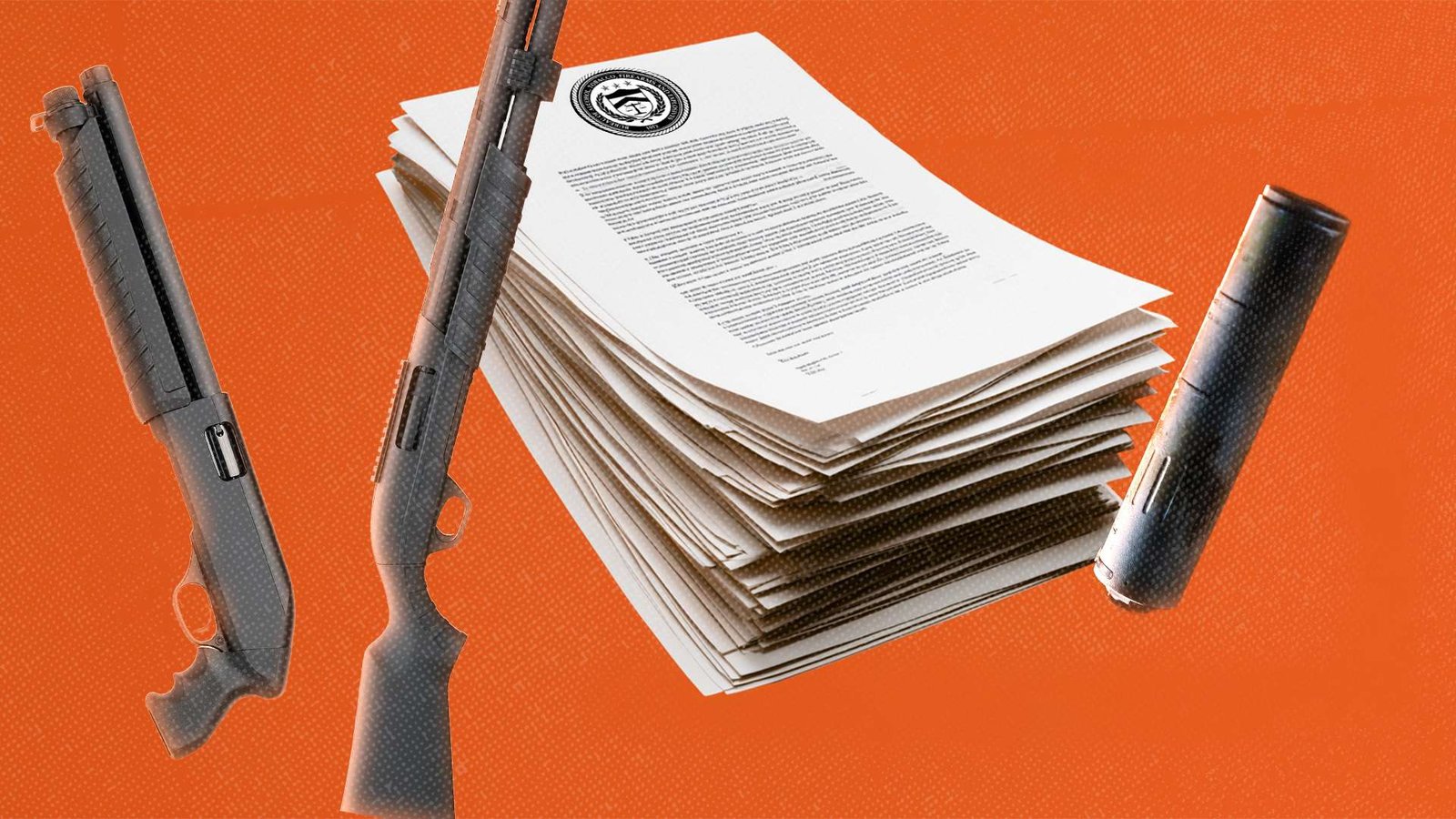
When Congress approved the National Firearms Act (NFA) in 1934, it framed the law as a tax measure, justifying its regulations as tools to facilitate the generation of revenue. That choice matters, a federal judge in Texas ruled on Wednesday, because several NFA provisions no longer serve that function. When Congress eliminated the federal taxes on making and transferring sound suppressors, short-barreled rifles, and short-barreled shotguns in 2025, U.S. District Judge James Hendrix concluded, it also eliminated the constitutional basis for the ancillary rules governing those activities.
Since the decision in Silencer Shop Foundation v. ATF bars enforcement of the challenged firearm regulations against the plaintiffs, it might look like a victory for gun rights. But it does not hinge on the Second Amendment, and it upholds a broader principle: The federal government’s powers are limited to those enumerated in the Constitution, and congressional legislation must be authorized by one of those powers.
“Because today’s NFA does not generate any revenue from untaxed firearms, its regulatory provisions cannot be upheld under the taxing power,” Hendrix writes. “And there is no sign in the NFA’s text, structure, or statutory history that Congress invoked any other power in crafting the NFA provisions at issue. Thus, the regulatory provisions must be enjoined as unconstitutional because they exceed Congress’s enumerated powers.”
The decision addresses consolidated lawsuits by two sets of plaintiffs, including gun owners, businesses, gun rights groups, and 15 states. Although the plaintiffs also argued that the NFA provisions they challenged violated the Second Amendment, they conceded that Hendrix did not need to reach that issue if he concluded that the regulations are no longer a valid exercise of congressional powers.
The NFA targeted weapons thought to be favored by gangsters, including machine guns and “destructive devices” such as bombs and grenades as well as “any silencer,” rifles with barrels shorter than 16 inches, and shotguns with barrels shorter than 18 inches. In addition to an annual occupational tax on importers, manufacturers, and dealers, it imposed a $200 tax on the production and transfer of the covered products. That tax, equivalent to about $5,000 today, was meant to be prohibitive.
Legislators were clear that they were relying on their tax power, the same rationale they had offered for the Harrison Narcotics Tax Act in 1914 and would again invoke when they approved the Marihuana Tax Act in 1937. Although that excuse might seem puzzling today, since Congress has long invoked its authority to regulate interstate commerce as an all-purpose license to legislate, the idea that the latter power could justify outright bans on politically disfavored products had yet to gain currency. The Commerce Clause did not become the go-to rationale for federal legislation until the Supreme Court expanded its meaning to encompass pretty much anything Congress wanted to do.
The NFA was enacted as part of the Internal Revenue Code, and Attorney General Homer S. Cummings explained why when he testified in favor of the bill. He noted that the federal government “of course” had “no inherent police powers to go into certain localities and deal with local crime.” Still, he said, “the power of taxation” could be used to restrict guns and accessories that Congress viewed as especially dangerous.
“If we made a statute absolutely forbidding any human being to have a machine gun,” Cummings explained, “you might say there is some constitutional question involved. But when you say, ‘We will tax the machine gun,’ and when you say that the absence of a license showing payment of the tax has been made indicates that a crime has been perpetrated, you are easily within the law.”
The NFA included various requirements ostensibly aimed at facilitating the collection of taxes. Anyone who wanted to make or receive a covered product had to file an application for approval and registration with the Treasury Department, accompanied by fingerprints, a photograph, personal information, and a detailed description of the relevant firearm or accessory. He had to send a copy of the application to the chief law enforcement officer in his local jurisdiction, who was instructed to supply any information that might disqualify the applicant.
That process is currently handled by the Bureau of Alcohol, Tobacco, Firearms, and Explosives (ATF), which used to be part of the Treasury Department but has been a division of the Justice Department since 2003. ATF approval “can take weeks,” Hendrix notes.
These requirements were presented as part of a revenue-raising scheme. But last year, Hendrix says, Congress fatally undermined that rationale with respect to most of the covered products by passing the One Big Beautiful Bill Act, which repealed the taxes on their production and transfer. “By zeroing out the transfer and making taxes on ‘any firearm’ except for ‘a machinegun or a destructive device,'” he writes, “the One Big Beautiful Bill Act eliminated the constitutional basis for the NFA’s regulation of those firearms.”
The Trump administration argued that the NFA’s registration, reporting, and record-keeping requirements could still be justified under the Commerce Clause. Hendrix, a Donald Trump appointee, disagreed.
“Because Congress enacted the challenged NFA provisions under the Taxing Clause only, the NFA cannot be retroactively justified under another power that Congress never invoked, such as its authority to regulate interstate commerce,” Hendrix writes. “Although a statute’s constitutionality does not depend on express recitals of an enumerated power, courts must be able to discern the constitutional basis on which Congress relied. And there is no sign here that Congress relied on its commerce power to craft the provisions.”
In fact, Hendrix notes, the NFA’s scope extends beyond interstate commerce in some ways. The law covers a firearm or suppressor “made in one’s home or transferred in a private sale between neighbors (an intrastate activity)” as well as a firearm or suppressor “purchased commercially and shipped to a customer in another state (an interstate activity).”
The government “cannot employ post-hoc justifications to save a statute based on an enumerated power that Congress never invoked,” Hendrix writes. “The same goes for the courts.”
Hendrix issued a permanent injunction that encompasses suppressors, short-barreled rifles, short-barreled shotguns, and (for one set of plaintiffs) a miscellaneous category that the NFA confusingly describes as “any other weapon.” The order bars the federal government from enforcing the NFA’s regulations “against the plaintiffs and, where applicable, the plaintiffs’ agencies, political subdivisions, members, and customers.”
The Firearms Policy Coalition (FPC), which joined one of the lawsuits, welcomed Hendrix’s decision. “This is a massive win and an important step forward in our strategic plan to end the NFA,” FPC President Brandon Combs said. “We cannot wait to fully and finally eliminate this unconstitutional scheme so people can exercise their rights when, where, and how they choose.”
Read the full article here
Fact Checker
Verify the accuracy of this article using AI-powered analysis and real-time sources.