

 Freedom Index
Listen to the article
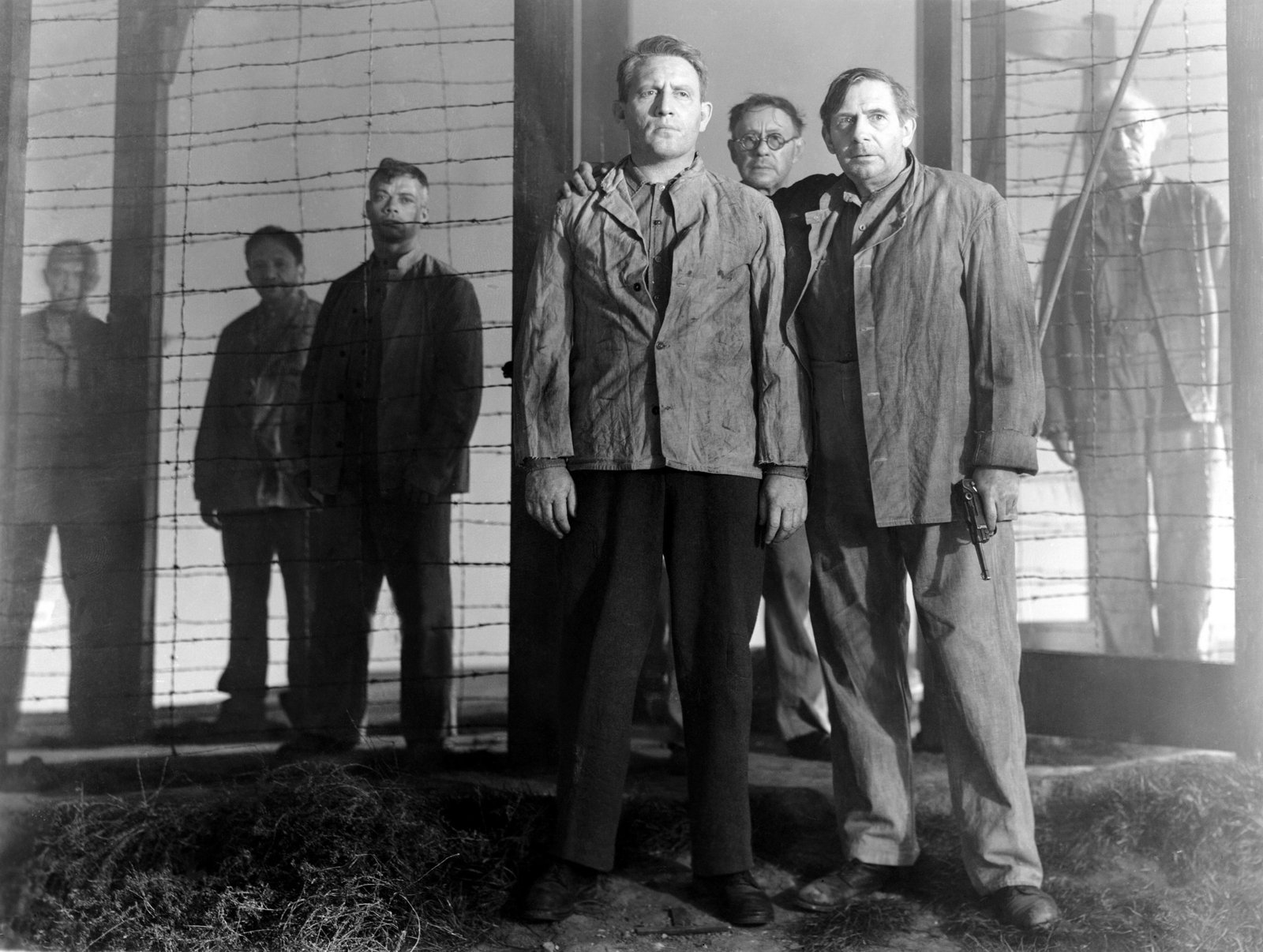
When award-winning author Rachel Seiffert met with Index on Censorship to talk about the freedom to read, she came armed with one of her favourite books, The Seventh Cross. Written by Anna Seghers, who was communist, Jewish and German, it’s what Seiffert describes as “an amazing cross-section of early Third Reich German life”. Published in 1942 in the USA while Seghers was in exile in Mexico and set in pre-war Nazi Germany, the novel tells the story of seven political prisoners who escape from a concentration camp and go on the run. Meanwhile the camp commandant has erected seven crosses which will serve as posts where they will be tortured on recapture. The novel, a graphic depiction, of German totalitarianism was made into a Hollywood film starring Spencer Tracy in 1944 (pictured top).
Seiffert has her own relationship with Germany’s dark past, and it is an uncomfortable one. The maternal side of her family was, as she describes it, implicated in Nazi crimes. To be precise, her maternal grandfather was in the Waffen SS, her step-grandmother was a social worker for the Nazi party and her great uncle was the deputy chief medical officer during the Third Reich. She grew up close to her German family and bilingual. Although her grandfather died the year she was born, she had a deep bond with her grandmother. Seiffert strongly identified with her own “German-ness”, but also knew about a lurking darkness.
“I’m still trying to find out whether my grandfather did anything during his time in terms of taking part in massacres, but it’s clear he was part of an organisation that was banned after the war,” Seiffert told Index. He had previously been in the SA, or Storm Troopers in Hamburg who she knows were involved in book burnings in the 1930s.
Before hearing about the Holocaust at school, Seiffert learnt about it at home. It was desperately important to her mother that she was aware of her family history. Knowing about her family’s past is something Seiffert carries with her.
This lifetime of trying to understand her family’s relationship with the Nazis has led directly to the subjects of her novels. She’s focused her work on trying to understand why people vote for dictatorships and hateful ideas, and why they follow these regimes even when they can see the cruelty.
The author Rachel Seiffert. Photo: Charlie Hopkinson © 2013
When Seiffert published her book A Boy in Winter in 2017, soon after Donald Trump had been elected US president for the first time, she could feel the echoes of Nazi Germany. She described how liberal people in the early 1930s would laugh at the Nazis, considering them anti-science and anti-knowledge. People thought they wouldn’t get into power, and if the Nazis did, people thought they were so incompetent that they wouldn’t last.
“People say it’s hysterical if you say Trump is like Hitler. But I saw so many parallels,” she said, describing how now Trump is in his second term “the gloves are off”. The ICE raids, the lawsuit against the New York Times, the censoring of comedian Jimmy Kimmel over remarks critical of the administration are all examples of what she describes as a fascist playbook.
This theme has remained current, and the political atmosphere has become more frightening to her. In the UK too, Seiffert sees parallels.
“History doesn’t repeat itself exactly, but there are so many rhymes here. The centre can’t hold, this is what we’re having at the moment, the hollowing out of the centre ground in terms of politics. And we’re all sitting somewhere at the extremes,” she said.
In this atmosphere, politicians feel they need to appeal to those extremes in order to get votes, she explained. As was the case in 1930s Germany.
“There was a period in my life where I thought it would never happen again in Germany. And I don’t have that conviction at all anymore,” she said. “Part of the drive to write is so that it doesn’t happen again.”
In her books, Seiffert puts readers into the shoes of those facing authoritarianism, showing that there isn’t a single, correct response. Her books also demonstrate that if you decide to stay silent, that is still an active decision. The idea that some people don’t have a choice is to her, inaccurate.
“No, you did have a choice, and you chose to stay silent. And that might have been absoluely the right choice for you and for your family, but it’s the wrong choice for other people, and we just have to be honest with ourselves about that,” she said.
She hopes that if people understood this better, they might step up more readily, unable to live with the idea that they chose to do nothing.
When Seiffert talks to Index, Banned Books Week UK is just around the corner. After a few fallow years, followed by a run of worrying violations of the freedom to read, a coalition led by Index on Censorship revived the annual event – the US version of which has been going strong for many years.
There are many UK examples of restrictions on the freedom to read: more than half of bookshop owners surveyed by the Booksellers Association have reported an increase in intimidating behaviour, school librarians told Index about LGBTQ+ books being whisked off the shelves and a book-related row broke out in a school in Dorset this last just days before Seiffert spoke to Index.
In this particular example, a parent put pressure on a school to remove a book from a year 10 lesson plan. The book in question was The Hate U Give by Angie Thomas, which explores issues of race, identity and social injustice, and the parent raised concerns about other books, too. According to local reporting from the Bournemouth Echo, the school removed the book after the parent refused a meeting with teachers because he was not allowed to record it. The paper described how the parent took issue with the book due to what he considered the use of bad language and inappropriate themes, and for making white characters appear as “baddies”. Other parents fought back, and soon launched a petition.
Seiffert herself works in schools, and believes that it is absolutely the right of parents to have conversations about which books are in the classroom, but that schools need to engage in the conversation in a way which backs up their teachers. She feels that classrooms should be open enough so that children who are feeling aggrieved can air their concerns, and the teacher can have those discussions with the class. Removing stories is not the answer.
“If adults are worried that their children might learn about something that makes them feel uncomfortable, it can feel preferable that they don’t know about it,” she said. “But it doesn’t make them safer in the end, because those ideas are out there and those experiences are out there.”
Instead, she believes hiding these parts of the world makes young people more insulated, and withholding information is doing them a disservice.
“I would really emphasise that taking away stories reduces our world. It reduces the possibilities of thought and of empathy, and it’s very dangerous. It should count for stories written from all perspectives. We have to be tolerant of upset.”
Once upon a time, Seiffert didn’t worry too much about her personal risk of being censored, considering it a practice more likely to be waged against writers in, for example, Russia. But as she talked to Index, she recognised how some of the things she was saying could, in today’s USA and a near-future UK, be taken as offensive by some people.
For those like her who have so far lived with the right to freedom of expression, it is now “all very much closer to the bone”.
Read the full article here
Fact Checker
Verify the accuracy of this article using AI-powered analysis and real-time sources.