Close Menu
FSNN | Free Speech News NetworkFSNN | Free Speech News Network
  • Home
  • News
    • Politics
    • Legal & Courts
    • Tech & Big Tech
    • Campus & Education
    • Media & Culture
    • Global Free Speech
  • Opinions
    • Debates
  • Video/Live
  • Community
  • Freedom Index
  • About
    • Mission
    • Contact
    • Support
Trending

LGBT Q&A: We’re Back With Season 2! 

6 minutes ago

Today in Supreme Court History: June 11, 1993

10 minutes ago

Tunisian journalist Khaoula Boukrim sentenced in absentia to 4 years in prison 

23 minutes ago
Facebook X (Twitter) Instagram
Facebook X (Twitter) Discord Telegram
FSNN | Free Speech News NetworkFSNN | Free Speech News Network
Market Data Newsletter
Thursday, June 11
  • Home
  • News
    • Politics
    • Legal & Courts
    • Tech & Big Tech
    • Campus & Education
    • Media & Culture
    • Global Free Speech
  • Opinions
    • Debates
  • Video/Live
  • Community
  • Freedom Index
  • About
    • Mission
    • Contact
    • Support
FSNN | Free Speech News NetworkFSNN | Free Speech News Network
Home»News»Media & Culture»1776 All-Stars: Why Thomas Jefferson Is the Most Fascinating Founder
Media & Culture

1776 All-Stars: Why Thomas Jefferson Is the Most Fascinating Founder

News RoomBy News Room1 hour agoNo Comments4 Mins Read799 Views
Share Facebook Twitter Pinterest Copy Link LinkedIn Tumblr Email VKontakte Telegram
1776 All-Stars: Why Thomas Jefferson Is the Most Fascinating Founder
Share
Facebook Twitter Pinterest Email Copy Link

Listen to the article

0:00
0:00

Key Takeaways

Playback Speed

Select a Voice

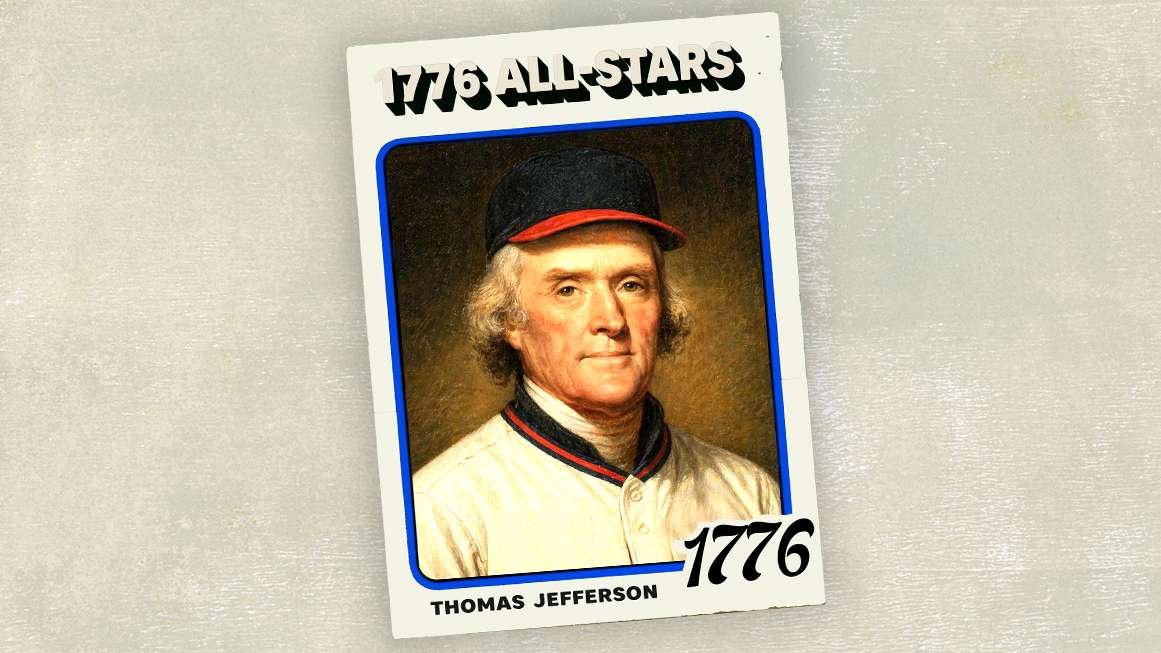
This is part of 1776 All-Stars, a series about Reason’s favorite American Founders. Read more here.

Joanna Andreasson

“Rightful liberty is unobstructed action according to our will, within the limits drawn around us by the equal rights of others,” wrote Thomas Jefferson in 1819. This accords well with the Cato Institute’s definition of libertarianism: “the belief that each person has the right to live his life as he chooses so long as he respects the equal rights of others.”

Immediately following his definition of rightful liberty, Jefferson properly cautioned, “I do not add ‘within the limits of the law’; because law is often but the tyrant’s will, and always so when it violates the right of an individual.”

Nearly half a century earlier, as a 27-year-old lawyer in 1770, Jefferson sought freedom for Samuel Howell, who was being held in indentured servitude because his grandmother was white and his grandfather was black. In his legal brief, Jefferson declared, “Under the law of nature, all men are born free, every one comes into the world with a right to his own person, which includes the liberty of moving and using it at his own will.” Jefferson was asserting the libertarian moral claim that every individual has full self-ownership. Alas, he lost the case.

Six years later, in the Declaration of Independence, Jefferson famously wrote, “We hold these truths to be self-evident, that all men are created equal, that they are endowed by their Creator with certain unalienable Rights, that among these are Life, Liberty and the pursuit of Happiness.” Historian Walter Isaacson calls that phrase “the greatest sentence ever written.” And the claim that sentence made has reverberated across the world for the last two and a half centuries.

Despite declaring that “all men are created equal,” Jefferson benefited from the labor of more than 600 enslaved people at Monticello and other properties over the course of his lifetime. Jefferson was conscious of this hypocrisy. In his first draft of the Declaration, he indicted King George III for having “waged cruel war against human nature itself, violating its most sacred rights of life and liberty in the persons of a distant people who never offended him, captivating & carrying them into slavery in another hemisphere.” Jefferson further accused the king of “suppressing every legislative attempt to prohibit or restrain this execrable commerce.” Jefferson later explained that this passage “was struck out in complaisance to South Carolina & Georgia who had never attempted to restrain the importation of slaves, and who on the contrary still wished to continue it.”

In his 1783 draft of a new constitution for the Commonwealth of Virginia, Jefferson proposed that the new General Assembly not have the power “to permit the introduction of any more slaves to reside in this state, or the continuance of slavery beyond the generation which shall be living on the 31st. day of December 1800; all persons born after that day being hereby declared free.” Jefferson recognized the evil of slavery but could not politically bring about its end or bring himself to give it up.

Jefferson was a fierce supporter of the liberty of conscience. “It does me no injury for my neighbour to say there are twenty gods, or no god,” he observed in 1782. “It neither picks my pocket nor breaks my leg.” While Rhode Island was the only colony without an established state church, the 1786 adoption of Jefferson’s Statute for Religious Freedom made Virginia the first state to end the use of taxes to support state-sanctioned churches.

Jefferson was ambassador to France as the new Constitution was being hammered out in 1787. But in his correspondence with chief writer James Madison, Jefferson decried the “omission of a bill of rights providing clearly & without the aid of sophisms for freedom of religion, freedom of the press, protection against standing armies, restriction against monopolies, the eternal & unremitting force of the habeas corpus laws, and trials by jury in all matters of fact triable by the laws of the land & not by the law of Nations.” Persuaded, Madison drafted a Bill of Rights that largely incorporated Jefferson’s concerns; it was ratified as the first 10 amendments to the Constitution.

Jefferson’s hypocrisy with respect to slavery is a blot on his legacy. But he still deserves our praise for expressing the principles and framing the institutions that enabled the eventual extension of civil and political rights to all American men and women. On the anniversary of Jefferson’s Declaration, it is up to us to sustain and extend that document’s ideals.

1776 All-Stars, a series about Reason‘s favorite American Founders:

Read the full article here

Fact Checker

Verify the accuracy of this article using AI-powered analysis and real-time sources.

Get Your Fact Check Report

Enter your email to receive detailed fact-checking analysis

5 free reports remaining

Continue with Full Access

You've used your 5 free reports. Sign up for unlimited access!

Already have an account? Sign in here

#FreePress #IndependentMedia #Journalism #OpenDebate #PressFreedom
Share. Facebook Twitter Pinterest LinkedIn Tumblr Email Telegram Copy Link
News Room
  • Website
  • Facebook
  • X (Twitter)
  • Instagram
  • LinkedIn

The FSNN News Room is the voice of our in-house journalists, editors, and researchers. We deliver timely, unbiased reporting at the crossroads of finance, cryptocurrency, and global politics, providing clear, fact-driven analysis free from agendas.

Related Articles

Media & Culture

Today in Supreme Court History: June 11, 1993

10 minutes ago
Media & Culture

Mitch McConnell’s Hemp Ban Betrays the Industry He Helped Create

2 hours ago
Media & Culture

Brickbat: ‘Less Serious’ Theft

3 hours ago
Debates

David Reich Nature Study Shows Recent Human Evolution

3 hours ago
Media & Culture

My New Lawfare Article on “Why Callais Doesn’t Justify Court-Packing”

4 hours ago
Cryptocurrency & Free Speech Finance

Morning Minute: Crypto Falls Amidst War Escalation and Mythos Release

5 hours ago
Add A Comment
Leave A Reply Cancel Reply

Editors Picks

Today in Supreme Court History: June 11, 1993

10 minutes ago

Tunisian journalist Khaoula Boukrim sentenced in absentia to 4 years in prison 

23 minutes ago

BTC price rises, holds above moving average signal that ETH, SOL can’t penetrate

29 minutes ago

1776 All-Stars: Why Thomas Jefferson Is the Most Fascinating Founder

1 hour ago
Latest Posts

Chicken heads sent to Indonesian news outlet after threats over coverage of Papua documentary

1 hour ago

Philippines’ central bank complicates Binance’s return to the country

2 hours ago

Tether Expands AI push with Lead Role in NEURA Robotics Raise

2 hours ago

Subscribe to News

Get the latest news and updates directly to your inbox.

At FSNN – Free Speech News Network, we deliver unfiltered reporting and in-depth analysis on the stories that matter most. From breaking headlines to global perspectives, our mission is to keep you informed, empowered, and connected.

FSNN.net is owned and operated by GlobalBoost Media
, an independent media organization dedicated to advancing transparency, free expression, and factual journalism across the digital landscape.

Facebook X (Twitter) Discord Telegram
Latest News

LGBT Q&A: We’re Back With Season 2! 

6 minutes ago

Today in Supreme Court History: June 11, 1993

10 minutes ago

Tunisian journalist Khaoula Boukrim sentenced in absentia to 4 years in prison 

23 minutes ago

Subscribe to Updates

Get the latest news and updates directly to your inbox.

© 2026 GlobalBoost Media. All Rights Reserved.
  • Privacy Policy
  • Terms of Service
  • Our Authors
  • Contact

Type above and press Enter to search. Press Esc to cancel.

🍪

Cookies

We and our selected partners wish to use cookies to collect information about you for functional purposes and statistical marketing. You may not give us your consent for certain purposes by selecting an option and you can withdraw your consent at any time via the cookie icon.

Cookie Preferences

Manage Cookies

Cookies are small text that can be used by websites to make the user experience more efficient. The law states that we may store cookies on your device if they are strictly necessary for the operation of this site. For all other types of cookies, we need your permission. This site uses various types of cookies. Some cookies are placed by third party services that appear on our pages.

Your permission applies to the following domains:

  • https://fsnn.net
Necessary
Necessary cookies help make a website usable by enabling basic functions like page navigation and access to secure areas of the website. The website cannot function properly without these cookies.
Statistic
Statistic cookies help website owners to understand how visitors interact with websites by collecting and reporting information anonymously.
Preferences
Preference cookies enable a website to remember information that changes the way the website behaves or looks, like your preferred language or the region that you are in.
Marketing
Marketing cookies are used to track visitors across websites. The intention is to display ads that are relevant and engaging for the individual user and thereby more valuable for publishers and third party advertisers.