Close Menu
FSNN | Free Speech News NetworkFSNN | Free Speech News Network
  • Home
  • News
    • Politics
    • Legal & Courts
    • Tech & Big Tech
    • Campus & Education
    • Media & Culture
    • Global Free Speech
  • Opinions
    • Debates
  • Video/Live
  • Community
  • Freedom Index
  • About
    • Mission
    • Contact
    • Support
Trending

Live BTC prices: Bitcoin whipsaws between $81,000 and $84,000 as altcoins slide

6 minutes ago

Metaplanet to Issue $329M Convertible Bonds to Pay Debt, Fund Share Buybacks

17 minutes ago

‘Leave’: Crypto Backlash Over French Proposal to Report Wallets Over $112K

20 minutes ago
Facebook X (Twitter) Instagram
Facebook X (Twitter) Discord Telegram
FSNN | Free Speech News NetworkFSNN | Free Speech News Network
Market Data Newsletter
Tuesday, October 13
  • Home
  • News
    • Politics
    • Legal & Courts
    • Tech & Big Tech
    • Campus & Education
    • Media & Culture
    • Global Free Speech
  • Opinions
    • Debates
  • Video/Live
  • Community
  • Freedom Index
  • About
    • Mission
    • Contact
    • Support
FSNN | Free Speech News NetworkFSNN | Free Speech News Network
Home»News»Global Free Speech»‘I do not feel safe’: The cost of 3 years of Israeli impunity for journalists in Lebanon
Global Free Speech

‘I do not feel safe’: The cost of 3 years of Israeli impunity for journalists in Lebanon

News RoomBy News Room2 hours agoNo Comments11 Mins Read2 Views
Share Facebook Twitter Pinterest Copy Link LinkedIn Tumblr Email VKontakte Telegram
‘I do not feel safe’: The cost of 3 years of Israeli impunity for journalists in Lebanon
Share
Facebook Twitter Pinterest Email Copy Link

Listen to the article

0:00
0:00

Key Takeaways

Playback Speed

Select a Voice

When visual journalist Ahmed Chihadeh came under Israeli drone fire in January 2025 while covering the return of displaced residents to the southern Lebanese town of Houla, he removed his press vest and hid his camera.

“After what happened to my colleagues, and after seeing that there has still been no justice for those who were killed or injured, I do not feel safe,” the Palestinian-Lebanese freelancer told the Committee to Protect Journalists.

Three years after Reuters video journalist Issam Abdallah was killed and six other journalists injured in the first instance CPJ has documented of Israeli forces deliberately targeting journalists following the outbreak of war on October 7, 2023, members of the press in Lebanon say continued attacks, combined with the absence of accountability, have changed how they work.

Journalists who have reported from southern Lebanon told CPJ that areas they once covered have become inaccessible due to Israel’s military presence and the risk of being targeted. They said that identifying themselves as press no longer offers them a sense of protection, while mounting risks have forced them to document events from afar they can no longer witness firsthand.

Chihadeh and fellow photojournalist Hassan Fneich were among a group of civilians about 150 to 200 meters (490 to 650 feet) from Israeli forces when a drone descended and began firing. Fneich, who was standing beside him, was hit in the leg.

“With all the technology and artificial intelligence we have reached, surely whoever is flying in the sky knows they are targeting civilians,” Chihadeh said.

A growing record of attacks

On October 13, 2023, two Israeli tank shells struck the group of seven journalists reporting near Alma al-Shaab in southern Lebanon, killing Abdallah and injuring six others, including Agence France-Presse photojournalist Christina Assi, who suffered life-altering injuries.

At least five independent investigations concluded that the clearly identifiable journalists were deliberately targeted.

A screenshot from a mobile phone video shows Agence France-Presse (AFP) photographer Christina Assi working at a site near the village of Alma al-Chaab in Lebanon, close to the Israeli border, October 13, 2023. (Photo: Reuters/ Issam Abdallah)

The journalists had been reporting from an open hillside, away from the active exchange of fire, when two 120mm tank rounds struck the group 37 seconds apart. Reuters found that heavy machine-gun fire was likely directed at the journalists for nearly two minutes after the strikes. 

In 2026, Israel acknowledged that its forces had fired the rounds but described the attack as a mistake. The acknowledgment confirmed who fired the rounds — but did not answer the question: who was responsible for the decision to fire, and have any consequences followed?

Lawyers representing Abdallah’s family submitted information about his killing to the Independent International Commission of Inquiry on the Occupied Palestinian Territory, including East Jerusalem, and Israel in 2024. In 2025, they filed a complaint to two UN Special Repertours on the failure of Israeli and Lebanese authorities to conduct a prompt, independent, effective and transparent investigation. No publicly documented criminal prosecution has followed.

Neither Lebanon nor Israel are party to the Rome Statute, meaning that the International Criminal Court does not have jurisdiction to prosecute the targeting of civilians or any other war crimes. In 2024, Lebanon approved a special declaration that would have granted the Court jurisdiction to investigate war crimes committed after October 7, 2023. However, a month later the government reversed that decision.

Nizar Saghieh, the executive director of Legal Agenda, a Beirut-based nonprofit research and advocacy organization, told CPJ that Lebanon’s reluctance to refer alleged violations to the ICC reflects both domestic and international pressure. 

The government withdrew its decision in May 2024 “under pressure from both Hezbollah and the US Embassy,” he said, referring to the powerful Lebanese armed group, who could also come under scrutiny by the ICC should it receive jurisdiction. “None of them said that officially.”

In June 2026, the U.S.-brokered Lebanon-Israel Framework bound both parties to cease “all hostile or negative actions in international political or legal forums,” prompting warnings from rights groups that it could obstruct efforts to seek accountability for alleged war crimes.

Meanwhile, as legal avenues narrowed, attacks on journalists continued.

On October 25, 2024, about a year after Abdallah’s killing, an Israeli airstrike hit a resort in Hasbaya housing at least 18 journalists, killing pro-Hezbollah Al-Mayadeen journalists Ghassan Najjar and Mohammed Reda, and Hezbollah-affiliated Al-Manar journalist Wissam Kassem.

Investigations by Human Rights Watch (HRW) and The Guardian found no military activity at the site, and presented evidence that the journalists may have been deliberately targeted. HRW found that U.S.-made weapons were used in the attack.

Following renewed hostilities in March 2026, Israeli forces killed three journalists — Al-Manar’s Ali Shoaib, Al-Mayadeen’s Fatima Ftouni and freelance photojournalist Mohammed Ftouni — in Jezzine, southern Lebanon.

About a month later, local newspaper Al-Akhbar correspondent Amal Khalil and freelance photojournalist Zeinab Faraj were heading on assignment to document an Israeli incursion in Bint Jbeil when an Israeli airstrike first hit the car in front of them, and then the building where they sought shelter. Israeli forces obstructed medical workers from reaching the site for hours. Khalil was killed and Faraj seriously injured, in an attack CPJ said should be investigated as a war crime.
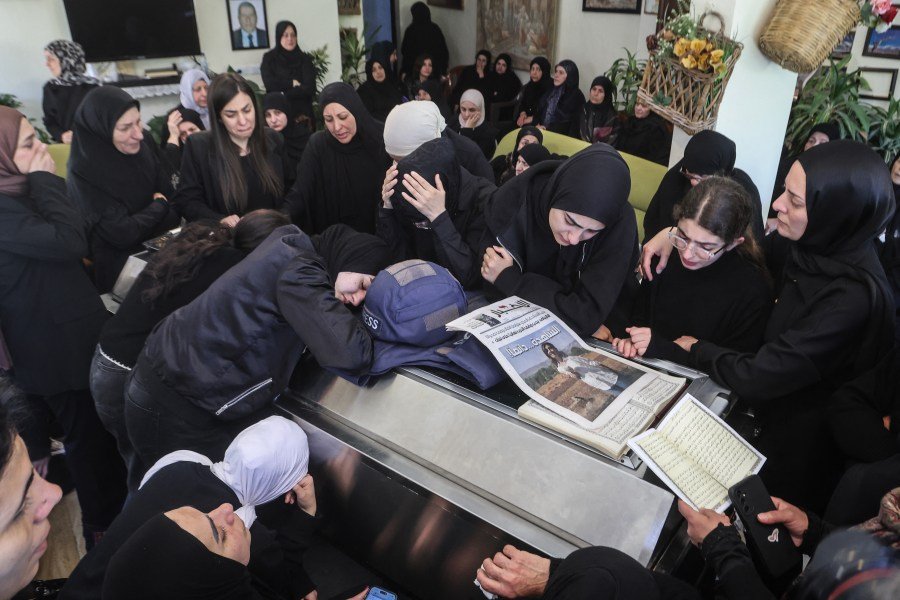
Relatives and friends of Amal Khalil, a veteran correspondent for the daily newspaper Al-Akhbar who was killed in a reported Israeli airstrike in southern Lebanon, mourn at her home in the village of Bisariyeh on April 23, 2026.
Relatives and friends of Amal Khalil, a veteran correspondent for the daily newspaper Al-Akhbar who was killed in a reported Israeli airstrike in southern Lebanon, mourn at her home in the village of Bisariyeh on April 23, 2026. (Photo: AFP/ Mahmoud Zayyat)

Civilians as targets

Chihadeh said the change began with basic decisions about where journalists could go.

Areas identified as targets by the Israeli or Lebanese armies became off-limits, even for important stories, he said. While journalists can sometimes access occupied villages as embeds in time-controlled UNIFIL tours, entry is not always granted, two journalists told CPJ. 

The danger has extended beyond locations formally designated as military zones.

“Even in places that are supposed to be safe and protected under international law, the risk is there,” said Chihadeh .

He recalled covering the aftermath of an Israeli strike in Nabatieh, southern Lebanon, in November 2024 alongside Lebanese Civil Defence and ambulance crews. The first strike had already hit. Chihadeh, a reporter and a producer, ambulance workers, and civil-defence members were attempting to leave when Israeli aircraft returned.

“There were people carrying cameras,” he said. “I had a camera, a reporter was with me, my producer was with me, and there were members of the civil defence and paramedics. The place was targeted while we were trying to leave.”

Two months later in Houla, it went further: when a drone opened fire and wounded Fneich, Chihadeh hid the equipment that identified him as a journalist.

For Chihadeh, he feared the press vest intended to distinguish him as a civilian might put a target on his back.
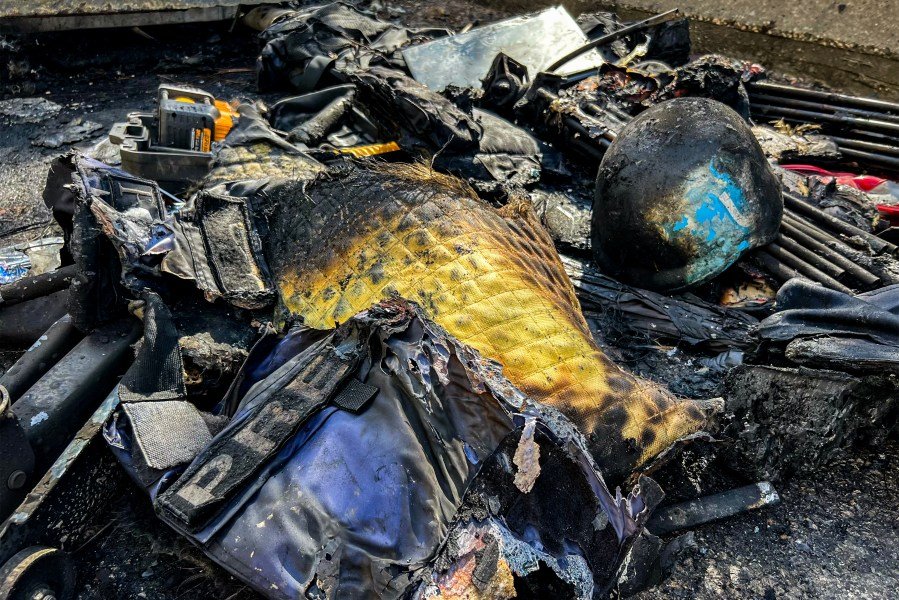
Gear that was used by a media crew of journalists who were killed in an Isareli strike earlier is displayed near the husk of their destroyed vehicle along the side of a road leading to Jezzine in southern Lebanon on March 28, 2026. (Photo: AFP/ Mahmoud Zayyat)

Distanced from the field

The growing danger has also changed how some Lebanese news organizations gather information.

Enass Sherry, a journalist with Legal Agenda and a member of the administrative body of Union of Journalists in Lebanon, said the organisation had changed its methods as growing impunity, and the heightened targeting of journalists expanded the scope of danger.

“When the risks increased, we started looking for other tools that could achieve our reporting while preserving our safety,” Sherry said.

The organisation introduced open-source investigations and trained staff to read maps, analyse videos and verify information remotely. It documented violations without always sending reporters to the site. It also investigated Khalil’s killing without requiring the team to return to the location, by reconstructing the attack through primary evidence, reporting, and witness testimonies.

“We started to reduce the areas we could reach,” Sherry said. “When the situation allowed it, we went to the field. When there were risks, we replaced that with calls, and information from outside the event.”

This shift has allowed journalists to continue reporting. It has also changed what can be independently observed. The more dangerous the ground becomes, the more journalism depends on information gathered at a distance.

Sherry and Chihadeh both pointed out that the precarious situation escalates when journalists are freelancers, without the institutional protection, equipment or insurance available to staff.

Up until recently, journalists were allowed rare access to Christian villages in the occupied areas through civilian convoys, UN peacekeepers or specific NGOs delivering aid to the isolated towns. The Israeli military often refused to grant access, though.

Nada Atallah and Nada Homsi, journalists for state-linked Emirati outlet The National, said they were, on one occasion, able to access some still-inhabited Israeli-occupied villages through civilian convoys of residents returning to their towns.

“Even when you manage to get there, you only have two hours, and you cannot drive freely, and people are very scared to talk,” Atallah said, adding that the restrictions bar them from reporting on how Israel “has completely erased the south, and potential war crimes.”

To her, Israel’s targeting of journalists since October 13, 2023, was “a clear message to scare us”.

“Only a small percent of what’s happening is even able to get out. So, anything that we know about this so-called security zone now, we know through residents that are too scared to talk over the phone,” Homsi added.

Journalists who requested anonymity out of fear for their safety told CPJ that Israel temporarily banned media embeds to two of the three inhabited occupied villages, supposedly due to reports painting the Israeli military in a negative light.
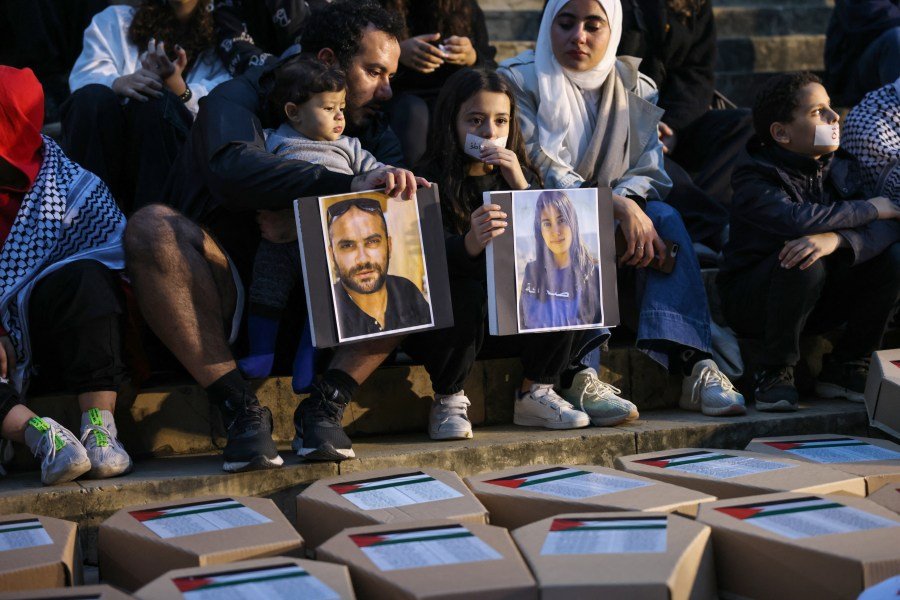
Demonstrators lift portraits of Reuters journalist Issam Abdallah and Al-Mayadeen TV reporter Farah Omar, killed in separate instances while covering the frequent exchanges of fire across Lebanon’s border with Israel, while sitting in front of symbolic coffins and shrouds of children at a rally supporting Gaza in front of the National Museum building in Beirut on December 8, 2023. (Photo: AFP/ Joseph Eid)

‘Accountability is protection’

“If Israel had been held accountable the first time it killed a journalist in Lebanon or Gaza, it would not have found it so easy to kill other journalists,” Sherry said. “The killings are documented with enough evidence to open a real judicial case.”

She said accountability was not only about punishment after the fact, but also a preventive measure.

“Accountability is protection,” Sherry told CPJ. “The first basic step to prevent attacks on journalists and guarantee their right to work, and access information has to begin with holding Israel accountable for these crimes.”

For Chihadeh, justice requires identifying the individuals responsible. 

“When Issam Abdallah was killed, there wasn’t a battalion of 500 soldiers, there were two Israeli tanks,” he said. “Why don’t we have a name?”

He said legal measures capable of imposing consequences on those responsible, including restricting their ability to travel internationally, could provide a deterrent against future attacks.

Christina Assi, who survived the October 13 attack and received CPJ’s 2026 International Press Freedom Award, made a similar argument.

“It is not enough to file a case against a country,” Assi told CPJ. “We need to know who did this to us.”

Three years after the attack that killed Abdallah and severely injured Assi, journalists in Lebanon continue to work without that answer — and some no longer trust the protections they once relied upon to do their jobs.

“With Israel’s blatant failure to take accountability, we call on the international community to pressure Israeli officials to complete a probe naming the units and individuals responsible for the deliberate attacks against journalists,” said CPJ Regional Director Sara Qudah. “The failure to hold those responsible to account is just a failure of justice – it puts other journalists at risk by allowing impunity to persist. The suspension of the EU-Israel Association Agreement is one of the few remaining avenues that could create a meaningful pressure to break this cycle of impunity.”


Read the full article here

Fact Checker

Verify the accuracy of this article using AI-powered analysis and real-time sources.

Get Your Fact Check Report

Enter your email to receive detailed fact-checking analysis

5 free reports remaining

Continue with Full Access

You've used your 5 free reports. Sign up for unlimited access!

Already have an account? Sign in here

Share. Facebook Twitter Pinterest LinkedIn Tumblr Email Telegram Copy Link
News Room
  • Website
  • Facebook
  • X (Twitter)
  • Instagram
  • LinkedIn

The FSNN News Room is the voice of our in-house journalists, editors, and researchers. We deliver timely, unbiased reporting at the crossroads of finance, cryptocurrency, and global politics, providing clear, fact-driven analysis free from agendas.

Related Articles

Global Free Speech

At least 37 journalists detained, several assaulted, while covering protests against India’s election chief

14 hours ago
Global Free Speech

Turkey: 4 more journalists arrested for ‘spreading disinformation’ as media crackdown intensifies

17 hours ago
Global Free Speech

Screenshot of silhouette in NAZA film (The Guardian/JW Films) NAZA, the new documentary film by Yuval Abraham and Rachel Szor, is not the first filmabout Israel, by Israelis, to speak out of turn. But the unrestrained response to it in Israel,following the film being awarded the Special Jury Prize at the Venice Film Festival lastmonth, is unprecedented. Israel’s minister of culture declared that he would take steps to have the filmmakers’citizenship revoked; angry protesters have demonstrated outside the homes of one of thefilmmakers’ parents; the offices of +972 Publications (the work builds on some of Abraham’s work for the news outlet) were evacuated after staff received credible threats of violence. Most tellingly, Prime Minister Benjamin Netanyahu declared that people who “slandered” the country and Israel Defence Forces (IDF) at a time of war were “traitors”. Allthis before the film’s official release, scheduled for 14 October, and for a film that, as of thetime of writing, has not been seen by very many Israelis – and, almost certainly, not byanyone voicing their opprobrium in the public sphere. This speaks of one thing: censorship. Yuval Abraham (right) and an interviewee seen during the NAZA documentary (The Guardian/JW Films) On 7 October 2023, Hamas launched a multi-pronged attack on Israel, killing more than1200 people in one day and taking another 300 hostage. In the three years since, Israel haswaged an unrelenting and pitiless war against the two million residents of the Gaza Strip,killing at least 74,000 people and laying to waste much of the territory. NAZA is the acronym in Hebrew for nezek agavi – collateral damage, a horrible euphemism that has bounced about since at least the Vietnam War. It is also, according to the film that carries this name, a protocol that has been deployed by the IDF over the course of the war. Israel’s minister of culture declared that he would take steps to have the filmmakers’ citizenship revoked When actualising remote strikes against Hamas targets, the protocol determines how many civilian deaths constitute an acceptable trade-off vis-à-vis the elimination (yes, anothereuphemism) of an identified Hamas target? NAZA, the documentary is underpinned by a simple premise. 24 men and women, theiridentities disguised, are interviewed by Abraham on Tel Aviv rooftops about theirknowledge of the protocol, about the wider prosecution of the ongoing war, and about theirfeelings concerning how the war is being waged – the manner in which Gaza and Gazans have been laid to waste by the tools that they themselves have operated. The documentary unpicks NAZA’s methodology, how this reduces human life to a mathematical calculation. One information source for the NAZA protocol is Lavender, an AI tool that extrapolates from telephone network data the likelihood that any given individual is a “Hamas operative” – and thus a target whose elimination becomes attached to a NAZA number. Concerning Lavender, one interviewee says that the AI tool has an 85% accuracy rate. The life of a target, and of the people around that target, hinges on a tool with a 15% error rate. This alone casts into stark relief the IDF claim that its war is against Hamas alone. The impression one develops across the course of the film is that for some of theinterviewees, the depersonalisation created by NAZA helps in distancing oneself from theemotional and psychological implications of waging this particular war. It is, I think, a sentiment being replicated across Israel as a whole. Of the war in Gaza and how it is beingprosecuted, even now there is remarkably little debate in the public sphere. Very littlereflection, in the media or in the wider public discourse, about the consequences of waginga war in a manner that has ignited revulsion across the world. NAZA’s principal audience, despite the rhetoric of “traitors”, is Israelis. There is no single reason for this. One of the interview subjects talks of a “hormonal rush”,presumably connected to a primal wish for vengeance after 7 October. Several, with varying degrees of reflection, express some regret. One references all he had been taught about the Nazis and the Holocaust, then pauses. It is difficult, he continues, not to see parallels between that set of atrocities and these. One says that they – the people operating the NAZA protocol – “do not hate Arabs”. Abraham then reminds him of the number of people that NAZA potentially anonymises, then erases. He first obfuscates, then falls silent. Another talks about how hard it was for him to calculate a NAZA for a target – a target he believed to be legitimate – knowing that they would include his two daughters: “toddlers, one three [years old] the second not more than six.” He knew this because he had access to the target’s picture library on his phone. The target in question was not killed in the subsequent targeted strike. The daughters, part of the approved NAZA collateral damage calculation, were. NAZA’s principal audience, despite the rhetoric of “traitors”, is Israelis. Contextual prods across the film are reminders of this. A single casual reference to the IDF’s elite 8200 cyber warfare unit, for instance, carries a lot of shorthand that would not be evident to non-Israelis. The rooftop settings for the interviews would be identifiable for many Tel Avivians, sometimes down to the very street. The point being driven home is that the people behind NAZA are relatable, part of the quotidian fabric of everyday life. A bifurcated life, though. One interviewee says that after selecting targets in HaKirya, the IDF’s central Tel Aviv headquarters, he may head off to meet friends on nearby Ibn Gvirol Street. Israel and many Israelis live in the shadow of the 7 October attacks but remain detached from the reality of the war being waged in their name in Gaza. Whether Israelis will get to see NAZA remains an open question. Abraham and Szor have said that they are open to discussing distribution terms with Israeli cinemas; the likelihood of any of them taking this up is slim. Whether or not the government will censor the film – quite plausible, given the rhetoric from above – is a moot point. In today’s Israel, I doubt that anyone will touch it with a barge pole. This weekend, Prime Minister Netanyahu wrote to his attorney-general and the heads of the IDF and the internal security agency, instructing that they “act urgently to uncover the identity of all those who are involved or appear in the libel film”, so that they may be prosecuted “for serious information security offenses, criminal defamation, and harming Israel’s diplomatic and security interests.” Making the film is being framed as treason; distributing it could easily be framed as much the same. NAZA will be made available to stream, for free, after its international theatrical run. Whether Israelis will choose to watch it, even in private, is a question I can’t answer. One thing that must be said, though. That the film was made at all says something about a capacity for self-reflection that did exist in Israel once, even if it was often mocked or dismissed or taken for granted. But that was before 7 October 2023. NAZA is not the first film about Israel, by Israelis, to speak out of turn. I’m not at all sure whether it won’t be the last. READ MORE

18 hours ago
Global Free Speech

As book bans continue to escalate across the United States and signs of similar pressures emerge in the UK, what can librarians, publishers and free expression advocates do now to prepare for the years ahead? For this year’s Banned Books Week UK, Index on Censorship and Pan Macmillan brought together leading voices from publishing and free expression for a timely transatlantic conversation on the future of the freedom to read. Rather than looking back, this conversation asks a more urgent question: what will the next five years demand of us, and how can we prepare? Designed primarily for librarians, this session bridges the gap between US and UK experiences, offering a proactive roadmap for challenging censorship and protecting diverse collections. While book censorship is often framed as a North American crisis, this session serves as both a strategic warning and a tactical guide for the UK. READ MORE

19 hours ago
Global Free Speech

CPJ, partners ask Turkey and social media platforms to halt online crackdown on journalists and rights defenders

22 hours ago
Global Free Speech

Ukrainian journalists detained in Austria; authorities must urgently explain why

4 days ago
Add A Comment
Leave A Reply Cancel Reply

Editors Picks

Metaplanet to Issue $329M Convertible Bonds to Pay Debt, Fund Share Buybacks

17 minutes ago

‘Leave’: Crypto Backlash Over French Proposal to Report Wallets Over $112K

20 minutes ago

Ledger finds covert cellular implant stole hardware wallet recovery phrases from screens

1 hour ago

UK Court Rules Chinese Law Applies to 61K Bitcoin Claims

1 hour ago
Latest Posts

NFT Marketplace Blur to Shut Down Website, Stop New Blend Loans Next Month

1 hour ago

‘I do not feel safe’: The cost of 3 years of Israeli impunity for journalists in Lebanon

2 hours ago

Brickbat: Paying the Piper

3 hours ago

Subscribe to News

Get the latest news and updates directly to your inbox.

At FSNN – Free Speech News Network, we deliver unfiltered reporting and in-depth analysis on the stories that matter most. From breaking headlines to global perspectives, our mission is to keep you informed, empowered, and connected.

FSNN.net is owned and operated by GlobalBoost Media
, an independent media organization dedicated to advancing transparency, free expression, and factual journalism across the digital landscape.

Facebook X (Twitter) Discord Telegram
Latest News

Live BTC prices: Bitcoin whipsaws between $81,000 and $84,000 as altcoins slide

6 minutes ago

Metaplanet to Issue $329M Convertible Bonds to Pay Debt, Fund Share Buybacks

17 minutes ago

‘Leave’: Crypto Backlash Over French Proposal to Report Wallets Over $112K

20 minutes ago

Subscribe to Updates

Get the latest news and updates directly to your inbox.

© 2026 GlobalBoost Media. All Rights Reserved.
  • Privacy Policy
  • Terms of Service
  • Our Authors
  • Contact

Type above and press Enter to search. Press Esc to cancel.

🍪

Cookies

We and our selected partners wish to use cookies to collect information about you for functional purposes and statistical marketing. You may not give us your consent for certain purposes by selecting an option and you can withdraw your consent at any time via the cookie icon.

Cookie Preferences

Manage Cookies

Cookies are small text that can be used by websites to make the user experience more efficient. The law states that we may store cookies on your device if they are strictly necessary for the operation of this site. For all other types of cookies, we need your permission. This site uses various types of cookies. Some cookies are placed by third party services that appear on our pages.

Your permission applies to the following domains:

  • https://fsnn.net
Necessary
Necessary cookies help make a website usable by enabling basic functions like page navigation and access to secure areas of the website. The website cannot function properly without these cookies.
Statistic
Statistic cookies help website owners to understand how visitors interact with websites by collecting and reporting information anonymously.
Preferences
Preference cookies enable a website to remember information that changes the way the website behaves or looks, like your preferred language or the region that you are in.
Marketing
Marketing cookies are used to track visitors across websites. The intention is to display ads that are relevant and engaging for the individual user and thereby more valuable for publishers and third party advertisers.