

 Freedom Index
Listen to the article
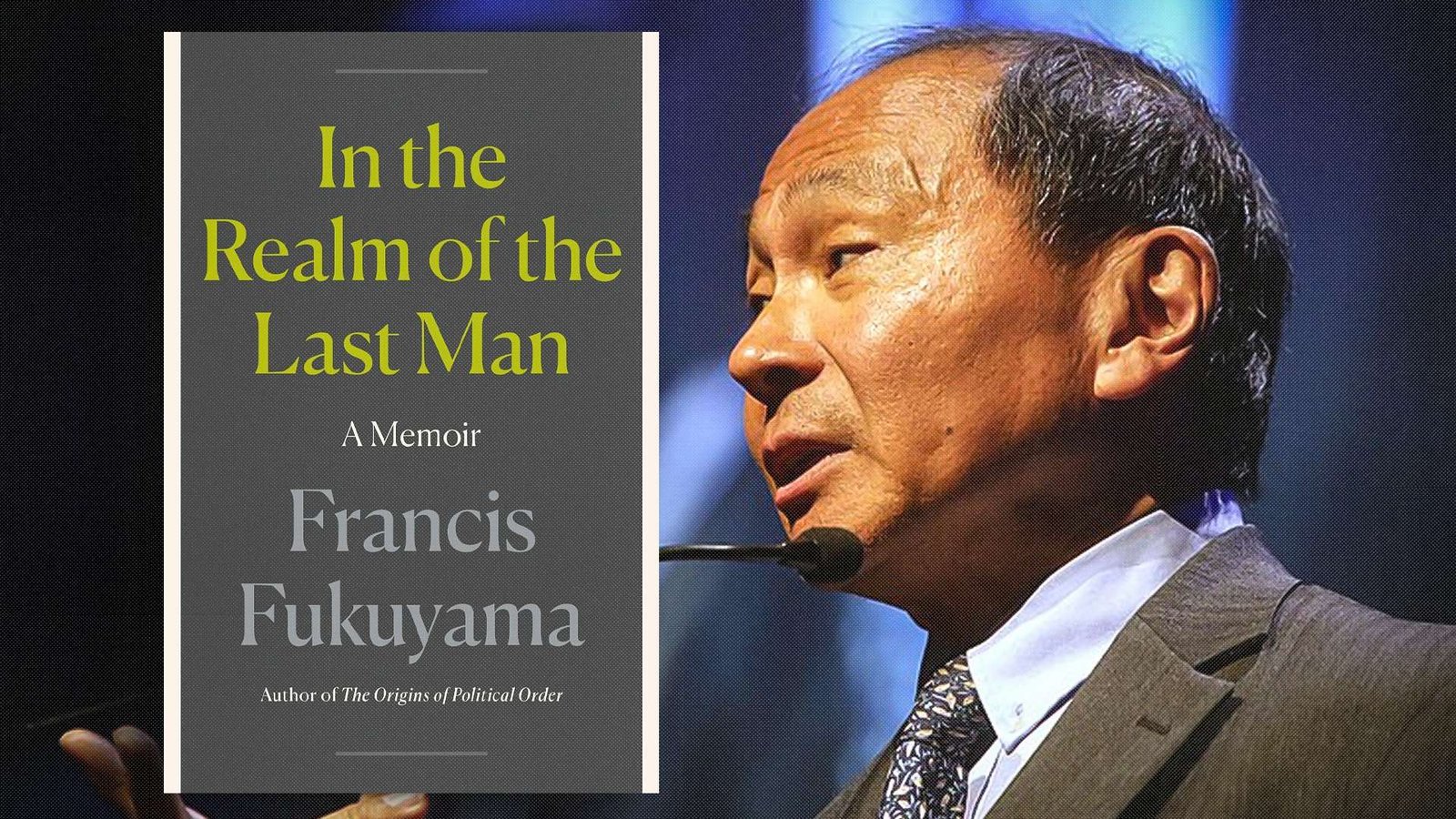
In the Realm of the Last Man: A Memoir, by Francis Fukuyama, Farrar, Straus and Giroux, 304 pages, $29
In his thirties, Francis Fukuyama was pursuing a respectable but low-key career as a RAND Corporation analyst and State Department bureaucrat focused on the Soviet Union. His breakthrough into the public sphere came in the summer of 1989, when his essay “The End of History?” appeared in The National Interest.
At the time, I was a producer at the PBS foreign affairs show American Interests. As a child of the Cold War, I was thrilled by his claim that we may be witnessing “the end point of mankind’s ideological evolution and the universalization of Western liberal democracy as the final form of human government.” This bold statement seemed confirmed by the fall of the Berlin Wall later that year and the collapse of the Soviet Union two years later.
Since then, Fukuyama has been one of America’s leading public intellectuals. Now he has written a charming and stimulating memoir, In the Realm of the Last Man. The book covers everything from his grandparents’ time in a World War II internment camp to his break with prominent neoconservatives over the misbegotten invasion of Iraq; the career it reveals is an inspiring example of how a rigorous liberal education sharpens a relentlessly questing mind. He credits his encounter with classicist Allan Bloom for instilling in him the passion to pursue the big questions: “What is the best way to live, what makes for the highest form of human happiness, what is the nature of justice, what is natural and what is conventional in human affairs.” Fukuyama is entirely correct when he observes, “An appreciation for truly philosophical thought is a gift of inestimable value that remains with you for a lifetime.”
But even as the book covers all these topics, it keeps coming back to ideas that Fukuyama started sketching in that 1989 essay and has expanded upon in countless works since then.
Fukuyama’s argument that humanity had reached the end of history rested on his reading of the French philosopher Alexandre Kojève, who argued that the mainspring of history is humanity’s drive for recognition, dignity, and respect. In his interpretation of Kojève, Fukuyama adapted Plato’s tripartite division of the human soul into logos (reason), eros (desire) and thymos (spiritedness). Fukuyama contends that thymos is the true psychological driver of history, distinct from basic physical survival or economic calculation. Human beings, he noted, are the only creatures that willingly risk death in the service of abstract ideals.
The “end of history,” for Fukuyama, is achieved with the universal recognition of the equal dignity of all human beings as the foundational ideal of liberal democracies. Liberal societies, he explains in Realm, provide “universal recognition by granting citizens equal rights; the rights to speak, to associate, to believe, and to have a share of political power through the vote.”
Not ready to buy into dialectical metaphysics? In their brilliant 2009 book Violence and Social Orders, the Nobel-winning economist Douglass North and two colleagues approached humanity’s political evolution from a less abstract but parallel track. The main problem that confronts societies encompassing more than a few hundred people, they argued, is how to control male violence. Humanity’s first solution to this problem was a “natural state” built around elite patron-client networks. Think of chiefs, kings, and oligarchs as gang leaders who maintain relative social peace by running protection rackets: In exchange for a portion of your earnings, the strongman and his minions will try to make sure that other guys don’t kill you or steal your stuff.
The dawn of the 19th century, North noted, saw the development of “open access orders” where the rule of law supplanted elite hierarchical rule. Subjects once under the authority of aristocrats become citizens bearing equal rights. These precursors to today’s liberal democracies were better at controlling social violence while simultaneously allowing more human flourishing through market-based economic growth. By the end of the 20th century, the number of people living in such societies had expanded greatly.
Back in 1989, Fukuyama observed that some societies remain mired in history. In other words, some people are still stuck in backward natural-state tyrannies. (Russia is a contemporary example.) But he predicted such societies would eventually join the post-historical world through the “unabashed victory of economic and political liberalism.”
North and his colleagues do not seem to have considered the prospect that bored citizens would rebel against open access orders and revert to autocratic natural states. But Fukuyama did.
In the concluding paragraph of his 1989 essay, Fukuyama declared: “The end of history will be a very sad time.” Sad? Because “daring, courage, imagination, and idealism will be replaced by economic calculation, the endless solving of technical problems, environmental concerns, and the satisfaction of sophisticated consumer demands.” The peace and prosperity that liberal societies make possible is not enough to satisfy some people’s thymotic impulses. “Perhaps this very prospect of centuries of boredom at the end of history will serve to get history started again,” he concluded.
Fukuyama expanded on that idea in his 1992 book, The End of History and the Last Man. Fukuyama took the term “the Last Man” from Friedrich Nietzsche’s epithet for the contented beneficiaries of bourgeois peace and prosperity. “We have been living in the realm of the Last Man for some time now,” Fukuyama writes in his memoir. “The problem, though, is that the peace and prosperity brought about by the liberal order based on equal recognition is not enough for many people.”
In Realm, Fukuyama reminds readers that the last chapters of The End of History and the Last Man “contain a clear premonition of the rise of the kind of demagogic populism that we have experienced from the mid-2010s to the present.” To quote the older book directly: “if men cannot struggle on behalf of a just cause because that just cause was victorious in an earlier generation, then they will struggle against the just cause. They will struggle for the sake of struggle. They will struggle, in other words, out of a certain boredom: for they cannot imagine living in a world without struggle. And if the greater part of the world in which they live is characterized by peaceful and prosperous liberal democracy, then they will struggle against that peace and prosperity, and against democracy.”
Thirty-four years later, Fukuyama writes, “We see this today on both the extreme right and left.” Furthermore, would-be strongmen have been rising to power by harnessing populist resentment, creating “a constant pressure” to revert to “clientelism and patronage, often revolving around friends and family of the ruler.”
Indeed, the V-Dem Institute’s latest annual assessment reports that more and more countries are succumbing to that pressure, with the result that autocracy is expanding around the globe. Worrisomely, the study also states that “the United States has lost its long-standing status as a liberal democracy for the first time in more than 50 years, falling into the lower category of electoral democracy.”
Fukuyama concludes Realm by considering three challenges he sees confronting liberal democracy today.
The first is a “fetishism of proceduralism.” When regulations proliferate, social trust erodes, until society becomes a “vetocracy” that stymies new infrastructure, blocks attempts to address new social needs, and drowns wealth-creating entrepreneurs in paperwork. He correctly warns that such minutely detailed rules leave some beleaguered citizens tempted to follow authoritarian figures promising to hack through the strangling red tape.
His second challenge is transhumanism, which he once called “the world’s most dangerous idea.” This is a longstanding concern of his. In Realm, Fukuyama mentions a debate he had on the subject back in 2003—one that pit him against “the science editor of a libertarian magazine,” who “gushed about the possibilities for life extension.”
That I did: I argued then and argue now that “the defining conflict of the 21st century will be the battle over life and death. On the one side stand the partisans of mortality, who counsel humanity to quietly accept our morbid fate and go gentle into that good night. On the other is the party of life, who yearn to extend the enjoyment of healthy life to as many as possible for as long as possible.” Fukuyama remains a partisan of death. Asked in 2004 if the government has a right to tell its citizens that they have to die, he answered, “Yes, absolutely.”
In Fukuyama’s account of our debate, he recalls telling me that “I was not looking forward to a world where he would be able to spout the same dumb libertarian views a hundred years from now.” I don’t remember that riposte, and I suspect that “esprit de l’escalier” may be affecting his recollections. In any event, biomedical progress has been much slower than Fukuyama feared and I hoped, so he probably won’t have to endure the sound of me spouting libertarian ideals into the next century.
Given Fukuyama’s ambivalent sadness about the end of history, it may seem somewhat perplexing that he so strenuously objects to the transhumanist project. Transhumanists are motivated by the same thymotic impulse he regrets being tamed by bourgeois complacency. As the tech investor Marc Andreessen directly stated in his “Tech Optimist Manifesto,” after identifying himself as one who believes “in deliberately and systematically transforming ourselves into the kind of people who can advance technology,” his “enemy is Friedrich Nietzsche’s Last Man.”
Fukuyama’s chief concern about transhumanism is that biotechnological progress could “take away the limitations of human nature.” He fears that using biotechnology to enhance human capacities will have fatal consequences for the idea of equal rights, and thus would restart history. I think he is underestimating liberal democracy’s ability to maintain social and political peace. As I have written before, “Political and moral equality have never rested on the facts of human biology….In liberal societies the law is meant to apply equally to all, no matter how rich or poor, powerful or powerless, brilliant or stupid, enhanced or unenhanced.”
Fukuyama’s third enduring challenge to liberal democracy is humanity’s thymotic drive to struggle, to seek recognition through sacrifice for ostensibly just causes. This impulse today fuels Islamism, Russian revanchism, and the various left- and right-wing authoritarianisms that afflict many developed countries. And, honestly, also transhumanism.
At the conclusion of The End of History and the Last Man, Fukuyama likened historical progress to a long wagon train heading to the same town. Some wagons arrive earlier at liberal democracy, but eventually the majority will get there. But in his last sentence, he wonders whether the wagoneers, having safely arrived, might find their new surroundings “inadequate and set their eyes on a new and more distant journey.”
Thirty-four years later, Fukuyama concludes, “No one to date has come up with a novel architecture to house the Last Man at the end of history, but the aspiration remains.”
Read the full article here
Fact Checker
Verify the accuracy of this article using AI-powered analysis and real-time sources.