

 Freedom Index
Listen to the article
When state lawmakers attempt to rewrite how the internet works, users rely on courts to recognize that laws can’t make technical impossibilities a reality. That’s why we were happy to see that a court has blocked Utah’s attempt to outlaw the privacy protections of Virtual Private Networks (VPNs).
In a win for digital rights, a federal judge has issued a preliminary injunction blocking Utah’s SB 73, the state’s draconian anti-VPN age verification law. The decision comes as EFF submitted our comments to the Utah Department of Commerce, detailing how forcing platforms to detect and block privacy-preserving tools undermines user privacy and security worldwide while demanding the impossible.
What SB 73 Does
Signed into law earlier this year, SB 73 attempted to regulate adult websites by requiring them to block VPN users or to identify the physical location of visitors using them or similar tools that mask their network traffic. It even went so far as to prohibit websites from offering instructions on how to use a VPN to bypass these checks. This made Utah, to EFF’s knowledge, the first state in the nation to target the use of VPNs to avoid legally mandated age-verification gates.
The Utah federal court halted enforcement of the law’s VPN provisions last week, ruling that the law likely violates the U.S. Constitution’s prohibition on passing laws that significantly burden businesses and people outside Utah’s borders.
SB 73 burdens the rights of all internet users outside of Utah because it requires adult websites to either know every visiting user’s physical location, and then block those in Utah, or to verify every visitor’s age just in case they might be in Utah. The law’s “actual-location provision in practice requires an entity to perform age verification services for every user visiting its site from any location because the entity would violate the law if even one of those users happened to be obfuscating,” the court wrote. The court essentially ruled that Utah has less-burdensome ways to prevent Utah minors from accessing adult websites than requiring all users in the world to comply with SB 73.
Aylo’s lawsuit does not challenge SB 73’s provision prohibiting the websites covered by the law from sharing information about VPNs.
The Legal Challenge
This court order follows months of legal maneuvering.
Initially set to go into effect in May 2026, SB 73 sparked an immediate constitutional challenge from Aylo, the parent company of major online adult platforms like Pornhub. In response to the lawsuit, Utah and Aylo initially agreed that the state would pause enforcement while the court considered the preliminary injunction request or until administrative rules setting specific compliance terms were finalized. Those proposed compliance rules (R152-78B, see Utah State Bulletin, page 6) were published by the Utah Department of Commerce’s Division of Consumer Protection on September 1st, and EFF submitted formal comments to the Department in opposition. According to the notice, the proposed rules could be effective as soon as October 8, 2026. However, Judge Barlow’s decision means that it cannot be enforced pending further action by the court.
The Ruling
EFF welcomes Judge Barlow’s ruling, which recognizes the fundamental disconnect between state legislation of the internet and how technology works. In his ruling, Judge Barlow noted that the statute requires a technical impossibility on pain of legal liability. “Aylo is correct that the statute, as amended, now essentially imposes strict liability for entities like it when it comes to determining the location of its websites’ users.”
The court recognized that the problem is that SB 73 “requires entities like Aylo to geolocate its website users with perfection to avoid liability.” But, at the same time, the court acknowledged “that geolocation perfection is not presently possible.”
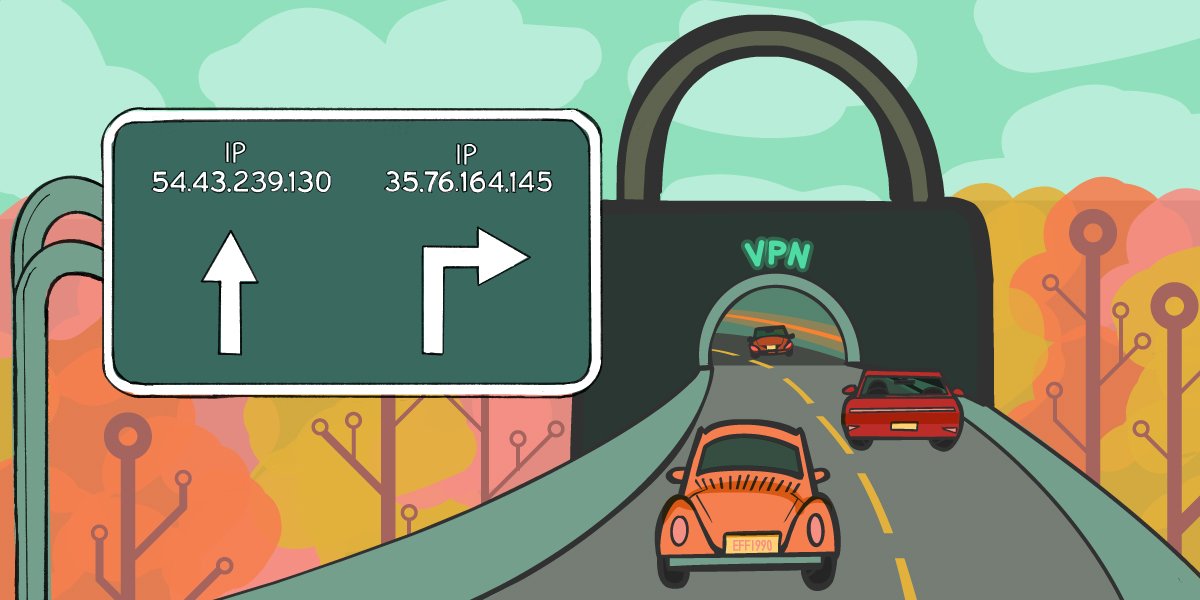
EFF explained this technical impossibility in our comment to the Department of Commerce. VPNs protect user privacy by routing web traffic through intermediary servers. Because destination websites only see the IP address of the VPN server, they have no reliable mechanism to tell whether a connection originates from Salt Lake City, Seattle, or Shanghai. So, under Utah’s current statutory framework, platforms are left with an impossible choice: completely block all VPN traffic nationwide or withdraw access from Utah entirely. Judge Barlow agreed, asserting:
Because the law requires perfection in the absence of perfect geolocation tools, Aylo would need to verify those 28 million users—whether located in Salt Lake City, Boston, New Orleans, Anchorage, or Honolulu—to ensure compliance and avoid liability.
The Rulemaking
The administrative rules drafted by the state compelled commercial entities to implement “commercially reasonable geolocation obfuscation detection systems”, which is a directive, we argue, that demands a technical impossibility.
In our submission to the Utah Department of Commerce, EFF also detailed how these rules force an invasive data collection regime onto internet users everywhere. So, in response to internet users trying to avoid invasive data collection required by age-verification requirements, SB 73 requires even greater surveillance of internet users’ online activities. The Department’s suggested detection heuristics (like monitoring connection latency or device time zones) are notoriously unreliable and easily skewed by normal network conditions. This active surveillance inevitably leads to widespread misclassification, unwarranted access blocks, and severe impacts on users’ privacy far beyond Utah’s borders.
You can read EFF’s full comments to the Department of Commerce here.
What Now?
As we’ve said time and time again: the internet will always route around censorship.
Mandating invasive tracking and punishing the use of essential security tools turns genuine privacy concerns into mere compliance theater and requires more state-mandated surveillance of internet users who rely on VPNs. As is the case in heavily censored regions, VPN services and obfuscation tools will simply adapt, making this framework fundamentally unsustainable.
As we’ve said time and time again: the internet will always route around censorship.
While Utah legislators have indicated they may attempt to revise the law during the next legislative session, the court’s preliminary injunction sets an important precedent: state lawmakers should not weaponize age verification to force dragnet tracking or undermine essential security tools.
As other states consider similar anti-VPN proposals, EFF will continue pushing back against these technically impossible mandates and defending users’ privacy and anonymity. Thus, we urge legislators and regulators to reject anti-privacy rules, prioritize real user security, and safeguard constitutional protections for all users.
Read the full article here
Fact Checker
Verify the accuracy of this article using AI-powered analysis and real-time sources.