

 Freedom Index
Listen to the article
The Trump administration has repeatedly challenged “assault weapon” bans, arguing that they violate the Second Amendment because they prohibit arms in common use for lawful purposes. In a Supreme Court brief filed last Friday, Solicitor General D. John Sauer fleshes out that argument, explaining the rationale for distinguishing between commonly used arms and “dangerous and unusual” weapons.
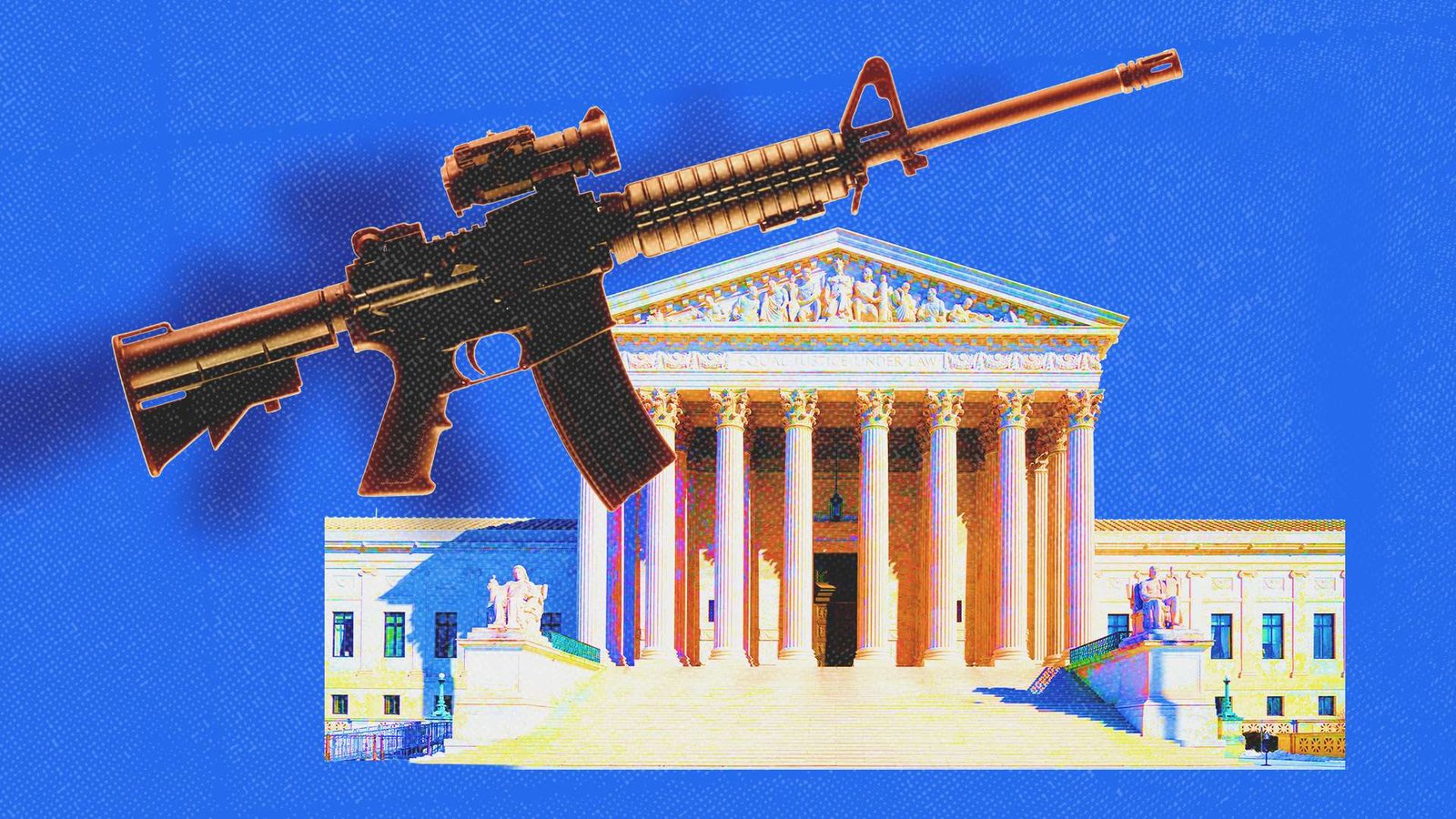
That distinction is at the heart of two consolidated cases that the Supreme Court will hear on December 2: Viramontes v. Cook County, which involves that Illinois jurisdiction’s “assault weapon” ban, and Grant v. Higgins, which involves a similar Connecticut law. The question presented is whether the Second Amendment protects “the right to possess AR-15 platform and similar semiautomatic rifles,” which are covered by both laws. The answer is clearly yes, Sauer says, reiterating the position that the Justice Department’s Civil Rights Division has taken in several lawsuits.
“A firearms restriction comports with the Second Amendment only if it is ‘consistent with the Nation’s historical tradition of firearm regulation,'” Sauer writes, citing the test established by the Supreme Court’s 2022 ruling in New York State Rifle & Pistol Association v. Bruen. “And this country’s regulatory tradition precludes banning arms that are ‘in common use’ among law-abiding citizens for lawful purposes. That common-use test has deep historical roots in English and American law. This Court has already adopted that test and has repeatedly applied it to evaluate the validity of arms bans.”
As Sauer sees it, that is enough to settle the question raised by these cases, since “the AR-15 rifle is unquestionably in common use among law-abiding citizens for lawful purposes.” Such rifles “are lawful at the federal level and in 40 States,” he notes. “The overwhelming majority of AR-15 owners possess those rifles for the lawful purposes to which they are adapted, such as self-defense in the home, hunting, and target shooting. A ban on possessing such rifles thus violates the Second Amendment.”
The U.S. Court of Appeals for the 7th Circuit, which upheld Cook County’s AR-15 ban in June 2025, disagreed, hewing to the logic of its 2023 decision in Bevis v. City of Naperville, which said such rifles can be banned because they resemble “military-grade weapons.” Two months later, the U.S. Court of Appeals for the 2nd Circuit likewise ruled that Connecticut’s rifle restrictions were consistent with the Second Amendment, saying they targeted “unusually dangerous weapons while preserving numerous legal alternatives for self-defense and other lawful purposes.”
Both appeals courts rejected the idea that widespread ownership of AR-15s was constitutionally dispositive. But as Sauer explains, that premise has a strong historical basis: “Three bodies of historical evidence—militia laws, going-armed laws, and state-court decisions—show that the common-use test has deep roots in English law, was settled in the United States by the founding, and was widely applied in the 19th century.”
Under “militia laws stretching back nearly a millennium,” the brief notes, “individuals had not just the right, but the duty, to keep arms in common use.” That tradition carried over from England to America. At the Founding, the Supreme Court noted in the landmark 2008 case District of Columbia v. Heller, the “well regulated militia” to which the Second Amendment refers “was formed from a pool of men bringing arms
‘in common use at the time’ for lawful purposes like self-defense.” State and federal militia laws therefore required those men to “supply themselves with arms ‘of the kind in common use.'”
That background “explains the link between the Second Amendment’s prefatory clause (‘A well regulated Militia, being necessary to the security of a free State’) and its operative clause (‘the right of the people to keep and bear Arms, shall not be infringed’),” Sauer says. “The founding generation feared that the new federal government would ‘destroy the citizens’ militia by taking away their arms.’ So the founders codified an individual right to keep and bear the type of arms used by the militia—arms ‘typically possessed by law-abiding citizens for lawful purposes.'”
That point underlines the illogic of the 7th Circuit’s reasoning, which posits that arms especially useful in a military context are not covered by the Second Amendment. “The founders would have been astonished at the claim that legislatures may ban arms in common use if those arms can also be used for military purposes,” Sauer writes.
Laws against “going armed,” which date back to the 1328 Statute of Northampton, reinforce the distinction between “arms in common use” and other weapons. “A person could violate the statute by publicly carrying ‘dangerous and unusual weapons’ in a manner that terrified the community,” Sauer notes. That category included “throwing lances that were typically carried only by those seeking to engage in combat or breaches of the peace” but “not daggers,” which “were often carried by law-abiding subjects for self-defense.” According to an 18th-century treatise, “a person was ‘in no Danger of Offending against this Statute by wearing common Weapons.'”
Across the Atlantic, state laws enacted in the 19th century drew a similar distinction, targeting “dangerous and unusual weapons” associated with “duels, brawls, and other criminal activities,” such as Bowie knives, spears, sword canes, slungshots, and brass knuckles. And in reviewing those laws, state courts applied the common-use test.
In 1871, for example, the Tennessee Supreme Court held that legislators could ban weapons that were “not usual” but could not ban “the usual arms of the citizen.” The top courts of Texas, Arkansas, West Virginia, North Carolina, and Michigan concurred that the right to arms encompassed weapons commonly owned by law-abiding people, including rifles.
In the 1939 case United States v. Miller, the U.S. Supreme Court upheld the federal ban on short-barreled shotguns, saying the petitioner, an armed bootlegger, had failed to show that “possession or use of a ‘shotgun having a barrel of less than eighteen inches in length’ at this time has some reasonable relationship to the preservation or efficiency of a well regulated militia.” The Court doubted that “this weapon is any part of the ordinary military equipment or that its use could contribute to the common defense.”
When the Second Amendment was adopted, the militia “comprised all males physically capable of acting in concert for the common defense,” the justices noted. “Ordinarily when called for service these men were expected to appear bearing arms supplied by themselves and of the kind in common use at the time.”
Like the state court decisions that Sauer cites, Miller addressed a weapon that had been prohibited because of its perceived association with criminals. But contrary to the 7th Circuit’s take on the scope of the Second Amendment, the decision implied that the right to possess a short-barreled shotgun would be constitutionally protected if it could be shown that such firearms were “in common use” and militarily appropriate.
The Supreme Court explicitly reaffirmed the common-use test in Heller, rejecting the District of Columbia’s ban on handguns, which the majority described as “the quintessential self-defense weapon” and “the most popular weapon chosen by Americans for self-defense in the home.” The Court was unfazed by the fact that criminals also favored handguns, saying a categorical ban on arms in common use for lawful purposes was plainly inconsistent with the Second Amendment.
In Bruen, the Court reiterated that “the Second Amendment protects the possession and use of weapons that are ‘in common use at the time,'” including handguns, which are “indisputably in ‘common use’ for self-defense today.” It contrasted that category with arms that are “highly unusual in society at large.”
Sauer suggests that “traditional legislative practice provides a useful guide to applying the common-use test.” Although semi-automatic rifles have been commercially available in the United States for about 120 years, he notes, they “have not traditionally been banned” or “even subjected to heavy regulation.” And the fact that four-fifths of the states see AR-15s as legitimate arms, he says, “suggests that they are in common use.”
So do sales and survey data. According to the most recent figures from the National Shooting Sports Foundation, the gun industry’s trade group, Americans own more than 32 million “modern sporting rifles,” its preferred term for the models covered by “assault weapon” bans. Surveys indicate that somewhere between 16 million and 25 million Americans have owned AR-15-style rifles, which they commonly report using for lawful purposes such as self-defense, hunting, and target shooting. Last year, a unanimous Supreme Court described the AR-15 as “the most popular rifle in the country.”
Appeals courts nevertheless have questioned the utility of AR-15s for self-defense, asserted that they are better suited to the battlefield, and averred that they are especially deadly when used in mass shootings. Although Sauer rebuts each of those claims, his bottom line is that they are irrelevant under the Second Amendment, which bars legislators from overriding the judgments made by millions of law-abiding gun owners. It makes no exception for weapons with a military lineage (which, Sauer notes, include popular handguns such as the Glock 17), firearms that can be used to commit mass murder (most of which involve handguns), or firearms favored by ordinary criminals (also overwhelmingly handguns).
Heller decisively rejected the proposition that a weapon’s prominence in homicide statistics justifies prohibiting law-abiding people from possessing it. “Rifles are in many ways less dangerous than handguns, which Heller establishes cannot be banned,” Sauer notes. “Handguns, which are easier to carry and conceal than rifles, ‘are the overwhelmingly favorite weapon of armed criminals.’ The Federal Bureau of Investigation estimates that, of the 13,674 homicides committed in 2025, 5,179 (about 38%) were committed with handguns, while 363 (about 3%) were committed with rifles of any kind—even though millions of Americans own rifles. Handguns also have been used in mass shootings, and some studies have found that ‘a victim’s probability of death is higher in shootings involving a handgun than in shootings involving a rifle.'”
Given all that, “holding that the Second Amendment protects handguns but not rifles would be ‘backwards,'” Sauer says, quoting Justice Brett Kavanaugh’s 2011 dissent from a D.C. Circuit decision upholding the District of Columbia’s “assault weapon” ban. In addition to Kavanaugh, Justices Clarence Thomas, Samuel Alito, and Neil Gorsuch have indicated that they are inclined to think such laws fail the Bruen test. And Bruen itself, which Chief Justice John Roberts and Justice Amy Coney Barrett also joined, reaffirmed the common-use test, which does not bode well for Cook County or Connecticut.
Read the full article here
Fact Checker
Verify the accuracy of this article using AI-powered analysis and real-time sources.