

 Freedom Index
Listen to the article
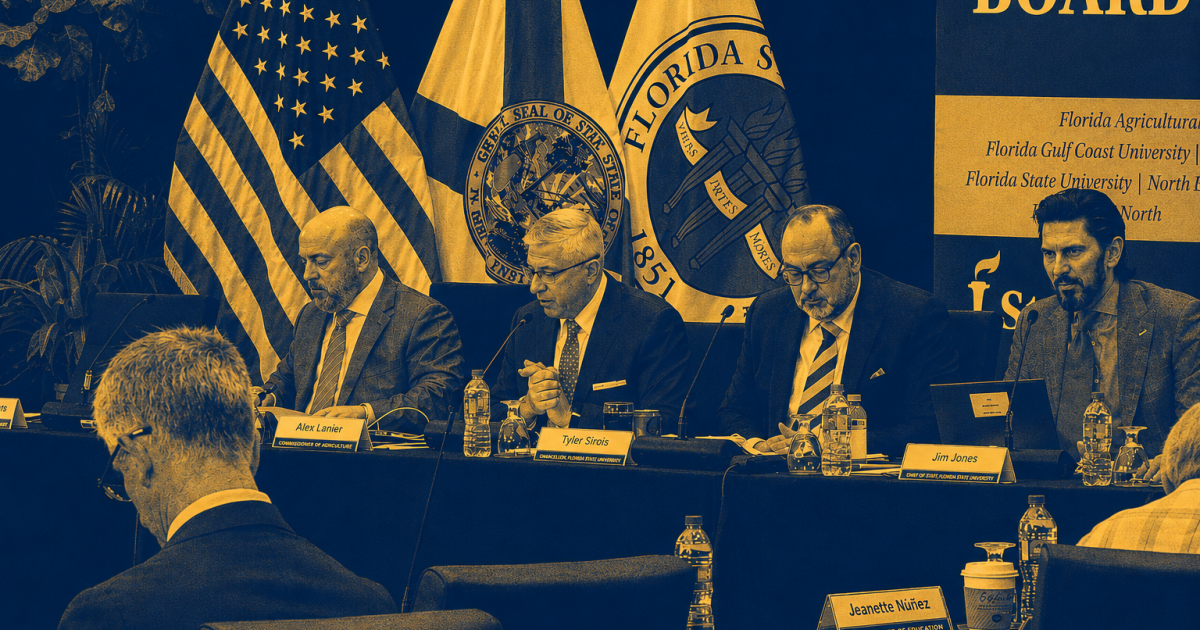
Last week, Polk State College proudly announced that its Board of Trustees had adopted a statement committing the school to institutional neutrality. On Sept. 3, the State University System of Florida’s Board of Governors will consider taking the first formal step toward requiring all 12 universities in the system to adopt institutional-neutrality policies of their own.
On the whole, that’s good news. Institutional neutrality can help colleges remain focused on their educational mission while leaving political and social debates to students and faculty.
But both the Polk State policy and the proposal before the Board of Governors contain a significant loophole. Rather than hew to the clear and rare exceptions used by many schools that have adopted institutional neutrality, these policies provide a new exception that threatens to render the neutrality commitment meaningless. Unless Florida fixes this defect, FIRE cannot treat these policies as the kind of institutional neutrality commitments we recommend to colleges and universities.
Enforcing the law is different from institutionally condemning conduct.
Polk State framed the move as part of new President Anastasios Kamoutsas’s “vision for his first 90 days as president” and as part of a broader tapestry of Florida Governor Ron DeSantis’s statewide education initiatives. The college even included a quote from Governor DeSantis, celebrating the adoption and touting Florida’s commitment to “free speech and open inquiry” in higher education and framing this as a strike against “echo chambers.”
That instinct is sound.
Institutional neutrality is the idea that universities should not, as institutions, take formal positions on social and political issues, instead leaving those discussions to members of the campus community. The concept was formalized at the University of Chicago in 1967 when a committee chaired by legal scholar Harry Kalven Jr. released its “Report on the University’s Role in Political and Social Action,” now known simply as the “Kalven Report.”
The Kalven Report has become an important template for schools seeking to make their own commitment to institutional neutrality. FIRE urges colleges and universities to adopt institutional neutrality, and 50 of them have formally done just that.
When FIRE analyzes universities’ approaches to institutional neutrality, to decide whether to include them on our list of formal adoptions, we are determining if the school has formally adopted an “official position of institutional neutrality substantially similar to the principles set forth in the University of Chicago’s Kalven Report.”
In China and Hong Kong, remembrance is a crime
Hong Kong jails Tiananmen memorial organizers, China imprisons an artist for mocking Mao, and Beijing’s censorship reaches London and Texas.
Read More
Not every policy carrying the label passes the test. Some lack an important component of Kalven. Others add language that risks swallowing the principles. Polk State’s policy and the similar approach being considered by the State University System of Florida’s Board of Governors fall into the latter category.
Polk State and the Board’s proposal get much of this right. The new policy says the college and its operating units generally will not take official positions on matters unrelated to the institution’s mission and operations.
Then comes the problem.
The Kalven Report is clear that only in rare circumstances is it acceptable for the university to overcome “a heavy presumption against the university taking collective action or expressing opinions on the political and social issues of the day.” According to Kalven, that exception comes into play for threats to the “very mission of the university and its values of free inquiry. In such a crisis, it becomes the obligation of the university as an institution to oppose such measures and actively to defend its interests and its values.”
Polk State says the college may nevertheless “speak out when an issue is in violation of the law, affects its educational purpose, how it operates, or the safety of students, faculty, and staff.”
The Board of Governors’ proposal contains a similar exception. It would require each university’s policy to provide that institutional neutrality does not prevent university representatives from “publicly addressing, condemning, or prohibiting expressions or actions that violate the law.” The same proposal separately allows institutional statements when an issue bears materially and directly on the university’s core mission.
That second exception is enough. The first is a fatal defect.
Of course a university may enforce the law. Institutional neutrality does not require administrators to ignore vandalism, violence, unlawful harassment, true threats, or other illegal conduct. Nor does neutrality prevent a university from telling its community what rules apply, explaining an arrest on campus, closing a building for safety reasons, or otherwise carrying out its ordinary responsibilities.
But enforcing the law is different from institutionally condemning conduct. The former is an operational responsibility. The latter is an institutional judgment. And once “this violates the law” becomes an independent justification for institutional speech, the boundaries of neutrality become remarkably unclear.
Universities exist to foster disagreement, not resolve political disputes in the institution’s name.
We can only speculate how administrators at Polk State, as well as schools across the Florida State System, will determine “when an issue is in violation of the law.” Is it enough that a state legislature is considering adopting a law? Or that someone is accused of violating a law? Or that the Supreme Court is considering a matter? Or that a country is accused by some of violating international law?
If the answer to any of those questions is yes, this carve-out could allow Polk State — a small public college in Winter Haven, Florida — to offer comments on everything from trans high school athletes in Idaho and the ongoing Lindsay Clancy trial in Massachusetts to President Trump’s White House ballroom and, of course, where the college stands on the Israeli-Palestinian conflict.
For the sake of Polk State’s reputation — and the sanity of its communications department — hopefully the college has no intention of offering comments on any of the above matters and will instead follow the Kalven Report’s vision of institutional neutrality. But policies should be written to constrain the next administration too, including one far more eager to speak.
The Kalven Report got the basic principle right nearly 60 years ago. Universities exist to foster disagreement, not resolve political disputes in the institution’s name. They must sometimes speak to protect their ability to perform that mission. But they do not need a free-floating power to condemn whatever administrators have determined to be illegal.
Florida has the right destination in mind. But before it can actually call this policy neutral, it needs to close the loophole.
Read the full article here
Fact Checker
Verify the accuracy of this article using AI-powered analysis and real-time sources.