

 Freedom Index
Listen to the article
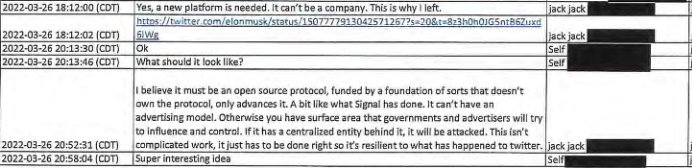
When Twitter launched, it was originally designed to be just like an open protocol. In the early days, the company eagerly supported third party development, building on that protocol. But, because it was a new communications protocol totally controlled by a single company, eventually commercial pressure led the company to close off the openness. Jack Dorsey later admitted that this was a mistake, and he hoped that Twitter would go back to being an open protocol. That eventually led to the rise of Bluesky (where I am now on the board, having taken Dorsey’s old board seat) and the ATprotocol (along with some other competing protocols, each with a different implementation, but all believing in the value of open social systems).
And, of course, in the middle of all this, Elon Musk took over Twitter. You may remember that. Even though Jack Dorsey supported Elon’s bid, and suggested he embrace the open protocol aspect of where Twitter was heading, Elon went in a very different direction.
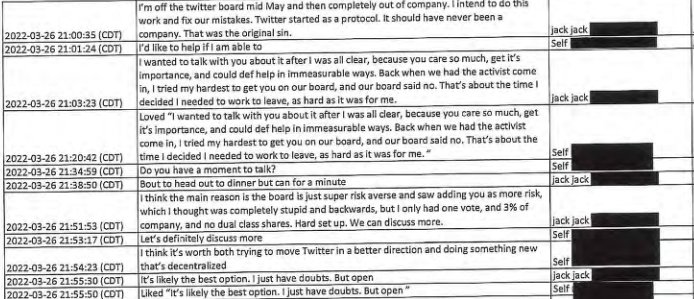
It’s funny now, four years on, to read those text messages between Jack and Elon, with Jack pushing for Elon to embrace reinventing Twitter as a decentralized open protocol, and Elon nodding along.
But, of course, that’s not what happened. Instead, what happened was Twitter became X, the personal, centralized, deliberately political project of Elon that no longer had any real resemblance to an open communications protocol. Almost immediately upon taking control, Elon began locking things down, and putting very high prices on access. There have been many changes to the API (and its pricing) since Elon took over the company (which eventually merged into xAI and then into SpaceX), but the one constant is that it’s a walled garden, focused almost exclusively on promoting the things Elon wants promoted, while demoting the things he’s scared of.
This has been known and somewhat obvious for years. But last week, it appears Elon put the final nail in the coffin for the belief that X might one day be an open protocol ever again. There were two widely known and widely used services for sharing posts on X without having to point people to X itself: Nitter and Xcancel. With both of them, if you wanted to share any particular tweet, you could just replace the “X.com” part of the URL (or the “twitter.com” part before that got rerouted) to either “nitter.net” or “xcancel.com” and you could see the same tweet (and the same thread above and below it) without giving Elon any of the traffic.
If you are an open protocol, that’s how it should work. Indeed, if you want to read Bluesky posts without ever touching Bluesky itself, there are already a bunch of independent ways to do it — different clients, different frontends, different views on the same underlying data — with more coming online all the time.
But, just to make it clear that X is a walled garden completely controlled by Elon and no one else, last week, X sent cease & desist notices to both Nitter and Xcancel, causing them to shut down.
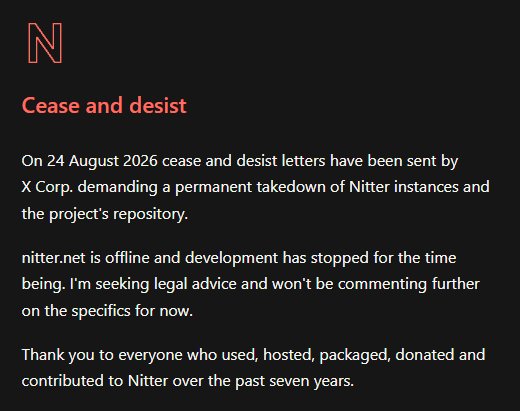
That’s Nitter saying:
Cease and desist
On 24 August 2026 cease and desist letters have been sent by X Corp. demanding a permanent takedown of Nitter instances and the project’s repository.
nitter.net is offline and development has stopped for the time being. I’m seeking legal advice and won’t be commenting further on the specifics for now.
Thank you to everyone who used, hosted, packaged, donated and contributed to Nitter over the past seven years.
Xcancel just put up some text saying something very similar:
On Monday 24th August at 8PM EST, we received at letter from X Corp. asking to cease and desist the service XCancel.
The service XCancel is stopped until further notice.
We are seeking legal advice and won’t share more details for now.
Thank you for the trust you have put in these two years of XCancel.
This does real harm to many people, not just those who didn’t want to support Elon Musk. Many journalists and researchers would use these tools to track things in ways that Elon’s platform might not allow (or for which he might ban users). And, as Elon has continually locked down X, many things now require a login to view. It also makes a mess of many archives, including Wikipedia citations, that frequently relied on Nitter links.
While the cease and desist letters have not been publicly revealed, TechCrunch claims they were able to see them, and they accused the platforms of circumventing X’s API restrictions.
The letter from X, which TechCrunch has viewed, accuses Nitter of an “unlawful use and circumvention of X’s Application Programming Interface (API) and associated data,” through its service, saying that X has evidence that Nitter scraped X data and accessed X accounts and session tokens in violation of X’s rules.
Lawyers for X said the actions are in violation of “various state and federal laws, including, but not limited to, the Texas Harmful Access by Computer Act (§ 143.001 and § 33.02) and the Lanham Act (15 U.S.C. §§ 1114, 1125).” The letter gave Nitter until 5 p.m. EST on August 25 to shut down.
The legal theories here are basically bullshit. The “Harmful Access by Computer Act” is basically a Texas state version of the CFAA, the deeply problematic federal “anti-hacking” law that is regularly abused to stop people from doing things that should be perfectly legal. And while there have been some cases, like the Power Ventures case, that blessed the idea that such laws can block scraping, courts have been much more open to saying that there’s no hacking in merely scraping openly available web pages, such as in HiQ v. LinkedIn.
In fact, Musk and his lawyers should know all this is bullshit, because he lost his earlier lawsuit against Bright Data over scraping X.
The Lanham Act (trademark) claims seem equally bullshit. There’s zero likelihood of confusion here. The reason people use these sites is not because they confuse them with X, but deliberately because they are not X. And, to whatever extent either site referred back to X (or Twitter), that would be nominative fair use as accurately describing the source of the content.
Still, most of that is besides the point. X doesn’t need to actually win in court. Elon just needs it to be more expensive to fight him. And given that he literally has more money than anyone else in the world (and most companies to boot), there is no fair fight between a legal threat from him against a volunteer maintainer of an open source project.
But this is how walled gardens get built. X isn’t building a better product. It’s using Elon’s vast resources and ability to conjure up legal threats to shut down any system that enables openness.
To be clear, X is hardly alone in doing things like this. And some of it is absolutely due to the rise of AI scrapers and the desire of companies to sell access to their data. Reddit famously made a bunch of changes to its API a few years ago to limit access, and recently cut access even more. The widespread walling off of the open internet to fight AI scrapers is going to have some long-term negative consequences.
But rather than accept this, it should be even more incentive to embrace the tools that put us, not large companies, in control over our data.
Paul Frazee, Bluesky’s CTO, and an instrumental player in creating the ATprotocol that powers Bluesky and a bunch of other “locked open” apps recently wrote about this on Leaflet (a long-form blogging platform also powered by ATprotocol), in an article he called SELECT * FROM internet.blogposts. In that article, he highlights how the web has turned into a bunch of silos, and more and more of them keep locking the door:
The walled garden problem is downstream of a simple question: how do I
SELECT * FROM internet?
If you’ve never written database code,
SELECT * FROM usersis how you ask a database for everything it knows about its users. Once you have it you can filter it, sort it, and join it against anything else you’ve got.
The web doesn’t historically work that way. The web is a few dozen companies, each holding a filing cabinet, each with a receptionist posted out front. He’ll read you one file at a time, but only files you can name, as fast as he cares to read, and as long as his boss allows.
The fact that “the web doesn’t historically work that way” is a historical error. Indeed, for many years, most people did think it worked that way. Google’s existence is kind of premised on the fact that it absolutely could ‘SELECT * FROM internet’ to build its index. The entire premise of the open internet was that everything could be indexed and searched, even if the SQL query were hidden behind a nicer UI.
But now, various companies (including Google!) have used a variety of both technical and legal measures to wall things off again.
Open protocols do a lot of useful things, but the most important may be that they lock the openness in place, so that no single company can send a legal threat letter and revoke it. A system like ATprotocol doesn’t rely on APIs controlled by a single company that can change them or cut off a provider. Instead, it corrects one of the original sins of the web: rather than one company holding all the data for a particular service, anyone can hold it. You can hold your own data (many people do) or you can let someone else (such as Bluesky) hold onto it, though in a manner where you can always take it out of their control, and host it yourself or somewhere else.
This is one of the reasons why I find ATprotocol so exciting. People looking at it as just a new way to build a Twitter clone have always missed the point. It’s a way to rebuild the entire web, where the users have way more control. Rather than handing over control to a new or different company and hoping they don’t enshittify, the entire setup is enabling the end users to have full control over their own data.
Killing off Nitter and Xcancel is the last step in Elon’s transformation of Twitter from something that wanted to be a new, open communications protocol, to “X,” a locked up, private platform tuned to the whims of a wealthy propagandist.
Every few months or so, someone writes an article about why you should get off of X, because every bit of engagement there feeds money, data, and influence to the world’s richest man in service of his fascistic political project, or because its algorithm is directly programmed to make you angry about stupid shit.
But I think there’s a more important reason: X’s transformation from a kind of open decentralized communications protocol to a closed bullshit delivery mechanism is symptomatic of many of the things going wrong in the world today, from the enshittification of all sorts of products and services, to the rise of authoritarianism around the globe.
Getting power back in the hands of the public doesn’t happen by further empowering the controllers of today’s data silos. Elon’s not going to help give you more power if you ask him nicely. Getting the power back means building and using the tools that make permission irrelevant in the first place.
Read the full article here
Fact Checker
Verify the accuracy of this article using AI-powered analysis and real-time sources.