Fed Chair Kevin Warsh dedicated a full section of his Jackson Hole keynote to artificial intelligence, calling the current moment a “hinge point in history.”
Warsh said annualized sales at the two leading AI labs now top $100 billion, an increase of more than 500% from a year earlier, and confirmed the Fed now treats AI as “potentially a new factor of production.”
Warsh flagged that he’s watching AI’s “second derivative”—whether capital-spending growth is still accelerating.
Kevin Warsh’s first Jackson Hole keynote as Federal Reserve chair made headlines mostly for what he refused to say about interest rates. But in the middle of the speech, under the header “Preparing for Future Policy Conjunctures,” sits the section that matters most for anyone tracking where AI money is actually flowing.
Warsh opened it by describing the mood before AI took off: Economists spent the years after the 2008 crisis warning of “secular stagnation,” a world with too much capital chasing too few good investments because, as Warsh put it, “all the good stuff had been invented.” That thesis, he said, no longer holds.
Myriad: What will the Fed do in September? Click to make your prediction.
He backed it with numbers. Business capital expenditures—what he called “the seed corn of future economic growth”—are rising at their fastest pace since 2021, up roughly 9% over the past four quarters, with more than half of that growth tied to AI buildout. What he’ll be watching from here, he said, isn’t the level of that spending but “the second derivative”—whether the growth rate itself keeps accelerating or starts to fade.
Those figures may help understand some of the things Warsh said about AI specifically.
1. AI progress has outpaced even its biggest believers
“Progress in artificial intelligence—the 80-year-old name for the newest technology—has been faster even than its evangelists predicted a couple of years ago,” Warsh said. “The potential for substantially higher growth is on the rise.”
He went further: “Ever-expanding pools of capital are pouring into AI-related infrastructure of all sorts. A kind of hyper–Moore’s law seems to be playing out.”
Moore’s law is the decades-old observation that computing power roughly doubles every two years. Warsh’s “hyper” version claims AI capability is compounding even faster than that—a striking framing from a historically hawkish central banker, not a Silicon Valley pitch deck, and the closest he came to arguing AI alone justifies the market’s massive capital inflows.
2. The AI economy now runs on a $100 billion token market
“Capital and labor have combined to create the large language models at the heart of AI,” Warsh said. “Users buy tokens to gain access to the models.”
He then put a number on it: “Reports put annualized token sales for the two leading labs alone at more than $100 billion—an increase of 500-plus percent from a year ago.”
A token, in this context, is the basic unit AI companies sell access by—roughly a chunk of text a model reads or generates. Warsh citing a specific dollar figure, rather than speaking abstractly about “the AI boom,” signals the Fed now treats token revenue as a trackable line item in the economy, not a niche tech metric.
3. The Fed now treats AI as a factor of production
Warsh said the Fed is closely following the market dynamics of the AI ecosystem. “We recognize that AI is a new variable—potentially a new factor of production—that will have consequences for both the economy and the conduct of monetary policy.”
Factors of production are labor, capital, land. Putting AI in that category is not flattery. It means the Fed is treating token consumption as something that could change how much the economy can produce without overheating—the potential growth rate that sets where interest rates have to sit. Get that wrong and every rate decision inherits the error.
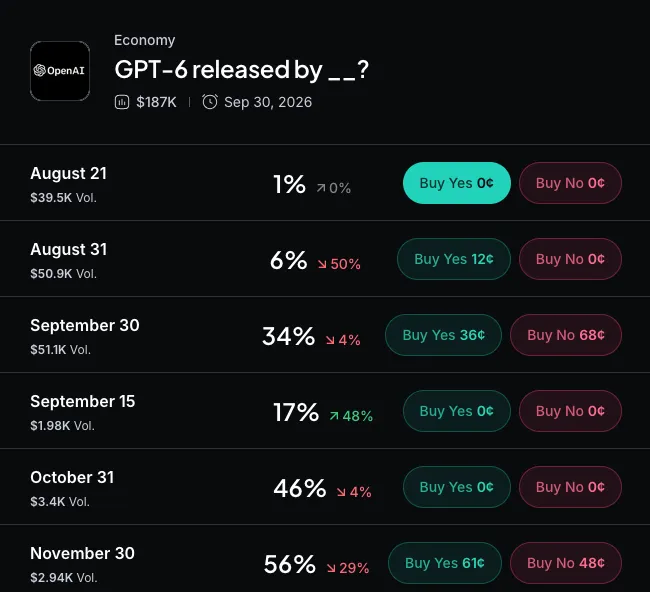
Myriad: When will OpenAI release GPT-6? Click to make your prediction.
Warsh asked whether AI will drive “a significant, sustained rise in productivity across the economy? And if so, when?” He also asked whether “token usage” will be “complementary or competitive to labor.” He answered neither. A Fed task force on productivity and jobs is studying it, and he was blunt that its findings “have no bearing on decisions we make in the current policy conjuncture.”
That gap is the real disclosure. The Fed has decided AI is macro-relevant and simultaneously admitted it has no framework for it yet—while cutting or holding rates on models built before any of this spending existed. Bill Gates has pushed the labor half of that question further, arguing for a robot tax and jobs humans can’t be fired from.
4. Nobody knows who captures the value
Warsh didn’t pretend to have answers. He notes that it’s hard to predict whether AI will actually increase productivity in the global economy, or when that shift will begin.
He also wonders whether this business will result in a global or sectoral growth. “How much of the surplus goes to owners of scarce assets—AI labs, chipmakers, energy producers, and cloud providers?”
He said a Fed task force on “productivity and jobs” is studying it, though its conclusions, he stressed, “have no bearing on decisions we make in the current policy conjuncture.”
Warsh’s own question about scarce assets got a real-world answer two days before he took the podium. Nvidia posted record quarterly revenue of $96.2 billion and disclosed $366 billion in future AI infrastructure commitments, while separately moving to acquire Hugging Face, the open-source AI hub, for roughly $12.9 billion. Conversely, a report from a year ago shows that 95% of generative AI companies are failing.
So the value may be concentrating instead of distributing. If a single chipmaker can absorb that much of the AI buildout’s surplus, and its own compute customers, Warsh’s open question about market structure already has a leading answer.
Daily Debrief Newsletter
Start every day with the top news stories right now, plus original features, a podcast, videos and more.
The FSNN News Room is the voice of our in-house journalists, editors, and researchers. We deliver timely, unbiased reporting at the crossroads of finance, cryptocurrency, and global politics, providing clear, fact-driven analysis free from agendas.
We and our selected partners wish to use cookies to collect information about you for functional purposes and statistical marketing. You may not give us your consent for certain purposes by selecting an option and you can withdraw your consent at any time via the cookie icon.
Cookies are small text that can be used by websites to make the user experience more efficient. The law states that we may store cookies on your device if they are strictly necessary for the operation of this site. For all other types of cookies, we need your permission. This site uses various types of cookies. Some cookies are placed by third party services that appear on our pages.
Your permission applies to the following domains:
https://fsnn.net
Necessary
Necessary cookies help make a website usable by enabling basic functions like page navigation and access to secure areas of the website. The website cannot function properly without these cookies.
Statistic
Statistic cookies help website owners to understand how visitors interact with websites by collecting and reporting information anonymously.
Preferences
Preference cookies enable a website to remember information that changes the way the website behaves or looks, like your preferred language or the region that you are in.
Marketing
Marketing cookies are used to track visitors across websites. The intention is to display ads that are relevant and engaging for the individual user and thereby more valuable for publishers and third party advertisers.


 Freedom Index