Close Menu
FSNN | Free Speech News NetworkFSNN | Free Speech News Network
  • Home
  • News
    • Politics
    • Legal & Courts
    • Tech & Big Tech
    • Campus & Education
    • Media & Culture
    • Global Free Speech
  • Opinions
    • Debates
  • Video/Live
  • Community
  • Freedom Index
  • About
    • Mission
    • Contact
    • Support
Trending

Solana ETFs draw record $188 million in a week as Bitwise takes two-thirds of inflows

25 minutes ago

Bitcoin ETFs draw $2.4B in biggest inflow week since October 2025

29 minutes ago

Brickbat: Every Step You Take

1 hour ago
Facebook X (Twitter) Instagram
Facebook X (Twitter) Discord Telegram
FSNN | Free Speech News NetworkFSNN | Free Speech News Network
Market Data Newsletter
Monday, September 28
  • Home
  • News
    • Politics
    • Legal & Courts
    • Tech & Big Tech
    • Campus & Education
    • Media & Culture
    • Global Free Speech
  • Opinions
    • Debates
  • Video/Live
  • Community
  • Freedom Index
  • About
    • Mission
    • Contact
    • Support
FSNN | Free Speech News NetworkFSNN | Free Speech News Network
Home»News»Global Free Speech»CPJ to recognize journalists from 6 countries with 2026 International Press Freedom Awards 
Global Free Speech

CPJ to recognize journalists from 6 countries with 2026 International Press Freedom Awards 

News RoomBy News Room2 months agoNo Comments6 Mins Read4 Views
Share Facebook Twitter Pinterest Copy Link LinkedIn Tumblr Email VKontakte Telegram
CPJ to recognize journalists from 6 countries with 2026 International Press Freedom Awards 
Share
Facebook Twitter Pinterest Email Copy Link

Listen to the article

0:00
0:00

Key Takeaways

Playback Speed

Select a Voice

Awardees to be honored in November in New York

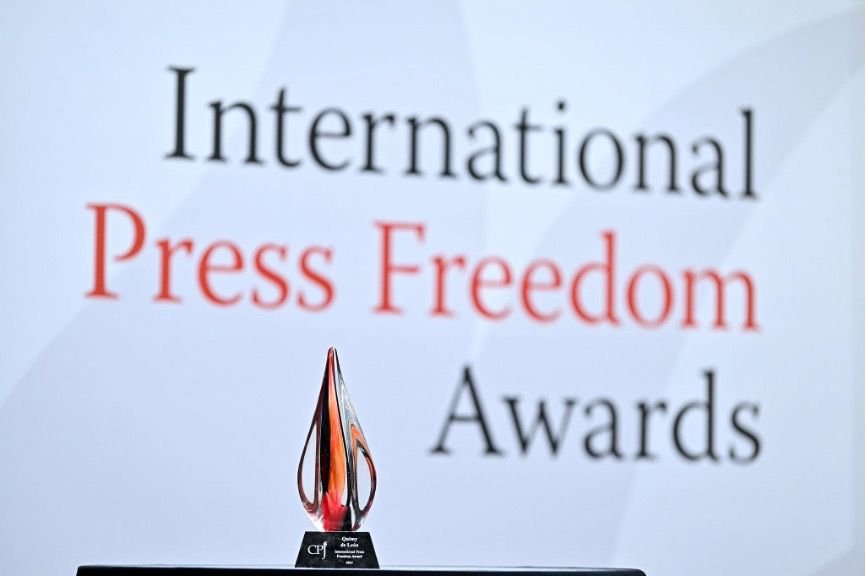
New York, August 5, 2026—The Committee to Protect Journalists (CPJ) today announced it will honor journalists from Colombia, Eritrea, El Salvador, Hungary, Lebanon, and Myanmar at the 36th annual International Press Freedom Awards in New York on Thursday, November 19, 2026.

The event will be chaired by Cesar Conde, chairman of the NBCUniversal News Group. Lulu Garcia-Navarro, journalist at The New York Times and co-host of “The Interview” podcast and CNN contributor, will serve as the master of ceremonies. 

“This year’s awardees exemplify the determination and courage of journalists worldwide,” said CPJ CEO Jodie Ginsberg. “They have endured targeting, imprisonment, exile, and surveillance for simply reporting the news. It is an honor to recognize their commitment to documenting the truth.”

Carlos Dada, the Salvadoran journalist who in 1998 co-founded El Faro, the first digital newspaper in Central America, will receive the 2026 Gwen Ifill Press Freedom Award. The award is presented annually by CPJ’s board of directors in recognition of an individual’s sustained commitment to press freedom. 

“For decades, Carlos Dada’s ingenuity and perseverance has seen El Faro’s journalism hold power to account in El Salvador and throughout Latin America,” said CPJ Board Chair Jacob Weisberg. “Today, Carlos leads a newsroom in exile from Costa Rica. Under his leadership, El Faro continues to deliver incisive reporting amid the erosion of press freedom under President Bukele’s administration.”

CPJ’s 2026 awardees are:

Christina Assi, Lebanon

Since 2018, Lebanese journalist Christina Assi has worked as photojournalist and photo editor for Agence France-Presse (AFP) in Cyprus. On October 13, 2023, Assi and six other journalists were targeted by Israel in a double-tap strike while reporting in Alma Al-Shaab on the Israeli-Lebanese border. Reuters correspondent Issam Abdallah, Assi’s best friend, was killed in the first strike, from which she sustained serious injuries resulting in the amputation of her right leg.

Multiple independent investigations concluded that Israel conducted a deliberate attack on the group of clearly identifiable journalists, which would constitute a war crime under international law.

Despite being the most well-documented attack on journalists by Israel on record, nearly three years on, no one has been held accountable. CPJ has recorded a longstanding pattern of journalist killings by Israel and a systemic failure to hold anyone accountable over them. Since the attack, Assi has campaigned for justice for Abdallah’s killing, advocated for journalist safety, and supported a rehabilitation program for people with similar life-altering injuries.

The Eritrea 16, Eritrea 

This year marks the 25th anniversary of the silencing of independent Eritrean media and the arrest of some of the world’s longest-detained journalists. 

On September 18, 2001, known as “Black Tuesday,” the Eritrean government shut down the country’s privately owned newspapers. Most of the Eritrea 16 were arrested in the weeks following the crackdown. The group comprises Amanuel Asrat, Dawit Habtemichael, Dawit Isaak, Ghebrehiwet Keleta, Hamid Mohamed Said, Idris Said, Jimi’ie Kimeil, Mattewos Habteab, Medhanie Haile, Said Abdelkader, Saleh Aljazeeri, Sahle Tsegazeab, Seyoum Tsehaye, Temesgen Ghebreyesus, Tesfay Ghebreab, and Yusuf Mohamed Ali. 

The journalists who remain imprisoned have never been charged or brought to trial. They continue to be held incommunicado, without access to their families or lawyers. There is no independent information about their health, conditions of detention, or even whether they remain alive. 

Eritrea’s media landscape has never recovered from the 2001 crackdown, and an entire generation of Eritreans has grown up knowing only state-controlled media.

Szabolcs Panyi, Hungary

Szabolcs Panyi is one of Europe’s leading investigative journalists. His reporting exposing the workings of the former Orbán regime has not only had a huge impact at home in Hungary, but also influenced wider European policy debate. 

Informed by his access to sources from national security experts to the highest ranks of government, Panyi’s reporting made him a target of former Hungarian Prime Minister Viktor Orbán, particularly in the run-up to Hungary’s 2026 high-stakes election. This year, his reporting on Russian influence operations brought him into direct confrontation with Hungarian authorities, who brought espionage charges against him in retaliation for his investigation into the Hungarian foreign minister’s murky relationship with the Kremlin. 

Panyi’s reporting on national security, foreign influence, corruption, and political power dynamics has been instrumental in exposing Russian influence networks in Hungary and shaping public debate in the run-up to the election that ultimately led to the Orbán government’s defeat.

Estefany Rodríguez, Colombia

Estefany Rodríguez is a Spanish-language reporter for the local Tennessee news outlet Nashville Noticias. On March 4, 2026, she was detained by federal agents and held in U.S. Immigration and Customs Enforcement (ICE) custody in Alabama and Louisiana despite being in the United States legally. Rodríguez was in a car marked with “Nashville Notícias” branding and in the company of her husband, a U.S. citizen, when she was arrested.

Leading up to her detention, Rodríguez had reported on immigration enforcement operations in Nashville. She came to the United States in 2021 from her native Colombia, after receiving death threats in connection with her reporting. She arrived on a tourist visa and then sought asylum. Rodríguez’s case is emblematic of the way in which immigration authorities have increasingly been used to chill speech that is critical of the Trump administration and its policies.

Sai Zaw Thaike, Myanmar 

Sai Zaw Thaike, a photojournalist with the independent news outlet Myanmar Now, was arrested on May 23, 2023, while covering the aftermath of Cyclone Mocha in Sittwe, where many members of the persecuted Rohingya minority were killed in the storm. 

In September 2023, a military tribunal sentenced Sai Zaw Thaike to 20 years with hard labor in Yangon’s Insein Prison. This is among the longest known journalism-related sentences given in Myanmar since the military’s democracy-suspending coup in 2021. In prison, Sai Zaw Thaike has been subjected to physical abuse and retaliatory torture, and denied medical treatment for serious ailments. 

Myanmar was ranked as the world’s second-worst jailer of journalists, with 30 cases documented in CPJ’s 2025 prison census. Sai Zaw Thaike’s case is emblematic of the Myanmar junta’s abysmal record of jailing journalists to silence critical media coverage and snuff out the country’s once-flourishing free press. 

###

About the Committee to Protect Journalists

The Committee to Protect Journalists (CPJ) is an independent, nonprofit organization that promotes press freedom worldwide. We defend the right of journalists to report the news safely and without fear of reprisal.

For more information about attending or sponsoring CPJ’s International Press Freedom Awards, please fill out this form, call Buckley Hall Events at (+1) 914-579-1000, or contact CPJ’s Development Office at (+1) 212- 300-9021 or [email protected].

Note to editors: Interviews with awardees or with relevant CPJ experts, may be arranged by emailing [email protected]. Spokespersons are available in Arabic, English, French, Hungarian, and Spanish. Images of the awardees will be provided upon request.

Read the full article here

Fact Checker

Verify the accuracy of this article using AI-powered analysis and real-time sources.

Get Your Fact Check Report

Enter your email to receive detailed fact-checking analysis

5 free reports remaining

Continue with Full Access

You've used your 5 free reports. Sign up for unlimited access!

Already have an account? Sign in here

Share. Facebook Twitter Pinterest LinkedIn Tumblr Email Telegram Copy Link
News Room
  • Website
  • Facebook
  • X (Twitter)
  • Instagram
  • LinkedIn

The FSNN News Room is the voice of our in-house journalists, editors, and researchers. We deliver timely, unbiased reporting at the crossroads of finance, cryptocurrency, and global politics, providing clear, fact-driven analysis free from agendas.

Related Articles

Global Free Speech

Ahead of trial, CPJ, partners demand release of detained photojournalist Hamdi al-Zaeem

2 days ago
Global Free Speech

Journalist Henry Constantín detained in Cuba on ‘disobedience’ charge

3 days ago
Global Free Speech

The BBC clearly sees the value of television series That Mitchell and Webb Look. Marking the 20th anniversary of its original screening, the Beeb has re-released the series on iPlayer. But – and there is very often a “but” with these things – they’ve removed around 11 sketches from the BAFTA award-winning show. The official word is that these sketches don’t “work today”, which is polite speak for “they may cause offence”. The episodes singled out include scenes featuring a battle reenactment with characters in blackface, a contestant on a show wearing a burka and a lost tribe” in a garden centre. These sketches set out to challenge stereotypes, not to reinforce them; but 20 years on, this distinction seems to have been lost along the way. I’m a bit uncomfortable about this. I find it infantilising, to say the least. Can’t we trust audiences to make up their own minds, to switch off if they find the sketches in question unpalatable? Does the BBC think that we are just passive consumers, unable to disaggregate the mocking of racism from racism itself? These sketches set out to challenge stereotypes, not to reinforce them This act of censorship is distorting – of the shows, whose narratives and rhythms were built to include these sketches, and more broadly too. Conversations we were having 20 years ago have been erased, as if to suggest that they never happened. But they did! And with this erasure, the opportunity for thoughtful engagement and learning from our past is gone. “Let’s just pretend we were all lovely 20 years ago. It’s better that way” seems to be the message. Speaking as a minority myself, I find that knowing the nasty stuff that people said before – and indeed, still say today – is much more useful than pretending it never happened. This approach, I think, is also inconsistent. What it reveals is a cherry-picking (intended or not) of the groups that we can mock, and those that we can’t. Let’s face it, gender stereotypes are rarely deemed to have aged beyond the pale – if that were the case, we would have to wave goodbye to half the television made before the mid-2010s. Suppression like this sends a bad message to artists, namely that what they’re creating today may hold less value tomorrow. Or, even worse, that future audiences may deem them bigots – that Sword of Damocles hovering over the heads of any creative paying attention to the discourse of the moment. Suppression like this sends a bad message to artists The BBC’s decision reaffirms a broader trend. In 2020, Little Britain was removed from the iPlayer platform for similar reasons. It has since been reinstated – minus some sketches. Meanwhile, the UK’s arts space more broadly is seeing a retreat to the land of “safe”, as Index recently revealed in a year-long investigation into self-censorship in UK theatre. The BBC, it must be said, does remarkable stuff. The ongoing podcast investigation into the disappearance of US journalist Austin Tice is just one example. But this does not mean, however, that they don’t sometimes get it wrong. Chopping at That Mitchell and Webb Look is one example. Sure, the removal of the material isn’t the life-or-death story that Index often works on. Sure, Mitchell and Webb aren’t the faces of persecuted artists – they have huge platforms and agreed to the changes themselves. Still, one can’t help but think that the decision came from a place of conservatism, perhaps even fear. This is weak and dispiriting, indeed the very opposite of what enables creativity in the arts. We shouldn’t be encouraging this cultural timidity. Rather, we should harness culture and creativity as the starting points of a conversation about our here and now. That’s what the arts are for, after all. READ MORE

3 days ago
Global Free Speech

CPJ urges US senators to seek accountability for Israel’s killing of journalist Shireen Abu Akleh

3 days ago
Global Free Speech

4 Cameroonian journalists jailed for theft of minister’s glasses – that he later found

4 days ago
Global Free Speech

3 Tunisian journalists briefly detained as media crackdown intensifies 

4 days ago
Add A Comment

Comments are closed.

Editors Picks

Bitcoin ETFs draw $2.4B in biggest inflow week since October 2025

29 minutes ago

Brickbat: Every Step You Take

1 hour ago

Stablecoin payments firm RedotPay completes financial audit ahead of planned IPO

1 hour ago

California bans its politicians from launching memecoins

2 hours ago
Latest Posts

South Korea Weighs Crypto Market Makers After JPYC Spike

4 hours ago

Vitalik Buterin Maps Ethereum’s Post-Hegotá Cryptographic Future

5 hours ago

Bitcoin (BTC), Nasdaq futures decline as Trump won’t rule out more Iran strikes

6 hours ago

Subscribe to News

Get the latest news and updates directly to your inbox.

At FSNN – Free Speech News Network, we deliver unfiltered reporting and in-depth analysis on the stories that matter most. From breaking headlines to global perspectives, our mission is to keep you informed, empowered, and connected.

FSNN.net is owned and operated by GlobalBoost Media
, an independent media organization dedicated to advancing transparency, free expression, and factual journalism across the digital landscape.

Facebook X (Twitter) Discord Telegram
Latest News

Solana ETFs draw record $188 million in a week as Bitwise takes two-thirds of inflows

25 minutes ago

Bitcoin ETFs draw $2.4B in biggest inflow week since October 2025

29 minutes ago

Brickbat: Every Step You Take

1 hour ago

Subscribe to Updates

Get the latest news and updates directly to your inbox.

© 2026 GlobalBoost Media. All Rights Reserved.
  • Privacy Policy
  • Terms of Service
  • Our Authors
  • Contact

Type above and press Enter to search. Press Esc to cancel.

🍪

Cookies

We and our selected partners wish to use cookies to collect information about you for functional purposes and statistical marketing. You may not give us your consent for certain purposes by selecting an option and you can withdraw your consent at any time via the cookie icon.

Cookie Preferences

Manage Cookies

Cookies are small text that can be used by websites to make the user experience more efficient. The law states that we may store cookies on your device if they are strictly necessary for the operation of this site. For all other types of cookies, we need your permission. This site uses various types of cookies. Some cookies are placed by third party services that appear on our pages.

Your permission applies to the following domains:

  • https://fsnn.net
Necessary
Necessary cookies help make a website usable by enabling basic functions like page navigation and access to secure areas of the website. The website cannot function properly without these cookies.
Statistic
Statistic cookies help website owners to understand how visitors interact with websites by collecting and reporting information anonymously.
Preferences
Preference cookies enable a website to remember information that changes the way the website behaves or looks, like your preferred language or the region that you are in.
Marketing
Marketing cookies are used to track visitors across websites. The intention is to display ads that are relevant and engaging for the individual user and thereby more valuable for publishers and third party advertisers.