

 Freedom Index
Listen to the article
On Democracy, by Walt Whitman, introduction by David Bromwich, Library of America, 210 pages, $12.50
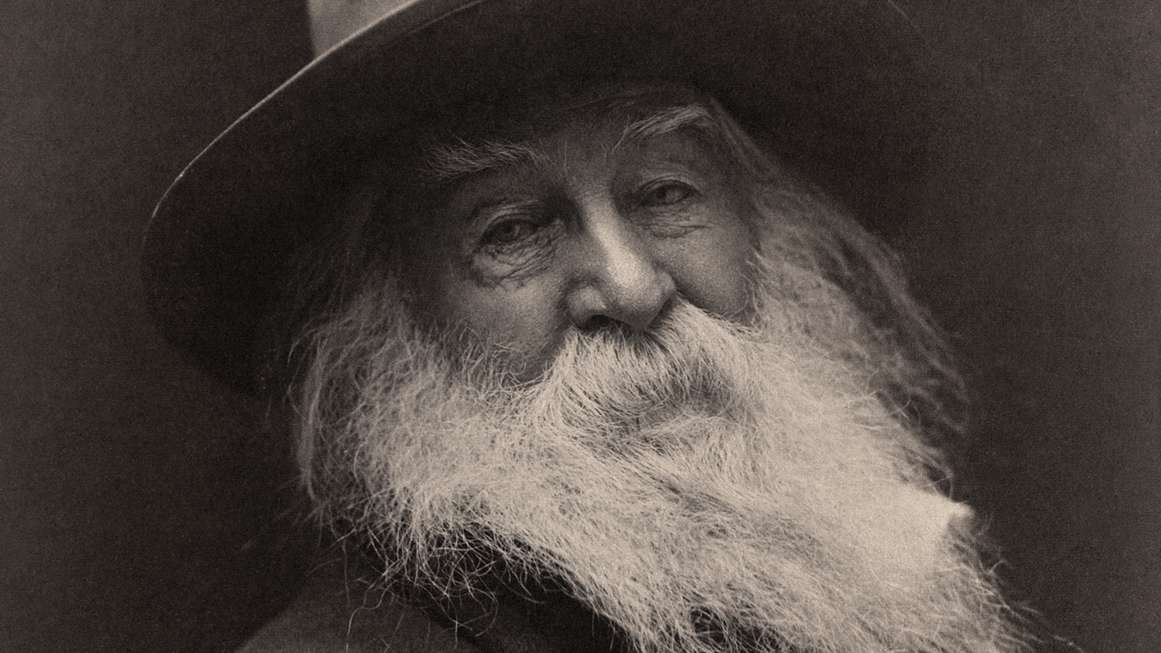
When Walt Whitman was born in 1819, traversing Long Island took days and was probably best done on foot. Brooklyn, still independent of New York City, was a farm-country alcove for Quakers, freethinkers, and country writers and educators. Whitman became a teacher while still a teenager (and included a student of color in his classes, a rare thing for teachers to accept at the time). His home was the sort of scene you might see on a gigantic puzzle today: old wooden fences, dirt roads, a few lonely wisps of chimney smoke out in the hilly distance.
Over the next two to three decades, New York City and the surrounding area experienced probably the most turbulent era in its history. First a transportation revolution extended roads, canals, and railroads across the east. Then a market revolution connected the economies of the coast, the hinterlands, and the globe. Finally, a communications revolution knit the young country together with telegraph lines. Everything changed during the formative period of Whitman’s life. The city’s politics reflected the constant flux of a new country launching itself forward in history. A good two centuries later, as we reach the country’s 250th birthday, it’s a fitting time to rediscover Whitman’s political writings—especially Democratic Vistas, a long-form musing on the meaning of America and the American people. On Democracy, a new collection from the Library of America, offers a useful selection.
During this rapid development, New York became the country’s population and economic center. It also became the focal point of the most significant challenge to mainstream politics: the Locofoco movement, represented electorally by New York’s Equal Rights Party, then the Free Soil Party, and finally a critical faction within the early Republican Party. The Locofocos left a long legacy, and Whitman read their work voraciously during his youth. His politics was a young artist’s locofocoism, and his master was the editor, poet, Navy man, and theater critic William Leggett.
Leggett was born in the Old West but moved east as a young man. He was interested in studying math and writing poetry, but instead joined the Navy and always regretted it. Leggett was court-martialed for neglecting his duties and for threatening his commanding officer during a suicidal spell. The officer had led a long bullying campaign against him, and Leggett never stopped resenting being exploited by the powerful and privileged.
Leggett was hired as a theater critic at William Cullen Bryant’s New York Evening Post, and he worked through the early 1830s under the condition that he never be asked to write about politics. He just wasn’t interested. But after a few years, Bryant took an extended trip to Europe and left the paper in Leggett’s hands—including the responsibility of serving as politics editor. The city was never the same (and the paper nearly failed from chronic financial mismanagement).
Leggett turned out to be a radical among radicals, and the more he wrote, the more radical he got. He was a free market extremist, an absolute abolitionist, virtually an anarchist. He was for free trade, free banking, free coinage—a libertarian before the word’s common usage. He was a radical abolitionist who called for the dissolution of the Union even earlier than William Lloyd Garrison did. He opposed special grants of incorporation and opposed intellectual property laws back when each of those positions was considered as radical as abolition. He championed the rights and liberties of all persons, bridging the color line and Jacksonian workingman’s democracy more clearly and consistently than any other figure of the era. His premature death from respiratory disease in 1839 was a hard blow to passionate young men such as Whitman.
Leggett helped found two sister movements: the Equal Rights Party (nicknamed the Locofoco Party) and the Young America arts movement. Young radicals aligned with Leggett’s Evening Post challenged the mainline Democratic Party in its stronghold of Tammany Hall from 1835 to 1837. The radicals pushed both major parties toward libertarian positions by controlling the balance of power in the city’s elections. Leggett was unrelenting on every issue, but the Democrats expelled him when he crossed the color line and advocated abolition. The Whitmans of the city gleefully fled with Leggett to more principled ground. The Locofoco Party fell victim to the usual fate: endless factional infighting, poor organization, and betrayal by its own elected officials (mostly disguised Whigs). But where the political quest failed, the artists’ mission began.
Young America began as a conscious effort on behalf of New York City’s literati, functioning as a sort of dinner circle. The group expanded to wider cultural producers, such as John L. O’Sullivan’s Democratic Review, which showcased up-and-coming writers and visual artists. Their glue was Locofoco politics and a firm conviction that the American arts must distinguish themselves from their European forebears. The Young Americans believed the United States occupied a unique place in history, able to leapfrog past the feudal societies of the Old World to a grandiose and free future.
Fueled by radical, abolitionist politics and nationalist, futuristic artistic commitments, Whitman launched into a career as a journalist (and a vocal critic of the Mexican-American War)—and into his life’s mission to find and cultivate the great American literatus who could bring the nation’s world-historical mission for emancipation to fruition. He sought the poet, the artist, the bard who could speak into existence the freest country on earth. He cherished American democracy and sought its perfection here, now, and then, but he did not seek to force it abroad. The Republic could welcome sisters into the fold, but not through a war for slaveowners.
The fundamental force driving that perfection forward was individualism. This was the core of Leggett’s political theory: the morally absolute, universal, equal individual rights shared by all human beings. Put that political principle into practice in a nation like the United States, and you have the perfect mix for the maximal human being: each of us like a nesting doll with infinite layers of the self to explore; each of us containing multitudes, like New York or America itself.
This infinite play of the self within the infinite possibilities of America led to what Whitman called “personalism,” which complements individualism with a feeling of “adhesiveness or love, that fuses, ties and aggregates, making the races comrades, and fraternizing all.” For Whitman, the limits of America’s possibilities depended upon the quality of its individuals, stacked back up into the infinite nesting doll of the nation. When its people failed their promise, their possibilities, so the country failed its potential, its historical abilities.
For Whitman, depression set in after he begrudgingly voted for slaveholder James K. Polk in the presidential election of 1844. Whitman remembered Polk’s locofoco leanings as speaker of the House, but as president Polk helped end the locofoco era of hopeful, emancipationist expansionism by taking half of Mexico for the planters. Rather than see America turned into a slaveholding empire, Whitman dedicated the rest of his life to finding the right person, in politics or literature, who could reunite the country on the grounds of individual liberation and the expansion of every self within our borders.
While Democratic Vistasis hampered by Whitman’s artistic spirit and the relative fuzziness with which he described political concepts, the more journalistic writings included in this volume put the case as forthrightly as Leggett did in the old Evening Post. “The berths, the Presidency included, are bought, sold, electioneered for, prostituted, and filled with prostitutes,” Whitman wrote. “In the North and East, swarms of dough-faces, office-vermin, kept-editors, clerks, attaches of the ten thousand officers and their parties, aware of nothing further than the drip and spoil of politics—ignorant of principles, the true glory of a man.”
Add to that: “The President eats dirt and excrement for his daily meals, likes it, and tries to force it on The States. The cushions of the Presidency are nothing but filth and blood. The pavements of Congress are also bloody….All outside the influence of government, (for ever the largest part,) thrives and smiles. The sun shines, corn grows, men go merrily about their affairs, houses are built, ships arrive and depart. Through evil and through good, the republic stands, and is for centuries yet to stand, immovable from its foundations.”
And then there is this blunt warning about life in Whitman’s day: “The United States are destined either to surmount the gorgeous history of feudalism, or else prove the most tremendous failure of time.” If the United States is currently a failure, there is no possible denying that the failure is simply ours. Unfortunately, Whitman’s observation of his own times feels shamefully resonant now—but perhaps we can follow his example, his quest to carry our project of infinitude forever forward. To do that, we need to rediscover William Leggett’s fire and relight the quest for radical reform.
Read the full article here
Fact Checker
Verify the accuracy of this article using AI-powered analysis and real-time sources.