Strategy sold 2,732,318 MSTR shares for $263.5 million in net proceeds between July 13–19, lifting its USD Reserve to $3.225 billion without touching its Bitcoin stash.
For the second consecutive week, the firm chose stock sales over Bitcoin sales—bringing its total cash accumulation to $675 million in two weeks via its at-the-market equity program.
Peter Schiff argued the move needlessly harms common shareholders, suggesting Strategy may fear Bitcoin demand can’t absorb a large sale without crashing the price.
Strategy added $225 million to its cash reserves last week—without selling a single Bitcoin.
According to the company’s latest SEC filing, the Bitcoin treasury firm sold 2,732,318 shares of its MSTR common stock between July 13 and July 19, netting $263.5 million through its at-the-market offering program—a mechanism that lets companies sell new shares gradually into the open market without arranging a traditional banking deal. It mirrors the firm’s actions last week, when it raised $466.7 million through issuing common stock.
The cash raised went directly into what Strategy calls its USD Reserve, a dedicated dollar fund maintained specifically to pay dividends and cover debt obligations. As of July 19, that reserve stands at $3.225 billion, per the form.
The people at the front of that payment line are preferred shareholders—investors who bought one of Strategy’s specialized dividend-paying securities like STRC (Stretch), STRK (Strike), STRF (Strife), or STRD (Stride). Preferred shareholders are essentially income investors: they collect regular dividend payments rather than betting on the stock price going up, and they get paid before regular MSTR buyers. Common stockholders—the people who hold MSTR stock—collect whatever’s left over.
Michael Saylor confirmed the update in a tweet, writing that Strategy had “increased its USD Reserve by $225 million” and that the firm still holds its full 843,775 BTC stack—roughly 4% of Bitcoin’s fixed 21-million-coin supply.
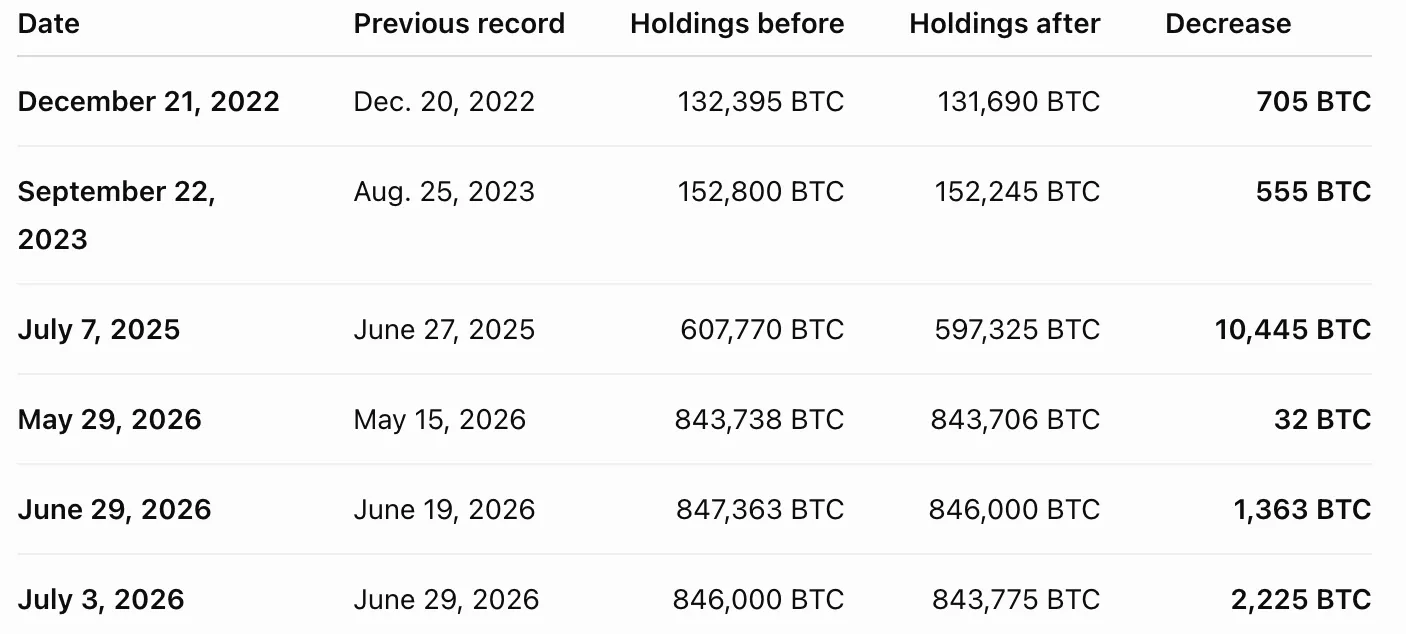
As the world’s largest Bitcoin treasury company, Strategy rarely touches its BTC holdings. According to Bitbo’s Bitcoin treasuries tracker, the firm has decreased its stack on just six occasions since 2020—three of which were in 2026 alone.
The most recent was a sale of 3,588 BTC for roughly $216 million between late June and early July, made under a formal capital framework the board approved in late June, which permits selling up to $1.25 billion in BTC to top off its reserves.
This week, Strategy’s BTC stash stayed untouched. The company reached for shares instead—issuing new MSTR stock, which dilutes existing common stockholders (each new share issued means every existing share represents a slightly smaller slice of the company), to protect the investors at the front of the payment line.
Peter Schiff, a famous gold advocate and longtime Bitcoin skeptic, didn’t hold back, writing that Strategy was “needlessly sacrificing common shareholders to protect preferred shareholders without selling Bitcoin.” He suggested the company may be reluctant to sell BTC because it fears the market can’t absorb a large liquidation without cratering the price, which could arguably be true given the company’s BTC treasury size.
Another week of needlessly sacrificing common shareholders to protect preferred shareholders without selling Bitcoin. You must be scared that there’s not enough demand for Bitcoin to absorb your sales; otherwise, there is no excuse for purposely creating a negative Bitcoin yield.
— Peter Schiff (@PeterSchiff) July 20, 2026
Schiff has been predicting Bitcoin’s collapse for over a decade—but the structural point he’s making here, that common shareholders are absorbing the cost of keeping preferred holders paid, is one that other analysts have flagged.
The reason all of this gets watched so closely is simple: Strategy isn’t just a company. The firm’s weekly cash reserve updates are a de facto signal for crypto markets. When it buys, Bitcoin tends to move. When it sells—or simply stops buying—market analysts take note.
Its 843,775 BTC were acquired at an average price of $75,476 per coin, leaving the firm with an unrealized loss of roughly $9.6 billion at current prices—a paper loss, meaning no cash actually leaves the building until coins are sold. The USD Reserve has grown by $675 million in two weeks, all from selling shares.
Earlier this year, Michael Saylor said his company “would probably buy all the Bitcoin produced by miners between here and the year 2140.” That’s around a million coins. User of Myriad, a prediction market owned by Decrypt‘s parent company Dastan, think it unlikely that he can deliver on his promise—at least not by 2027.
Daily Debrief Newsletter
Start every day with the top news stories right now, plus original features, a podcast, videos and more.
The FSNN News Room is the voice of our in-house journalists, editors, and researchers. We deliver timely, unbiased reporting at the crossroads of finance, cryptocurrency, and global politics, providing clear, fact-driven analysis free from agendas.
We and our selected partners wish to use cookies to collect information about you for functional purposes and statistical marketing. You may not give us your consent for certain purposes by selecting an option and you can withdraw your consent at any time via the cookie icon.
Cookies are small text that can be used by websites to make the user experience more efficient. The law states that we may store cookies on your device if they are strictly necessary for the operation of this site. For all other types of cookies, we need your permission. This site uses various types of cookies. Some cookies are placed by third party services that appear on our pages.
Your permission applies to the following domains:
https://fsnn.net
Necessary
Necessary cookies help make a website usable by enabling basic functions like page navigation and access to secure areas of the website. The website cannot function properly without these cookies.
Statistic
Statistic cookies help website owners to understand how visitors interact with websites by collecting and reporting information anonymously.
Preferences
Preference cookies enable a website to remember information that changes the way the website behaves or looks, like your preferred language or the region that you are in.
Marketing
Marketing cookies are used to track visitors across websites. The intention is to display ads that are relevant and engaging for the individual user and thereby more valuable for publishers and third party advertisers.


 Freedom Index