Close Menu
FSNN | Free Speech News NetworkFSNN | Free Speech News Network
  • Home
  • News
    • Politics
    • Legal & Courts
    • Tech & Big Tech
    • Campus & Education
    • Media & Culture
    • Global Free Speech
  • Opinions
    • Debates
  • Video/Live
  • Community
  • Freedom Index
  • About
    • Mission
    • Contact
    • Support
Trending

The Most Corrupt Presidency in American History, by the Numbers

2 minutes ago

Swift rolls out new blockchain ledger to bring 24/7 banking to 17 global giants

18 minutes ago

AI Bitcoin Miner Rally Shifts Focus to Governance

22 minutes ago
Facebook X (Twitter) Instagram
Facebook X (Twitter) Discord Telegram
FSNN | Free Speech News NetworkFSNN | Free Speech News Network
Market Data Newsletter
Thursday, July 9
  • Home
  • News
    • Politics
    • Legal & Courts
    • Tech & Big Tech
    • Campus & Education
    • Media & Culture
    • Global Free Speech
  • Opinions
    • Debates
  • Video/Live
  • Community
  • Freedom Index
  • About
    • Mission
    • Contact
    • Support
FSNN | Free Speech News NetworkFSNN | Free Speech News Network
Home»News»Media & Culture»Rhode Island Is Regulating Grocery Checkout Lines Now
Media & Culture

Rhode Island Is Regulating Grocery Checkout Lines Now

News RoomBy News Room2 hours agoNo Comments5 Mins Read1,986 Views
Share Facebook Twitter Pinterest Copy Link LinkedIn Tumblr Email VKontakte Telegram
Rhode Island Is Regulating Grocery Checkout Lines Now
Share
Facebook Twitter Pinterest Email Copy Link

Listen to the article

0:00
0:00

Key Takeaways

Playback Speed

Select a Voice

Lines at Rhode Island grocery stores are about to get a whole lot longer.

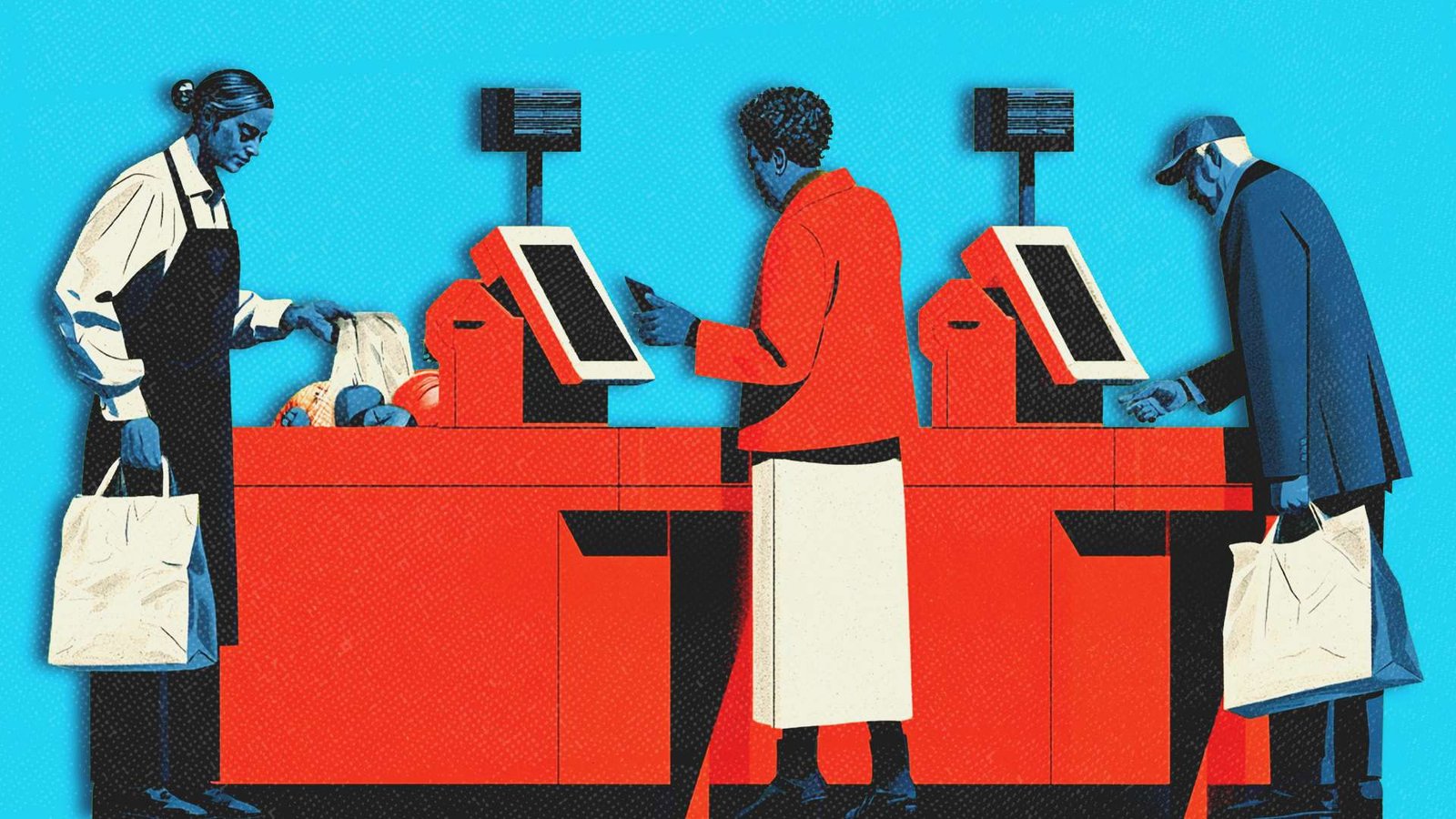
In late June, Rhode Island became the first state to limit grocery self-checkout lanes after Democratic Gov. Daniel McKee signed the Restrictions on Self-Service Checkout Stations Act. The legislation mandates that every grocery store in the state have at least one staffed checkout for every three self-checkouts operating. The law takes effect on January 1, 2027, and failure to comply can result in fines of up to $500 per day.

“Today, we’re protecting jobs and strengthening customer service,” McKee said in a press release. “Whether it’s helping a customer with an issue, assisting a senior or ensuring accessibility for people with disabilities, this law is about preserving choice and keeping people at the center of the shopping experience.”

The bill’s supporters frame the policy as both a consumer protection and job protection measure. State Rep. Megan Cotter (D–Exeter) argued that self-checkout lanes are “specifically used to reduce the number of people that stores employ, and the number of hours that their employees work.” Cotter also accused “big corporations” of trying to get customers to gradually accept the shift toward self-checkouts when “many people still want the advantages of checking out with a real human being.”

Yet survey data suggest that many shoppers do, in fact, value self-checkouts. A 2024 NCR Voyix survey of 1,133 U.S. shoppers found that 43 percent of consumers prefer self-checkout over traditional checkout, with that preference rising to 53 percent among shoppers ages 18 to 44. Their 2025 Commerce Experience Report found that among shoppers who prefer self-checkout, 77 percent say they do so because it is faster, while 36 percent cite shorter lines and 43 percent say they prefer bagging their own items. A 2026 CapitalOne Shopping Research report found that 79.3 percent of consumers use self-checkout regularly, and among them, 61.4 percent use it for most or all purchases.

The legislation was also supported by the United Food and Commercial Workers International Union (UFCW), which argued that self-checkout has led grocery chains to cut cashier hours. Domenic Pontarelli, secretary-treasurer at UFCW Local 328 (which represents Rhode Island workers), said in a press release that grocery workers are “often overburdened, having to monitor too many self-checkouts while shoppers face delays,” and that “staffing ratios fix this issue for all parties.”

Rhode Island grocers, on the other hand, described the bill as an “egregious” attempt to micromanage how stores staff their checkout lanes. The Rhode Island Food Dealers Association, which represents chain and independent grocery retailers and other food-related organizations, argued in a March letter that the bill “puts Rhode Island grocers at a significant competitive disadvantage.” The bill’s arbitrary staffing requirements “severely limits our members’ ability to properly utilize their staff as needed.”

“This bill while labeled as a restriction on self-checkout is in fact a ban on self-checkout. There is no way a grocery retailer would be able to keep self-checkout with these restrictions,” the group added.

Indeed, while policymakers often portray grocery stores as “big corporations” that make massive profits, they are usually operating on razor-thin margins. The Food Industry Association says the average net profit for food retailers was just 2.1 percent in 2025. This means that costly regulations risk pushing up prices for customers and threatening the viability of many of those businesses altogether.

Self-checkout restrictions have been tried before. Last year, Long Beach, California, introduced a similar law in 2025 in an attempt to combat theft. Two weeks after the city approved its “Safe Stores are Staffed Stores” law, which requires larger grocery stores and pharmacies to staff at least one employee for every three self-checkout stations, Vons closed self-checkout lanes at all four of its Long Beach locations, according to the Long Beach Post. Signs at Vons told customers the lanes were unavailable “due to a new City of Long Beach ordinance (25-0010) regulating self-checkout operations.”

“There was an unusually long line at Whole Foods self-checkout today. Of 10 self-checkout kiosks, only 2 were working,” claimed one Reddit user in late 2025. When the shopper asked an employee why so many kiosks were down, the employee allegedly replied that it was because of “a new law in Long Beach.” Another shopper said the self-checkout area at a Target on Bellflower Boulevard was “completely closed,” leaving “long lines everywhere.”

Now Rhode Island is on track to repeat Long Beach’s mistakes. The fundamental question is why lawmakers think they should be deciding how grocery stores organize their checkout lanes in the first place. Every store has different customers, staffing pressures, and peak hours. Some shoppers may want a human cashier, and others may want to scan their groceries more quickly with a self-checkout. A functioning market can and does accommodate both preferences.

At a time when Americans are already worried about food prices, potentially making a basic necessity more costly and grocery shopping more stressful is a strange way to help them.

Read the full article here

Fact Checker

Verify the accuracy of this article using AI-powered analysis and real-time sources.

Get Your Fact Check Report

Enter your email to receive detailed fact-checking analysis

5 free reports remaining

Continue with Full Access

You've used your 5 free reports. Sign up for unlimited access!

Already have an account? Sign in here

#CivicEngagement #MediaBias #NarrativeControl #PoliticalDebate #PressFreedom
Share. Facebook Twitter Pinterest LinkedIn Tumblr Email Telegram Copy Link
News Room
  • Website
  • Facebook
  • X (Twitter)
  • Instagram
  • LinkedIn

The FSNN News Room is the voice of our in-house journalists, editors, and researchers. We deliver timely, unbiased reporting at the crossroads of finance, cryptocurrency, and global politics, providing clear, fact-driven analysis free from agendas.

Related Articles

Media & Culture

The Most Corrupt Presidency in American History, by the Numbers

2 minutes ago
Cryptocurrency & Free Speech Finance

OpenAI Releases GPT-5.6 Sol: Here’s How It Stacks Up Against Other AI Models

24 minutes ago
Media & Culture

ICE Office Of Professional Responsibility Ditches ICE Oversight, Starts Hunting Down ICE Critics

58 minutes ago
Media & Culture

Good Riddance to Graham Platner

1 hour ago
Cryptocurrency & Free Speech Finance

Swift Readies Ledger for 24/7 Token Transfers—Though True Settlement Is Stuck on Old Rails

1 hour ago
Legal & Courts

Government ‘gag’ policies are far too common. It’s time to push back.

2 hours ago
Add A Comment
Leave A Reply Cancel Reply

Editors Picks

Swift rolls out new blockchain ledger to bring 24/7 banking to 17 global giants

18 minutes ago

AI Bitcoin Miner Rally Shifts Focus to Governance

22 minutes ago

OpenAI Releases GPT-5.6 Sol: Here’s How It Stacks Up Against Other AI Models

24 minutes ago

ICE Office Of Professional Responsibility Ditches ICE Oversight, Starts Hunting Down ICE Critics

58 minutes ago
Latest Posts

Good Riddance to Graham Platner

1 hour ago

Cipher, TeraWulf among AI infrastructure stocks trading below contract value, Compass Point argues

1 hour ago

Bitcoin Reclaims 63k but Traders Fear Correction Before Deribit Expiry

1 hour ago

Subscribe to News

Get the latest news and updates directly to your inbox.

At FSNN – Free Speech News Network, we deliver unfiltered reporting and in-depth analysis on the stories that matter most. From breaking headlines to global perspectives, our mission is to keep you informed, empowered, and connected.

FSNN.net is owned and operated by GlobalBoost Media
, an independent media organization dedicated to advancing transparency, free expression, and factual journalism across the digital landscape.

Facebook X (Twitter) Discord Telegram
Latest News

The Most Corrupt Presidency in American History, by the Numbers

2 minutes ago

Swift rolls out new blockchain ledger to bring 24/7 banking to 17 global giants

18 minutes ago

AI Bitcoin Miner Rally Shifts Focus to Governance

22 minutes ago

Subscribe to Updates

Get the latest news and updates directly to your inbox.

© 2026 GlobalBoost Media. All Rights Reserved.
  • Privacy Policy
  • Terms of Service
  • Our Authors
  • Contact

Type above and press Enter to search. Press Esc to cancel.

🍪

Cookies

We and our selected partners wish to use cookies to collect information about you for functional purposes and statistical marketing. You may not give us your consent for certain purposes by selecting an option and you can withdraw your consent at any time via the cookie icon.

Cookie Preferences

Manage Cookies

Cookies are small text that can be used by websites to make the user experience more efficient. The law states that we may store cookies on your device if they are strictly necessary for the operation of this site. For all other types of cookies, we need your permission. This site uses various types of cookies. Some cookies are placed by third party services that appear on our pages.

Your permission applies to the following domains:

  • https://fsnn.net
Necessary
Necessary cookies help make a website usable by enabling basic functions like page navigation and access to secure areas of the website. The website cannot function properly without these cookies.
Statistic
Statistic cookies help website owners to understand how visitors interact with websites by collecting and reporting information anonymously.
Preferences
Preference cookies enable a website to remember information that changes the way the website behaves or looks, like your preferred language or the region that you are in.
Marketing
Marketing cookies are used to track visitors across websites. The intention is to display ads that are relevant and engaging for the individual user and thereby more valuable for publishers and third party advertisers.